¶ Grid
The Grid is the indoor testbed at WINLAB, Rutgers (NJ) — a 20×20 array of radio nodes based on the legacy ORBIT deployment. Each node has at least two wireless interfaces, and the grid is surrounded by a small support infrastructure of Massive-MIMO mini-racks, application servers, on-demand VMs, a noise-injection subsystem, and a synchronized clock reference.
The Grid is the indoor counterpart to the outdoor BED testbed in West Harlem, NYC, which is the main COSMOS testbed.
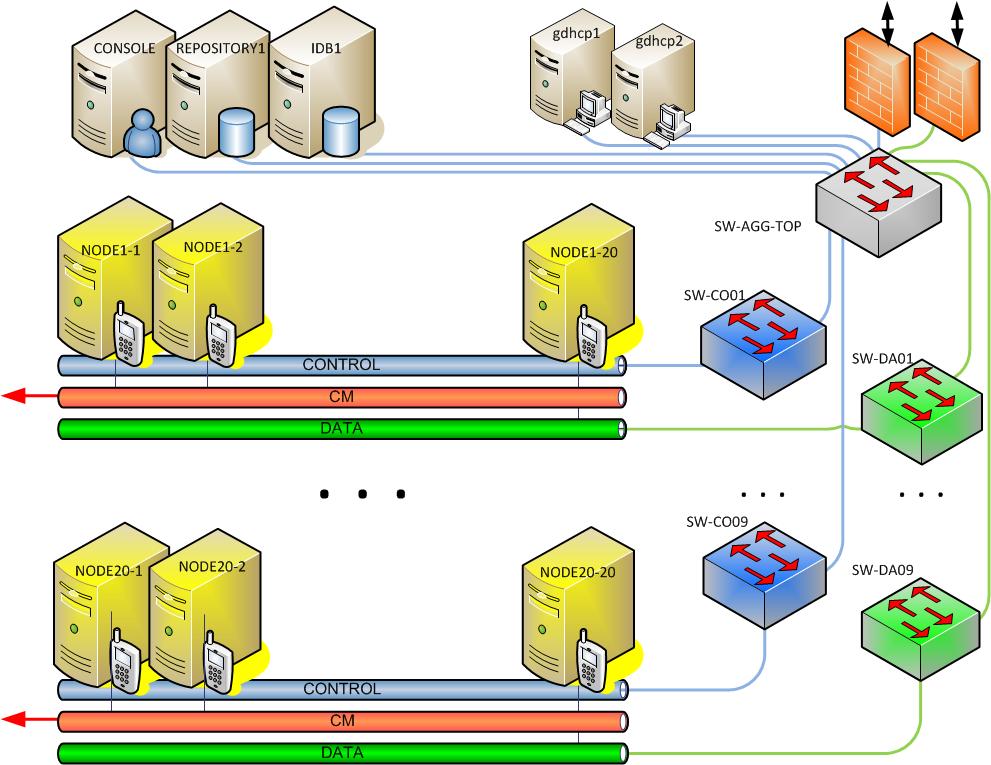 Figure 1 — ORBIT Grid block diagram.
The main components of the domain are:
- Grid nodes — 20 rows of 20 machines on a 3-foot grid pitch (62 generation-3 + 338 generation-1 nodes).
- Massive-MIMO mini-racks — four mini-racks of SDRs with 32 antennas each in the corners.
- Servers — high-core-count / large-memory back-end machines, some with GPUs.
- Virtual machines — on-demand VM instances for non-performance-critical back-end roles.
- Noise injection (CAWIS) — central waveform generator that injects arbitrary signals into the grid through four corner antennas.
- Support infrastructure — SDN-capable Ethernet data switches, GPS / 10 MHz reference distribution, and the grid console.
¶ Massive-MIMO mini-racks
Four mini-racks live in the corners of the Grid, each containing 8 Ettus USRP X310 SDRs outfitted with two UBX 160 radio daughterboards. Unlike the per-node USRPs in the main 20×20 grid, the mini-rack USRPs are connected over 10 G Ethernet and appear as nodes (node23-1 through node23-8, etc.) that respond to standard omf power commands and are reachable from any other node on the Grid domain. PPS and 10 MHz synchronization signals are distributed via an Octoclock-based timing system using equal-length cables so all USRPs across the four racks stay synchronized. Power-cycling and image management work the same way they do for ordinary nodes.
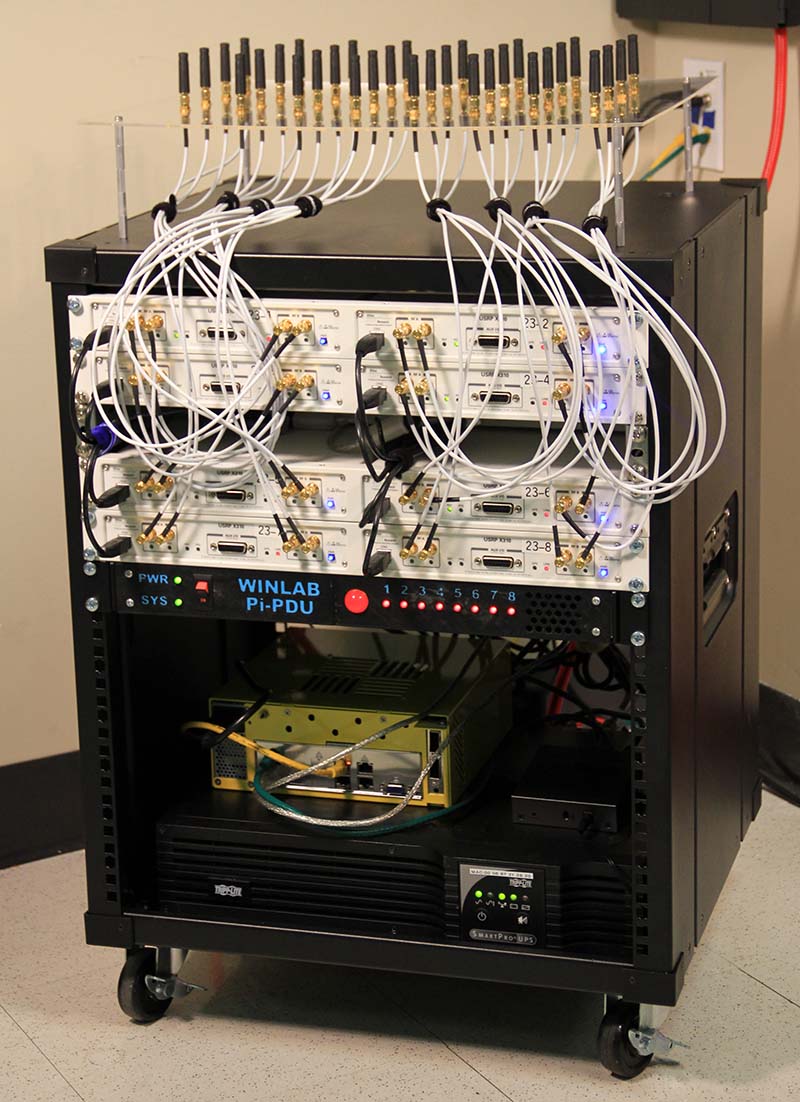 Figure 2 — Massive-MIMO mini-rack.
| Location | Node IDs |
|---|---|
Mini-rack under node1-1 |
23-1 … 23-8 |
Mini-rack under node1-20 |
23-11 … 23-18 |
Mini-rack under node20-1 |
24-1 … 24-8 |
Mini-rack under node20-20 |
24-11 … 24-18 |
The top of each mini-rack carries a horizontal array of 32 antennas on a rectangular plate with a 2-inch grid pitch.
¶ Servers
A number of high-CPU-core-count / large-memory servers are available for running back-end software. Some are equipped with GPUs for accelerated computation.
¶ Virtual Machines
A VM infrastructure is provided for on-demand "node-like" instances — a common place to run controllers, non-performance-critical back-end software, monitoring, or telemetry collectors.
¶ Noise injection subsystem (CAWIS)
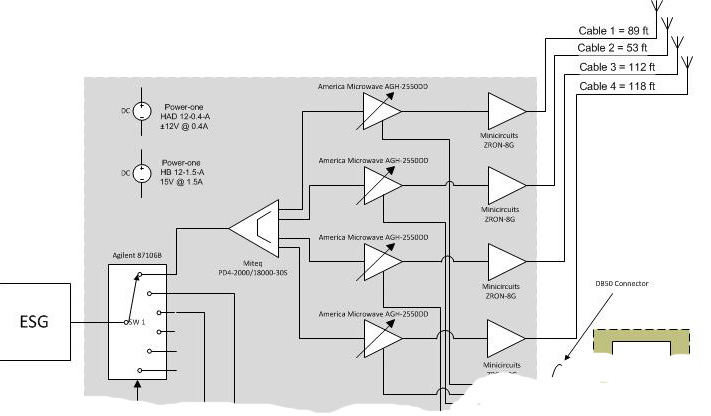
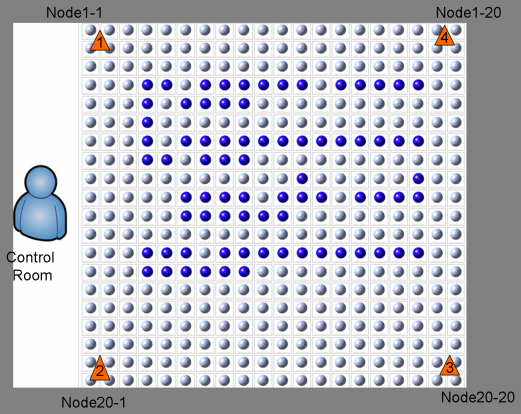
The Centralized Arbitrary Waveform Injection Subsystem (CAWIS) consists of an arbitrary waveform generator (Agilent ESG) connected through a distribution network to four multi-band antennas located in the four corners of the grid. The distribution network gives independent attenuation control on each antenna feed, so users can inject AWGN (or other waveforms) and create different effective topologies on the main ORBIT grid.
| Block diagram | Antenna positions |
|---|---|
 |
 |
CAWIS is a web service running on the grid aggregate manager and is accessed from the grid console at http://instrument1.orbit-lab.org:5054/interference. Calling that URL with no arguments returns its usage reference.
¶ Support infrastructure
The Grid runs on top of:
- SDN-capable data switches that users can reconfigure for their experiments.
- Synchronized clock reference (see below) for the Massive-MIMO mini-racks and corner nodes.
- A console machine for jump access to grid nodes and for control of domain-specific hardware (CAWIS, the imaging service, the scheduler proxy, etc.).
¶ Synchronized Clock Reference (Octoclock)
The Massive-MIMO mini-racks and several SDRs in the grid corners are connected to a GPS-disciplined clock reference system that supplies PPS and 10 MHz reference signals for synchronizing the SDRs' internal oscillators. The tree topology uses equal-length cables to minimize timing skew. Connected nodes:
| Location | Nodes |
|---|---|
1-1 corner |
1-1, 1-2, 2-1, 2-2, 3-1, 3-2 |
1-20 corner |
1-19, 1-20, 2-19, 2-20, 3-19, 3-20, 4-19, 4-20 |
20-1 corner |
17-1, 17-2, 18-1, 18-2, 19-1, 19-2, 20-1, 20-2 |
20-20 corner |
18-19, 18-20, 19-19, 19-20, 20-19, 20-20 |
Massive-MIMO mini-rack 1-1 |
23-1 … 23-8 |
Massive-MIMO mini-rack 1-20 |
23-11 … 23-18 |
Massive-MIMO mini-rack 20-1 |
24-1 … 24-8 |
Massive-MIMO mini-rack 20-20 |
24-11 … 24-18 |
See the Clock Reference page for the distribution-network details.