¶ COSMOS Testbed Wiki
Welcome to the user wiki for the COSMOS testbed — Cloud-enhanced Open Software-defined MObile wireless testbed for city-Scale deployment. This site is the operational reference: how to reserve nodes, image them, run experiments, and build on top of the testbed infrastructure.
Everything here runs under the cosmos-lab.org domain.
New here? Start with Getting Started — account creation, your first reservation, and a five-minute end-to-end experiment. Already have an account? Jump straight to the scheduler or the portal dashboard.
¶ Overview
The COSMOS (Cloud enhanced Open Software defined MObile wireless testbed for city-Scale deployment) project is aimed at the design, development, and deployment of an advanced wireless city-scale testbed to support real-world experimentation on next-generation wireless technologies and applications.
The COSMOS testbed is deployed in West Harlem, New York City, with a technical focus on ultra-high-bandwidth and low-latency wireless communication tightly coupled with edge computing, and an emphasis on millimeter-wave (mmWave) radio and dynamic optical switching. A set of indoor sandboxes at WINLAB, Rutgers (New Jersey) and the original ORBIT testbed share the same portal, scheduler, and control framework.
Looking for principal investigators or publications beyond the citation below? See the project site at www.cosmos-lab.org. The rest of this wiki is the user-facing how-to (the mandatory publication citation is included below, in Acknowledging COSMOS).
¶ Origins
COSMOS did not start from nothing. It grew out of ORBIT — the Open-access Research testbed for next-generation wireless networks — begun at WINLAB, Rutgers, in 2003–2004 as an NSF-funded facility built around a large indoor grid of software-programmable radio nodes. ORBIT established the working model this testbed still uses: reserve a slice of real radios, image them from a common disk image, run a repeatable experiment, collect the results, hand the hardware back. The OMF framework and the omf command you will meet throughout these tutorials both came from that work.
That indoor grid is still in service, and is still the largest single collection of radios on the testbed — it is the grid domain used throughout these tutorials.
¶ What's on the testbed
COSMOS spans both regions described in the Overview above, all reachable through the same portal, scheduler, and OMF control plane. ORBIT is the original NJ-only sister testbed that shares the same framework and remains in active use.
You can compose experiments from any combination of:
- Software defined radios — USRP X310 / N310 / X410 with FPGAs (RFNoC) for tight-loop processing, plus B210, N210, and 2974 / 2974R RF systems-on-module.
- mmWave (28 GHz) — IBM dual-polarisation phased-array transceivers (PAAM) on the West Harlem rooftops and at WINLAB.
- O-RAN / 5G — O-RAN-compliant 7.2x O-RUs at multiple NYC sites plus programmable srsRAN / OpenAirInterface stacks running on edge servers.
- Edge compute — rack-mounted servers (Intel Xeon and NVIDIA A100 80 GB GPUs) co-located with the radio sites, along with a dedicated GPU sandbox (
nebula) for ML workloads. - Optical x-haul — OpenROADM ROADM nodes and FibroLan PTP-aware Ethernet switches connecting the rooftop sites back to the data centre.
- Smart-intersection sandbox — vehicle-and-roadside-unit testbed with cameras, lidar, and 5 GHz / mmWave radios at the Rutgers Livingston campus intersection.
- Free-space optical and visible-light — FSO links and VLC transceivers for non-RF experimentation.
- Domain sandboxes — single-purpose environments (
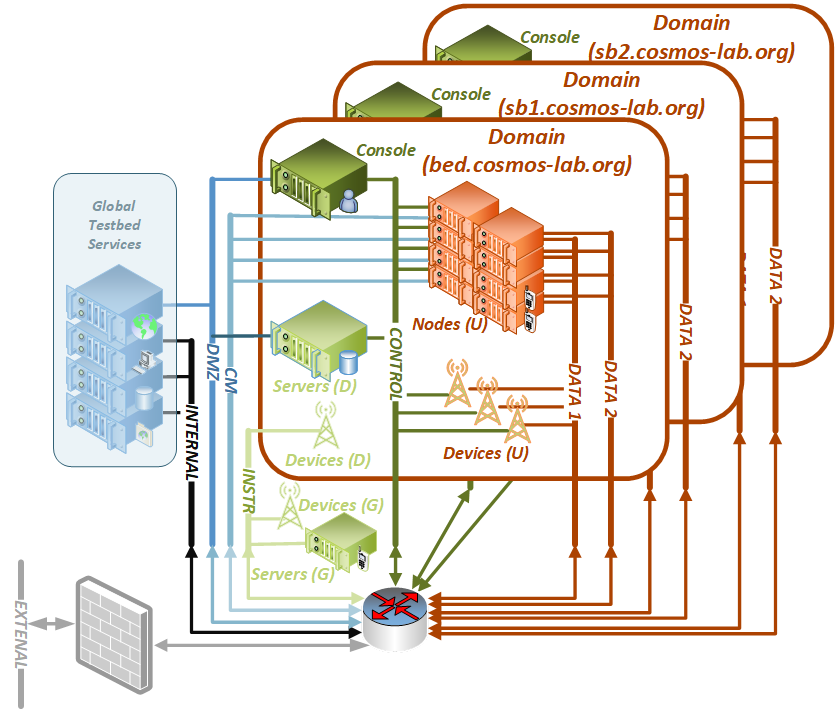
sb1,sb2,sb3,accord,osc,weeks,rrail,nebula,bed,instrument) you can reserve in isolation without conflicting with the main grid.
Hardware-by-hardware detail lives under
Hardware; pre-built disk images, OMF tools, and portal services are documented under Software.
¶ How experiments work
A typical session on COSMOS or ORBIT looks like:
- Reserve a window on a node, sandbox, or domain through the scheduler. The grid and high-demand sandboxes have wall-clock reservations; dedicated domains use weekly or project-level allocations.
- Connect to the corresponding console host over SSH (or the in-portal SSH shortcut). Each domain has its own console.
- Image the nodes you want from the disk-image library:
omf load -i <image-name> -t <topology-or-node-list> - Run your experiment. Most users drive nodes either with OMF (the ORBIT/COSMOS control framework —
omf tell,omf exec) or with Ansible playbooks against the imaged hosts. - Save any modified image with
omf save, collect results, and release the reservation.
The full workflow with worked examples is on the Getting Started page; common command recipes are in the OMF Commands reference.
¶ Documentation map
| Section | What's there |
|---|---|
| Getting Started | Account creation, first reservation, first experiment, reduced setup for FR3 / advanced features |
| Tutorials | Step-by-step walkthroughs — wireless basics, SDR experiments, edge computing, O-RAN, smart-intersection |
| Hardware | Per-device specs and topologies for grid, sandboxes, dedicated domains, and the NYC outdoor deployment |
| Software | Disk-image catalogue, OMF tooling, scheduler, portal services, and pre-installed stacks |
| Datasets | Published reproducible datasets generated on the testbed |
| Storage | Per-user, per-group, and shared storage layout (NFS, TrueNAS) |
¶ Programs
| Program | Pages |
|---|---|
| Summer Internship | Per-year project pages (2015 – 2025) with abstracts, posters, and presentations |
| Workshops (historical) | Slides, agendas, and materials from past tutorials and workshops |
¶ Project workspaces
Group-private wikis for ongoing projects live under /wiki/projects/<name>/. These are visible only to members of the corresponding LDAP group.
- DARPA Spectrum Challenge — historical match-execution framework and tournament tutorials.
¶ Support
- Forum — ask the community, share tips, browse past discussions.
- Status — live testbed health (per-node uptime, sandbox readiness, image-server status).
- Email —
support@cosmos-lab.orgfor testbed access issues, account problems, or hardware-fault reports.
If a documentation page is wrong or out of date, you're already signed in — click Edit and fix it. Anyone with a testbed account can edit the public sections.
¶ Acknowledging COSMOS
COSMOS — Cloud enhanced Open Software defined MObile wireless testbed for city-Scale deployment — is a joint project of Rutgers, Columbia, and NYU with New York City, CCNY, Silicon Harlem, the University of Arizona, and IBM, funded by the U.S. National Science Foundation (NSF) under the Platforms for Advanced Wireless Research (PAWR) program.
If you publish results obtained using the COSMOS testbed, please cite:
D. Raychaudhuri, I. Seskar, G. Zussman, T. Korakis, D. Kilper, T. Chen, J. Kolodziejski, M. Sherman, Z. Kostic, X. Gu, H. Krishnaswamy, S. Maheshwari, P. Skrimponis, and C. Gutterman, "Challenge: COSMOS: A city-scale programmable testbed for experimentation with advanced wireless," in Proc. ACM MobiCom '20, 2020. DOI: 10.1145/3372224.3380891
Please also acknowledge NSF PAWR support in any resulting publications. See RF Policies & Compliance for spectrum-use rules and testbed usage policy.