¶ Wideband Channel Sounding with USRP X310s
Measure the power delay profile (PDP) of a wideband radio channel using an RFNoC-based channel sounder on USRP X310s in the ORBIT/COSMOS massive-MIMO mini-racks.
¶ Overview
Channel sounding is the process of evaluating the characteristics of a radio environment. Evaluating the power delay profile (PDP) of a radio channel helps in developing statistical models for channel simulation.
This tutorial demonstrates how to use the RFNoC channel sounder design for obtaining the PDP of channels up to 100 MHz wide. An FPGA correlator module computes real-time correlation power, and an averaging module averages contiguous sets of PDP over time and sends the result to the host CPU. This design is compatible with 3rd-generation Ettus USRP devices (USRP X310).
The experiment runs on the ORBIT grid, which houses USRP X310 devices in massive-MIMO mini-racks (rows 23 and 24). A browser-based visualization page shows the live PDP once the experiment is running.
¶ Learning outcomes
After completing this tutorial you will be able to:
- Load a custom channel-sounder disk image onto grid nodes using
omf load. - Verify that a USRP X310 has the required RFNoC FPGA bitfile using
uhd_usrp_probe. - Load the RFNoC FPGA image onto a USRP X310 using
uhd_image_loader. - Run the transmit and receive channel-sounding applications (
rfnoc_tx_mobicom/rfnoc_rx_mobicom). - Set up a WebSocket proxy for browser-based streaming of PDP results.
- Visualize the power delay profile of the measured channel in a web browser.
¶ At a glance
| Difficulty | Intermediate |
| Estimated time | 60 min |
| Domain / sandbox | grid.cosmos-lab.org |
| Topic group | Channel Sounding & MIMO |
| Last verified | Not re-tested (migrated 2026-06-20) |
¶ Prerequisites
Background knowledge
- Familiarity with the COSMOS workflow (reservation, imaging, OMF commands).
- Basic RF concepts: spread spectrum, correlation, power delay profile.
- Understanding of RFNoC (RF Network on Chip) FPGA signal-processing blocks is helpful but not required.
Account & access
- A COSMOS account — register here.
- An approved reservation on the ORBIT grid — see Make a reservation.
- SSH access to the grid console — see SSH access.
¶ Resources required
Devices / nodes
| Resource | Role | Qty | Notes |
|---|---|---|---|
| node19-1 | Transmitter host | 1 | Connected to TX USRP X310 in MIMO rack |
| node20-1 | Receiver host | 1 | Connected to RX USRP X310 in MIMO rack |
| USRP X310 (e.g. 10.10.23.16) | Transmitter SDR | 1 | In massive-MIMO mini-rack, row 23 |
| USRP X310 (e.g. 10.10.24.16) | Receiver SDR | 1 | In massive-MIMO mini-rack, row 24 |
Disk images
| Image | Load onto | Provides |
|---|---|---|
| channel-sounder.ndz | node19-1, node20-1 | UHD libraries, rfnoc_tx_mobicom, rfnoc_rx_mobicom, run-websock, channel-sounding display tools |
Software components
| Component | Version | Source |
|---|---|---|
| UHD (USRP Hardware Driver) | 3.14 (compatible) | preinstalled in channel-sounder.ndz |
| rfnoc_tx_mobicom | TODO: verify | preinstalled in channel-sounder.ndz (/root/uhd/host/build/examples/) |
| rfnoc_rx_mobicom | TODO: verify | preinstalled in channel-sounder.ndz (./uhd/host/build/examples/) |
| FPGA bitfile: spreader_corr_specsense_uhd_3_14.bit | UHD 3.14 | preinstalled in channel-sounder.ndz |
| channel_sounding_display.html | TODO: verify | attached to this tutorial page — download to your local machine |
| run-websock | TODO: verify | preinstalled in channel-sounder.ndz |
Spectrum / RF / special
- Operates at 3 GHz (
--freq 3e9) with up to 100 MHz bandwidth. - USRP X310 devices are located in massive-MIMO mini-racks at grid rows 23–24.
- For group-based topology assignments: group-red uses USRP 23-16 as TX and 24-16 as RX.
- Ensure your reservation covers use of the MIMO mini-rack USRPs.
¶ Topology
Two grid host nodes each connect to a USRP X310 in the massive-MIMO mini-racks (rows 23 and 24 of the ORBIT grid). The TX node (node19-1) drives USRP X310 at 10.10.23.16; the RX node (node20-1) drives USRP X310 at 10.10.24.16. Both nodes are reachable from the grid console via SSH.
A WebSocket proxy (run-websock) on the console forwards the receive node's data stream (port 5100) to your browser, which renders the live PDP via channel_sounding_display.html.
¶ Setup
-
Reserve the grid and log into the console:
ssh <username>@console.grid.cosmos-lab.org -
Make sure the nodes are off before imaging:
omf tell -a offh -t system:topo:allres -
Load the channel-sounder image. If you have specific nodes:
omf load -i channel-sounder.ndz -t node19-1,node20-1Or, if you were assigned a topology (e.g. group-red):
omf load -i channel-sounder.ndz -t system:topo:group-red -
Turn the nodes on:
omf tell -a on -t node19-1,node20-1Or with a topology:
omf tell -a on -t system:topo:group-red -
Check the node status and confirm they are POWERON:
omf stat -t node19-1,node20-1Expected output:
----------------------------------------------- Node: node19-1.grid.cosmos-lab.org State: POWERON Node: node20-1.grid.cosmos-lab.org State: POWERON -----------------------------------------------Or with a topology:
omf stat -t system:topo:group-red -
SSH to the transmitter node:
ssh root@node19-1
¶ Instructions
¶ Step 1 — Verify the USRP X310 FPGA image
From node19-1 (TX host), probe the assigned TX USRP. Substitute the correct IP address for your USRP (e.g. 10.10.23.16 for group-red):
root@node19-1:~# uhd_usrp_probe --args="addr=10.10.23.16"
At the end of the output, confirm that the following RFNoC blocks are present:
| | _____________________________________________________
| |/
| | RFNoC blocks on this device:
| |
| | * DmaFIFO_0
| | * Radio_0
| | * Radio_1
| | * DDC_0
| | * DUC_0
| | * Corrmag63avg8k_0
| | * Spreader_0
| | * SpecSense2k_0
| | * FIFO_0
| | * FIFO_1
Spreader_0 spreads the transmit signal; Corrmag63avg8k_0 is the correlator on the receive side. If these blocks appear, the USRP is ready.
Repeat the probe on node20-1 for the RX USRP (e.g. addr=10.10.24.16).
¶ Step 2 — Load the FPGA bitfile (if needed)
If the required RFNoC blocks are not present in the probe output, load the correct FPGA image using uhd_image_loader. Run this from the TX host node:
root@node19-1:~# uhd_image_loader --args="addr=10.10.23.16,type=x300" --fpga-path="spreader_corr_specsense_uhd_3_14.bit"
Run the same command on node20-1 for the RX USRP (addr=10.10.24.16). After loading, reprobe with uhd_usrp_probe to confirm the blocks are present.
¶ Step 3 — Set up the web-based streaming proxy
From the console, set up a WebSocket proxy for the receive node. This is required for browser-based real-time PDP streaming:
prasanthi@console.grid:~$ run-websock 5100 10.10.20.1:5100 --daemon
Expected output:
WARNING: no 'numpy' module, HyBi protocol will be slower
WebSocket server settings:
  - Listen on :5100
  - Flash security policy server
  - No SSL/TLS support (no cert file)
  - Backgrounding (daemon)
Note: The RX node data-plane IP
10.10.20.1corresponds to node20-1's connection to its USRP X310. Adjust if your node assignment differs.
¶ Step 4 — Start the transmit application
On node19-1 (TX), start the channel-sounder transmit application.
If you were assigned a topology group, use the --group flag:
root@node19-1:~# /root/uhd/host/build/examples/rfnoc_tx_mobicom --group red
Alternatively, pass explicit parameters (100 MHz bandwidth, 3 GHz carrier):
root@node19-1:~# /root/uhd/host/build/examples/rfnoc_tx_mobicom --args"addr=10.10.23.16,type=x300,skip_ddc,skip_duc" --freq 3e9 --gain 20 --duc-args="input_rate=50000000.0,output_rate=200000000.0"
¶ Step 5 — Start the receive application
Open a new SSH session to node20-1 (RX) and start the receive application.
If you were assigned a topology group:
root@node20-1:~# ./uhd/host/build/examples/rfnoc_rx_mobicom --group red
Or with explicit parameters:
root@node20-1:~# ./uhd/host/build/examples/rfnoc_rx_mobicom --args"addr=10.10.24.16,type=x300,skip_ddc,skip_duc" --freq 3e9 --gain 10 --ddc-args="output_rate=50000000.0,input_rate=200000000.0"
¶ Step 6 — View the power delay profile in your browser
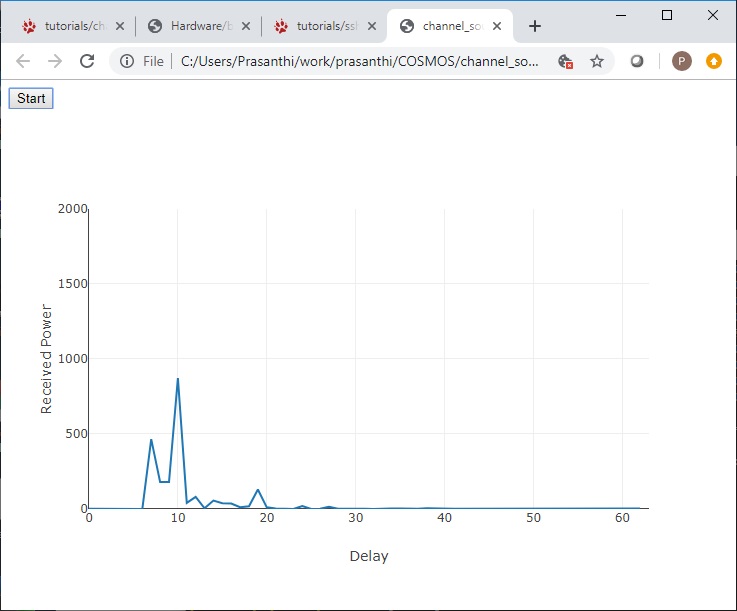
Download channel_sounding_display.html (attached to this wiki page) to your local machine. Open it in a browser and click the Start button. You should see the live PDP of the channel updating in real time.
¶ Verification
uhd_usrp_probeon both the TX and RX USRPs shows the full set of RFNoC blocks (Spreader_0,Corrmag63avg8k_0,DmaFIFO_0,Radio_0,Radio_1, etc.).- The transmit application (
rfnoc_tx_mobicom) runs without errors on node19-1. - The receive application (
rfnoc_rx_mobicom) runs without errors on node20-1. - Opening
channel_sounding_display.htmlin a browser and clicking Start shows a live power delay profile plot.
¶ Cleanup
omf tell -a offh -t system:topo:allres
(No omf save needed unless you modified the disk image.)
¶ Troubleshooting
| Symptom | Likely cause | Fix |
|---|---|---|
uhd_usrp_probe does not show Spreader_0 / Corrmag63avg8k_0 |
USRP has a different FPGA bitfile loaded | Run uhd_image_loader with spreader_corr_specsense_uhd_3_14.bit as shown in Step 2 |
rfnoc_tx_mobicom or rfnoc_rx_mobicom fails to connect |
Wrong USRP IP or type argument | Confirm USRP address with uhd_find_devices; check type=x300 and correct addr= |
| Browser PDP display shows no data after clicking Start | WebSocket proxy not running or wrong port/IP | Confirm run-websock is running on the console; verify RX node data-plane IP matches the proxy target |
| Nodes stuck in POWERON but not reachable via SSH | Image load did not complete | Re-run omf load and wait for completion before powering on |
omf stat shows nodes not in POWERON |
Nodes failed to boot | Power cycle with omf tell -a offh -t ... then omf tell -a on -t ... and check again |
¶ References
- COSMOS workflow
- ORBIT grid hardware — massive-MIMO mini-racks
- Available SDR hardware
- OMF commands reference
- Ettus RFNoC documentation
Author(s): COSMOS team · Last verified: Not re-tested (migrated 2026-06-20) · Tested image/release: channel-sounder.ndz / UHD 3.14 compatible · Tags: sdr, usrp, x310, rfnoc, channel-sounding, pdp, mimo