¶ TDD 2×2 MIMO Channel Sounding with RENEW Sounder and USRP-2974
Demonstrate TDD 2×2 MIMO channel sounding on two USRP-2974 radios in COSMOS Sandbox 2 (sb2) using the RENEW Sounder software, and analyze the resulting 2×2 channel matrix H.
¶ Overview
This tutorial demonstrates the TDD 2×2 MIMO channel sounding procedure using two USRP-2974 (NI-2974 / X310-based) software-defined radios in the COSMOS Sandbox 2 (sb2). One USRP acts as the base station (BS), the other as the user equipment (UE). Both radios use dual-channel (AB) operation, enabling the experiment to sound all four elements of the 2×2 channel matrix H = [h00, h01; h10, h11].
The experiment uses the RENEW Sounder software (C++ Sounder, develop branch), which was extended by the COSMOS team to support UHD-based radios. A server node (srv2-lg1) drives both radios over a 10G Ethernet link, collects pilot frames, and saves them to an HDF5 log file. A Python analysis script then plots the estimated channel responses.
The RENEW Platform Sounder software is used under the RENEW license. The UHD support was contributed by the COSMOS team under the UHD license.
¶ Learning outcomes
After completing this tutorial you will be able to:
- Configure a 10G Ethernet interface on a server node to reach USRP-2974 radios at fixed IP addresses.
- Verify USRP reachability using
uhd_find_devices. - Build and configure the RENEW C++ Sounder for UHD-based radios.
- Run a TDD 2×2 MIMO channel sounding experiment (BS and client in separate terminals).
- Analyze the captured HDF5 dataset to extract and plot the 2×2 channel matrix.
¶ At a glance
| Difficulty | Intermediate |
| Estimated time | 90 min |
| Domain / sandbox | sb2.cosmos-lab.org |
| Topic group | channel-sounding-mimo |
| Last verified | Not re-tested (migrated 2026-06-20) |
¶ Prerequisites
Background knowledge
- Basic familiarity with COSMOS reservations and the OMF experiment workflow — see the six-step experiment life cycle.
- Basic USRP / UHD concepts (device addressing, daughterboards) — see available SDR hardware.
- Familiarity with HDF5 datasets and Python is helpful for the analysis step.
Account & access
- A COSMOS account — register here.
- An approved reservation on sb2 — see Make a reservation.
- SSH access to the console — see SSH access.
¶ Resources required
Devices / nodes
| Resource | Role | Qty | Notes |
|---|---|---|---|
| sdr2-s1-lg1 | Base station (BS), dual-channel | 1 | USRP-2974 (NI-2974); 10G port hard-coded to 10.115.2.22 |
| sdr2-md1 | User equipment (UE), dual-channel | 1 | USRP-2974 (X310); 10G port hard-coded to 10.115.2.32 |
| srv2-lg1 | Control / compute server | 1 | Runs Sounder software; connects to USRPs over 10G via eno2 |
Disk images
| Image | Load onto | Provides |
|---|---|---|
| baseline-gr.ndz | srv2-lg1 | Ubuntu 18.04, UHD 3.15, GNU Radio 3.8 |
Software components
| Component | Version | Source |
|---|---|---|
| UHD (USRP Hardware Driver) | 3.15 | Preinstalled in baseline-gr.ndz |
| GNU Radio | 3.8 | Preinstalled in baseline-gr.ndz |
| RENEW Sounder (C++) | develop branch |
github.com/renew-wireless/RENEWLab — build on node |
| Python 3 + HDF5 / h5py | TODO: verify | Used for post-processing (plot_hdf5.py) |
Spectrum / RF / special
- Over-the-air transmit inside sb2. The two USRP-2974s are co-located in sb2; sounding is performed over the local RF environment.
- RF switch ports for
rfsw-s1-lg1.sb2.cosmos-lab.organdrfsw-md1.sb2.cosmos-lab.orgmust be set to port 1 (USRP-2974 path) before running the experiment.
¶ Topology
srv2-lg1 is the single compute node. It connects to both USRP-2974 radios over a 10G Ethernet interface (eno2), configured with IP 10.115.2.12/24. The two USRPs have fixed IPs on the same subnet:
sdr2-s1-lg1(BS):10.115.2.22sdr2-md1(UE):10.115.2.32
The server drives both radios simultaneously: Terminal 1 runs the UE (client) process and Terminal 2 runs the BS process. All data collection and analysis also happen on srv2-lg1.
¶ Setup
-
Reserve the resources and log into the sb2 console (open two SSH sessions — you will need them simultaneously in the Experiment Execution stage):
ssh <username>@console.sb2.cosmos-lab.org -
Make sure all nodes and devices used in the experiment are turned off:
omf tell -a offh -t sdr2-s1-lg1,sdr2-md1,srv2-lg1 -
Load the
baseline-gr.ndzimage on the server node (see available disk images for the full list):omf load -i baseline-gr.ndz -t srv2-lg1 -
Turn all required resources on and check their status:
omf tell -a on -t sdr2-s1-lg1,sdr2-md1,srv2-lg1omf stat -t all -
Make sure the RF switch ports are set to use the USRP-2974s. If any ports are set to
2, reset them to1:curl "am-rt1.cosmos-lab.org:5054/rf_switch/set?name=rfsw-s1-lg1.sb2.cosmos-lab.org,rfsw-md1.sb2.cosmos-lab.org&switch=1,2,3,4&port=1" -
Open two SSH sessions to
srv2-lg1from the console, using-Yto forward X11 (needed for GUI plots):# Terminal 1 ssh -Y root@srv2-lg1# Terminal 2 ssh -Y root@srv2-lg1
¶ Instructions
¶ Step 1 — Configure the 10G network interface and verify USRP reachability
On srv2-lg1, configure eno2 with an IP on the USRP subnet, set jumbo frames (MTU 9000), and increase socket buffer sizes:
root@srv2-lg1:~# ifconfig eno2 10.115.2.12 netmask 255.255.255.0 mtu 9000 up
root@srv2-lg1:~# sudo sysctl -w net.core.wmem_max=24862979
net.core.wmem_max = 24862979
root@srv2-lg1:~# sudo sysctl -w net.core.rmem_max=24862979
net.core.rmem_max = 24862979
root@srv2-lg1:~# ifconfig
eno2: flags=4163<UP,BROADCAST,RUNNING,MULTICAST>  mtu 9000
        inet 10.115.2.12  netmask 255.255.255.0  broadcast 10.115.2.255
        inet6 fe80::9a03:9bff:fe61:9609  prefixlen 64  scopeid 0x20<link>
        ether 98:03:9b:61:96:09  txqueuelen 1000  (Ethernet)
        RX packets 4053772  bytes 17770502341 (17.7 GB)
        RX errors 0  dropped 0  overruns 0  frame 0
        TX packets 1727950  bytes 2972166223 (2.9 GB)
        TX errors 0  dropped 0 overruns 0  carrier 0  collisions 0
Verify that both USRP-2974s are reachable:
root@srv2-lg1:~# uhd_find_devices --args="addr=10.115.2.22"
[INFO] [UHD] linux; GNU C++ version 7.5.0; Boost_106501; UHD_3.15.0.HEAD-0-gaea0e2de
--------------------------------------------------
-- UHD Device 0
--------------------------------------------------
Device Address:
    serial: 318F20F
    addr: 10.115.2.22
    fpga: XG
    name:
    product: NI-2974
    type: x300
root@srv2-lg1:~# uhd_find_devices --args="addr=10.115.2.32"
[INFO] [UHD] linux; GNU C++ version 7.5.0; Boost_106501; UHD_3.15.0.HEAD-0-gaea0e2de
--------------------------------------------------
-- UHD Device 0
--------------------------------------------------
Device Address:
    serial: 3165747
    addr: 10.115.2.32
    fpga: XG
    name:
    product: X310
    type: x300
If either device is not found, see Troubleshooting.
¶ Step 2 — Download and build the RENEW Sounder software
Download and build the RENEW Sounder on the develop branch (the master branch does not include UHD support):
root@srv2-lg1:~# git clone https://github.com/renew-wireless/RENEWLab.git ~/git/renew-software
root@srv2-lg1:~# cd ~/git/renew-software
root@srv2-lg1:~/git/renew-software# git checkout develop
Then follow the build instructions for the C++ Sounder.
¶ Step 3 — Configure the BS and UE JSON files
Edit the configuration files for the BS (base station) and UE (client).
Base station — files/usrp-bs-serials.txt
Set the BS radio IP address to sdr2-s1-lg1:
10.115.2.22
Base station — files/usrp-bs-only.json
Enable dual-channel on the BS:
"channel" : "AB",
Client (UE) — files/usrp-client-only.json
Set the UE radio IP address to sdr2-md1 and enable dual-channel:
"sdr_id" : [ "10.115.2.32" ]
"channel" : "AB",
¶ Step 4 — Run the channel sounding experiment
In Terminal 1, start the client (UE) process first:
root@srv2-lg1:~/git/renew-software/CC/Sounder# ./sounder files/usrp-client-only.json
...
...
pinning client thread 0 to core 1
scheduling TX 13 Frames (41.08 ms) in the future!
1 uplink symbols will be sent per frame...
Beacon detected at Time 32476200, sync_index: 13100
Start main client txrx loop...
In Terminal 2, start the BS process:
root@srv2-lg1:~/git/renew-software/CC/Sounder# ./sounder files/usrp-bs-only.json
...
...
Set HDF5 File to logs/trace-2020-9-21-18-46-29_1x2x2.hdf5 and group to /
task thread 0 starts
pinning thread 0 to core 1
Recv Thread 0: waiting for release
receiver thread 0 has 1 radios
Sync BS host and FPGA timestamp...
Start BS main recv loop...
Saving HDF5, 2000 frames saved.
...
...
The BS process saves the sounding data to an HDF5 file (e.g., logs/trace-2020-9-21-18-46-29_1x2x2.hdf5).
¶ Step 5 — Analyze the results
Once the HDF5 file is recorded, follow the Analyze the HDF5 dataset step in the RENEW Sounder documentation to post-process the data.
To plot the pilot sequence used to compute the 2×2 channel matrix H = [h00, h01; h10, h11]:
root@srv2-lg1:~/git/renew-software/PYTHON/IrisUtils# python3 plot_hdf5.py ../../CC/Sounder/logs/trace-2020-9-21-18-46-29_1x2x2.hdf5 --ref-ant 0 --ref-user 0 --ref-frame 1500
Where:
--ref-ant 0or1selects the BS antenna index.--ref-user 0or1selects the user index.
Expected channel matrix plots:
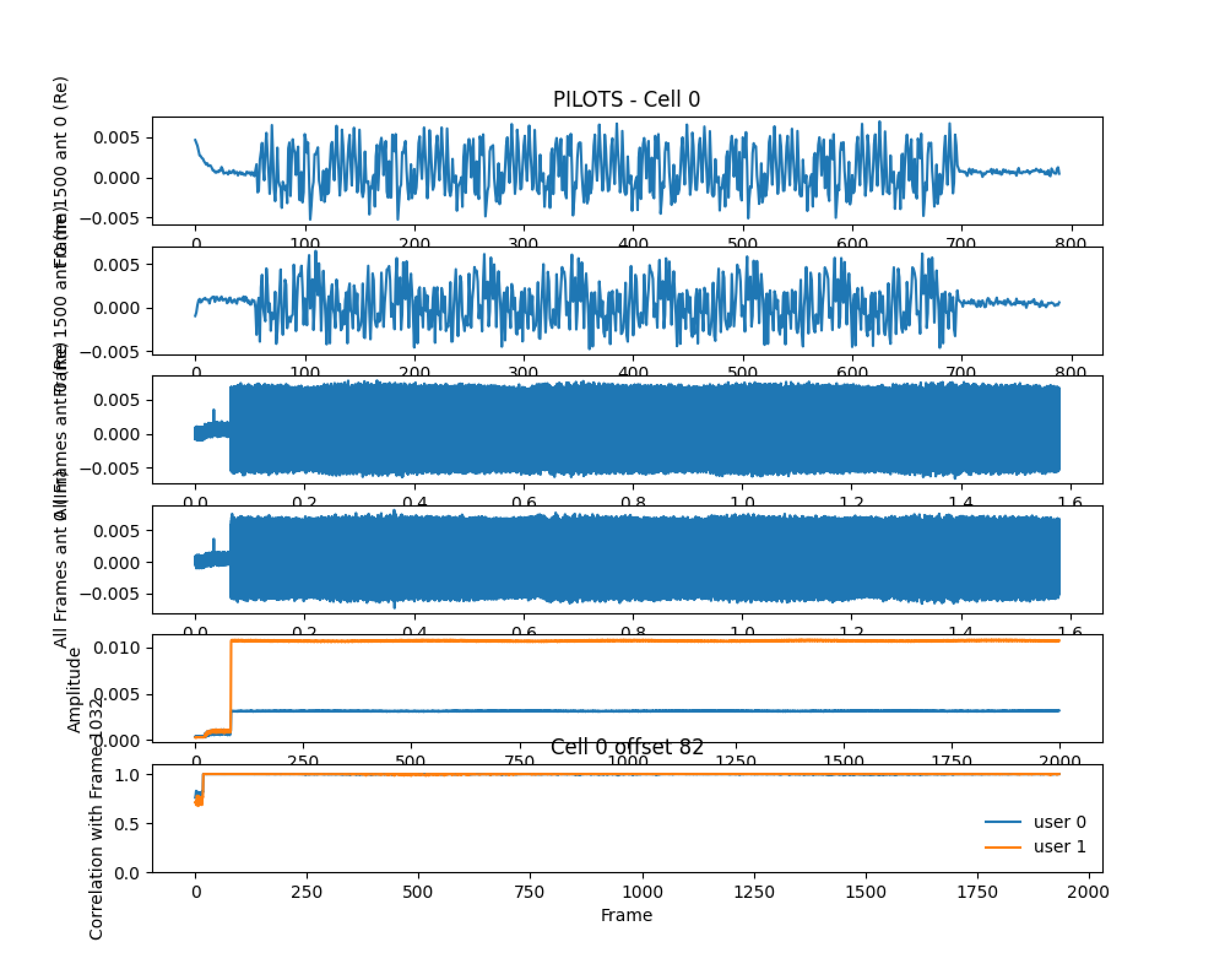
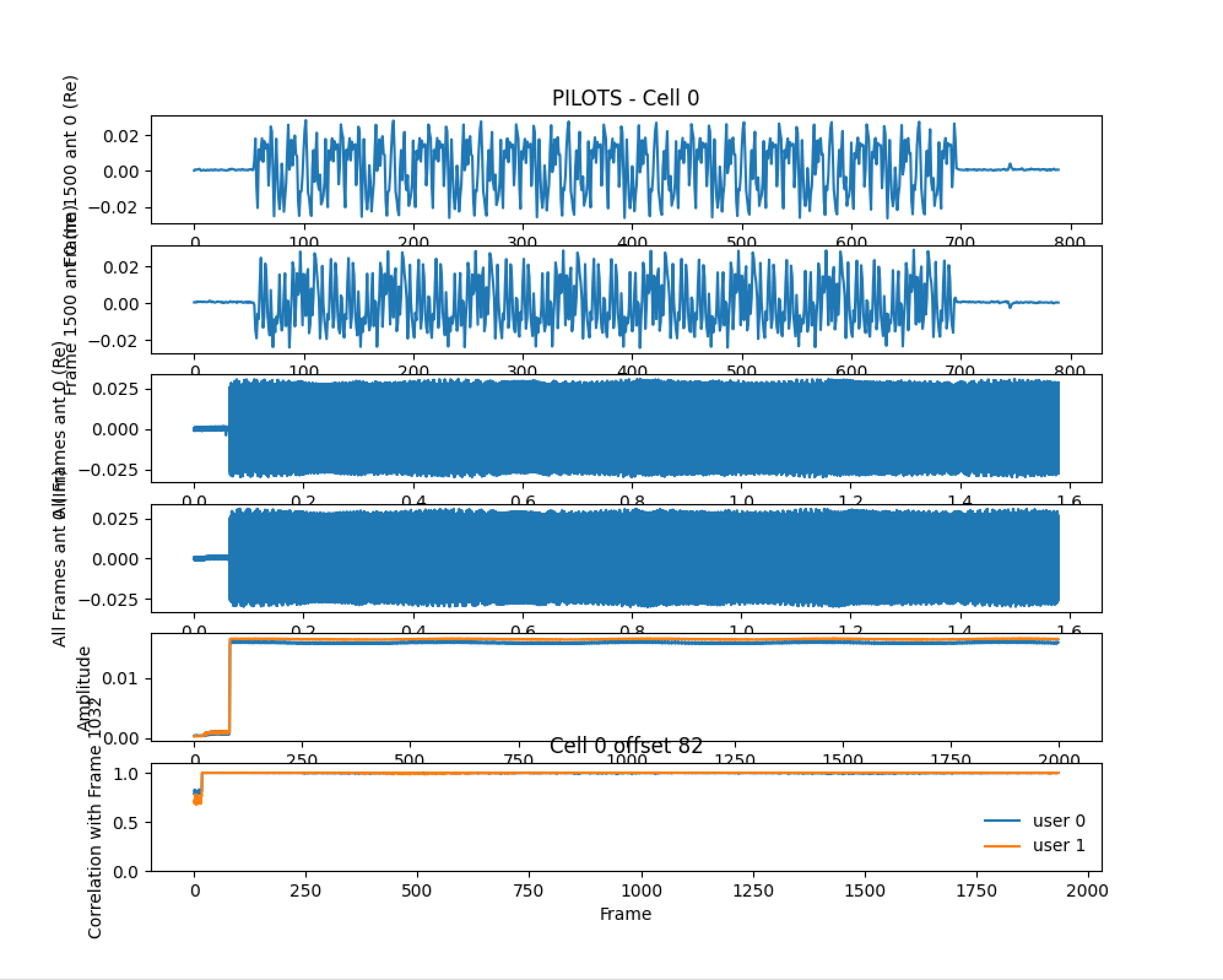
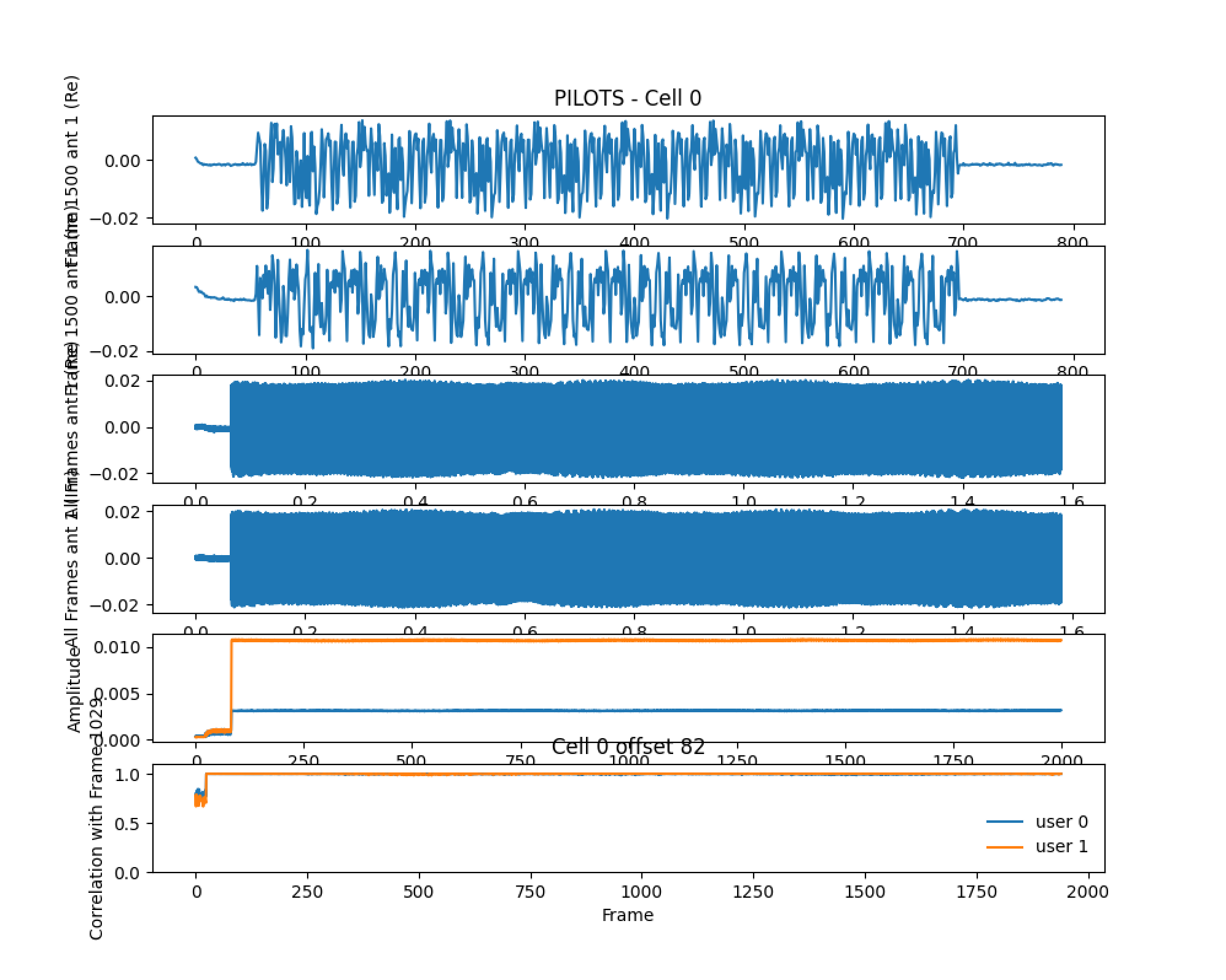
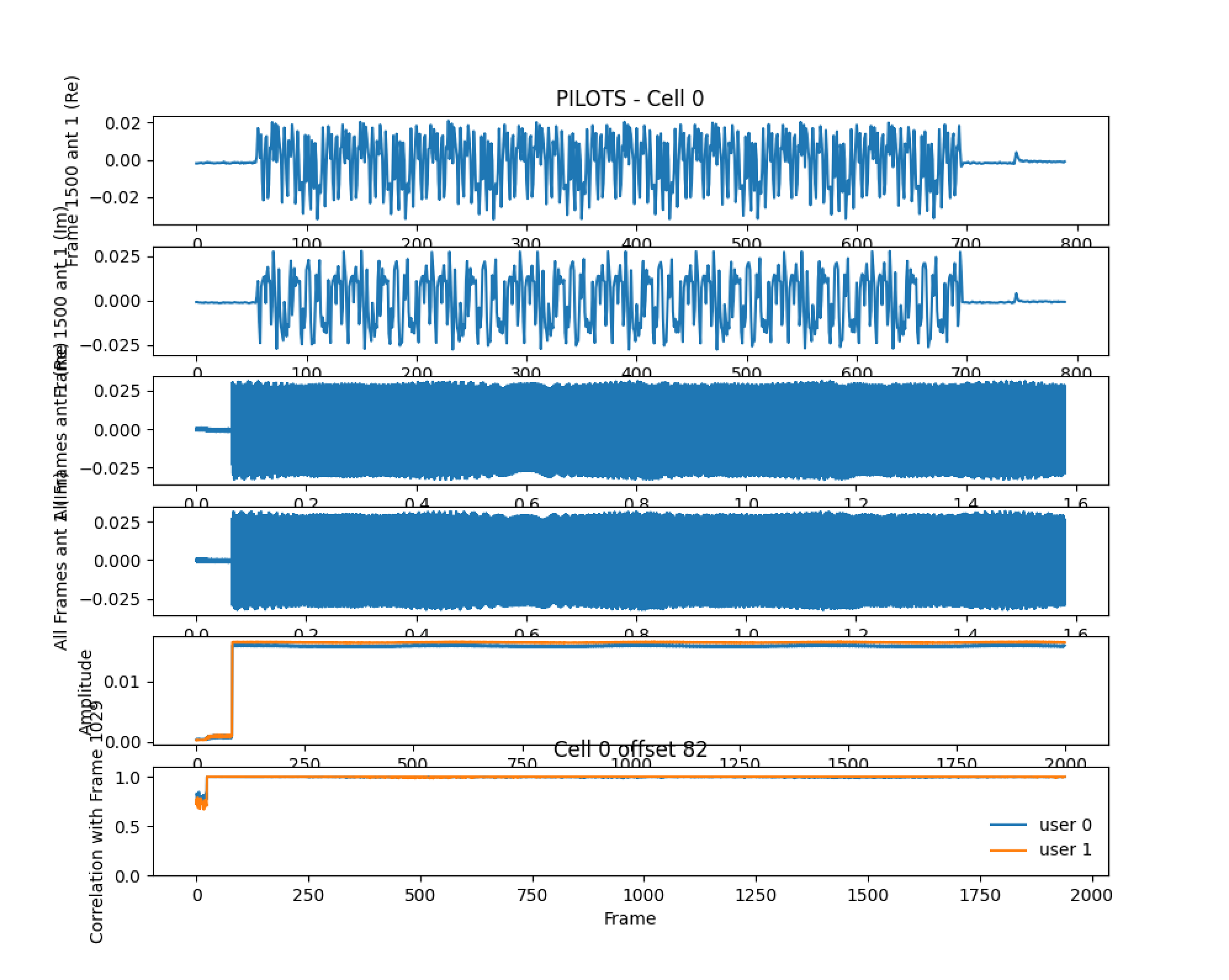
| h00 | h01 |
|---|---|
|
|
| h10 | h11 |
|
|
¶ Verification
uhd_find_devices --args="addr=10.115.2.22"returns the NI-2974 device with serial318F20F.uhd_find_devices --args="addr=10.115.2.32"returns the X310 device with serial3165747.- The client terminal shows
Beacon detectedandStart main client txrx loop.... - The BS terminal shows
Saving HDF5, 2000 frames saved.and the HDF5 file appears inlogs/. - Running
plot_hdf5.pyproduces four channel response plots (h00, h01, h10, h11) without errors.
¶ Cleanup
omf tell -a offh -t sdr2-s1-lg1,sdr2-md1,srv2-lg1
(No omf save needed unless you modified the image.)
¶ Troubleshooting
| Symptom | Likely cause | Fix |
|---|---|---|
uhd_find_devices returns No UHD Devices Found for a USRP |
eno2 not configured or wrong subnet |
Run ifconfig eno2 10.115.2.12 netmask 255.255.255.0 mtu 9000 up and retry; confirm with ping 10.115.2.22 / ping 10.115.2.32 |
| Client does not detect beacon / times out | RF switch ports not set to USRP-2974 path | Re-run the curl RF switch command from Setup step 5 to set all ports to 1 |
| Sounder build fails with UHD errors | Wrong branch (master) checked out |
Switch to develop branch: git checkout develop |
| HDF5 file not created / BS exits immediately | JSON config file has wrong IP or channel settings | Verify usrp-bs-serials.txt contains 10.115.2.22 and usrp-bs-only.json has "channel" : "AB" |
plot_hdf5.py fails with missing module |
Python dependencies not installed | Install with pip3 install h5py matplotlib numpy (TODO: verify exact requirements) |
¶ References
- RENEW Sounder documentation
- RENEWLab GitHub repository (
developbranch for UHD support) - RENEW license
- UHD license
- COSMOS Sandbox 2 (sb2) architecture
- Available COSMOS disk images
- Available SDR hardware
- OMF commands reference
Author(s): COSMOS team (original: Tingjun Chen, Duke University) · Last verified: Not re-tested (migrated 2026-06-20) · Tested image/release: baseline-gr.ndz / UHD 3.15 · Tags: mimo, channel-sounding, usrp-2974, renew, uhd, tdd