¶ Savannah: Efficient mmWave Baseband Processing with Minimal and Heterogeneous Resources
Demonstrate Savannah, a framework for efficient real-time mmWave baseband processing on COSMOS SB2, using IBM 28 GHz PAAMs and USRP N310 SDRs — running both simulation and over-the-air RRU modes.
¶ Overview
Savannah is a framework for efficient mmWave baseband processing with minimal and heterogeneous resources. This tutorial shows how to run Savannah on the COSMOS SB2 testbed using two USRP N310 SDRs connected to two IBM 28 GHz Phased Array Antenna Modules (PAAMs).
The experiment covers two execution modes: a simulation mode (Savannah-mc) where the full baseband DSP pipeline runs without live radio traffic, and an RRU mode where gNodeB and UE communicate over the air through the PAAMs. An optional ACC100 DPDK BBDev section documents hardware LDPC acceleration for reference.
The COSMOS team contributes UHD support for the Agora software base, DSP pipeline updates (equalization, demodulation), and ACC100 BBDEV acceleration integration for decoding. The Savannah software itself is distributed under the RENEW license as Savannah.zip in the page attachments.
This tutorial is associated with the following publications — please cite them when publishing results obtained using the PAAMs deployed in COSMOS:
- Z. Qi, Z. Gao, C. Tung, and T. Chen, "Programmable Millimeter-Wave MIMO Radios with Real-Time Baseband Processing". in Proc. ACM MobiCom '23 Workshop on Wireless Network Testbeds, Experimental evaluation & Characterization (WiNTECH '23), 2023.
- Z. Qi*, C. Tung*, A. Kalia, and T. Chen, "Savannah: Efficient mmWave Baseband Processing with Minimal and Heterogeneous Resources". in Proc. 30th Annual International Conference on Mobile Computing and Networking (MobiCom'24), 2024.
¶ Learning outcomes
After completing this tutorial you will be able to:
- Load and configure a pre-built Savannah node image on COSMOS SB2.
- Initialize IBM 28 GHz PAAM boards via the COSMOS array management API.
- Configure 10G data interfaces and verify USRP N310 connectivity with
uhd_find_devices. - Run Savannah-mc in simulation mode and interpret per-frame DSP timing output.
- Run Savannah-mc in RRU (over-the-air) mode with live gNodeB and UE and observe BER/BLER results.
- Select CMake build flags to switch LDPC decoder (FlexRAN vs. ACC100) and radio type (SIMULATION vs. PURE_UHD).
¶ At a glance
| Difficulty | Advanced |
| Estimated time | 90 min |
| Domain / sandbox | sb2.cosmos-lab.org |
| Topic group | mmwave-paam |
| Last verified | Not re-tested (migrated 2026-06-20) |
¶ Prerequisites
Background knowledge
- Familiarity with the COSMOS experiment life cycle.
- Basic understanding of OFDM baseband processing (FFT, equalization, LDPC decoding).
- Basic UHD / USRP concepts — see available SDR hardware.
Account & access
- A COSMOS account — register here.
- An approved reservation on sb2.cosmos-lab.org — see Make a reservation.
- SSH access to the domain console — see SSH access.
Software
Savannah.zipattachment from this page (available under the RENEW license) — already extracted in theSavannah.ndzimage.
¶ Resources required
Devices / nodes
| Resource | Role | Qty | Notes |
|---|---|---|---|
srv1-lg1 |
Baseband processing server (runs Savannah gNodeB + UE) | 1 | Intel server with AVX-512 and ACC100 card slot; image loaded here |
sdr1-s1-lg1 |
USRP N310 SDR (connected to rfdev2-1) | 1 | 10G data link to srv1-lg1 via DATA1 |
sdr1-md1 |
USRP N310 SDR (connected to rfdev2-2) | 1 | 10G data link to srv1-lg1 via DATA2 |
rfdev2-1 |
IBM 28 GHz PAAM (TX side) | 1 | Connected to sdr1-s1-lg1 RF2/RF3 ports |
rfdev2-2 |
IBM 28 GHz PAAM (RX side) | 1 | Connected to sdr1-md1 RF2/RF3 ports |
Disk images
| Image | Load onto | Provides |
|---|---|---|
Savannah.ndz |
srv1-lg1 |
Ubuntu 20.04; UHD 4.1.0; PAAM control software; PAAM CFO calibration; Savannah framework (pre-built) |
Software components
| Component | Version | Source |
|---|---|---|
| Ubuntu | 20.04 | preinstalled in Savannah.ndz |
| UHD (USRP Hardware Driver) | 4.1.0 | preinstalled in Savannah.ndz |
| Intel oneAPI (setvars.sh) | TODO: verify | preinstalled in Savannah.ndz at /opt/intel/oneapi/ |
| FlexRAN LDPC library | TODO: verify | preinstalled in Savannah.ndz |
| Savannah / Agora mmwave | as of Sep 2024 | Savannah.zip attachment (RENEW license); pre-extracted in image at ~/Savannah/agora-mmwave/ |
| PAAM Control API | TODO: verify | preinstalled in Savannah.ndz |
Spectrum / RF / special
- 28 GHz mmWave band via IBM PAAMs; over-the-air between
rfdev2-1(TX) andrfdev2-2(RX). - RF cabling between USRP N310 and PAAM boards (fixed hardware in SB2 — see Topology).
- Experiment requires an SB2 reservation; the PAAMs are dedicated SB2 hardware.
¶ Topology
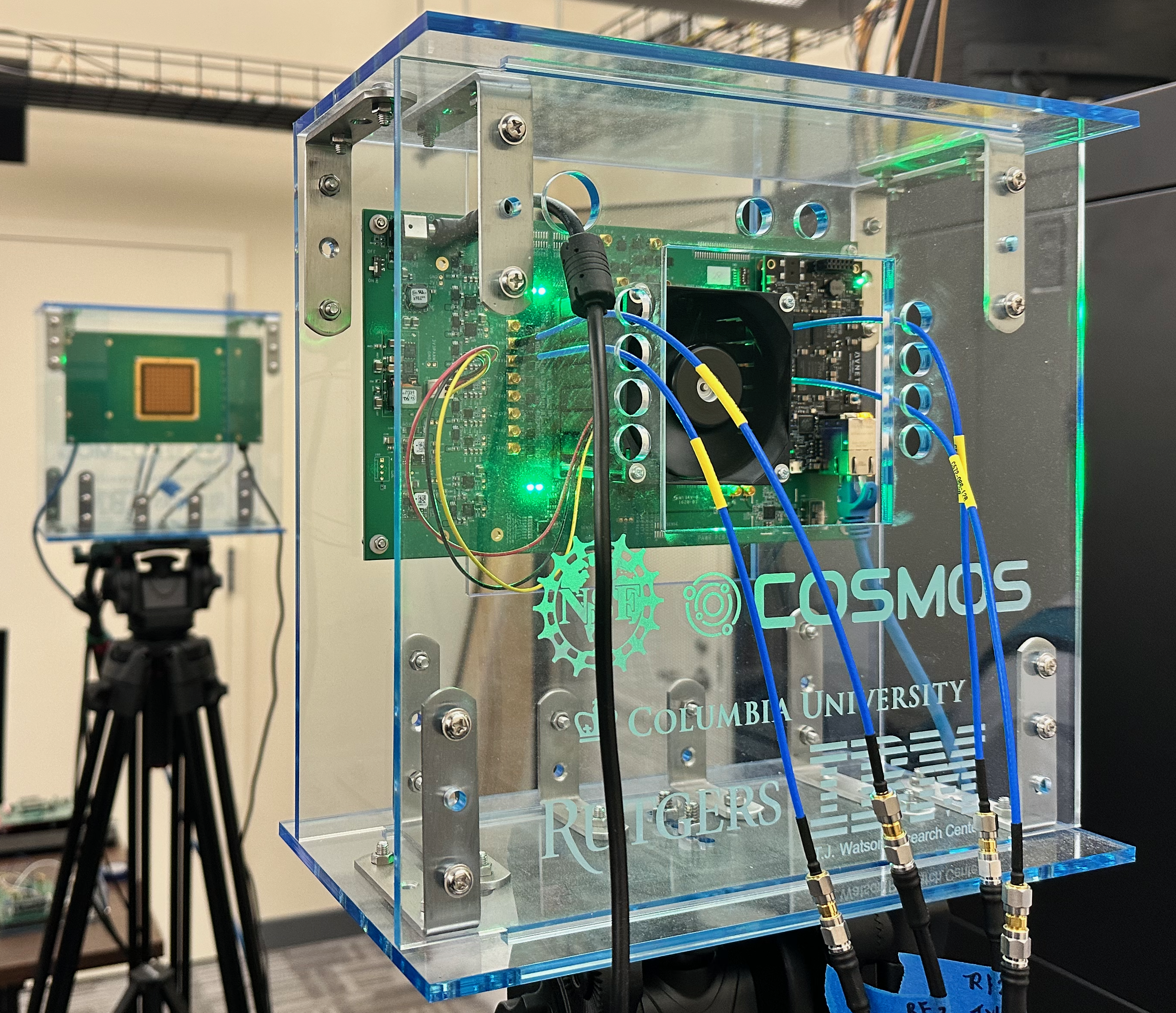
The fixed hardware connections in SB2 are:
sdr1-s1-lg1RF2 TX/RX →rfdev2-1IC0/TX/Hsdr1-s1-lg1RF2 RX2 →rfdev2-1IC1/RX/Hsdr1-s1-lg1RF3 TX/RX →rfdev2-1IC0/TX/Vsdr1-s1-lg1RF3 RX2 →rfdev2-1IC1/RX/Vsdr1-md1RF2 TX/RX →rfdev2-2IC0/TX/Hsdr1-md1RF2 RX2 →rfdev2-2IC1/RX/Hsdr1-md1RF3 TX/RX →rfdev2-2IC0/TX/Vsdr1-md1RF3 RX2 →rfdev2-2IC1/RX/V
srv1-lg1 connects to sdr1-s1-lg1 via the DATA1 10G interface and to sdr1-md1 via DATA2. The USRP management addresses are on the 10.113.2.x subnet; data-plane addresses are 10.114.2.x (DATA1) and 10.115.2.x (DATA2). All resources are controlled from console.sb2.cosmos-lab.org.
¶ Setup
Open four separate SSH sessions to the console before beginning.
-
Log into the sandbox console:
ssh <username>@console.sb2.cosmos-lab.org -
In terminal 1, turn off all resources used in the experiment:
omf tell -a offh -t sdr1-s1-lg1,sdr1-md1,rfdev2-1,rfdev2-2,srv1-lg1 -
Load the
Savannah.ndzimage onto the server:omf load -i Savannah.ndz -t srv1-lg1 -r 0 -
Turn all required resources on and check their status:
omf tell -a on -t sdr1-s1-lg1,sdr1-md1,rfdev2-1,rfdev2-2,srv1-lg1omf stat -t all -
SSH to the server with
-Yto enable GUI forwarding (used for live demo display):ssh -Y root@srv1-lg1 -
In all SSH sessions to
srv1-lg1, source the Intel oneAPI environment:source /opt/intel/oneapi/setvars.sh --force --config="/opt/intel/oneapi/renew-config.txt"
¶ Configure 10G data interfaces and verify USRPs
These steps are performed in terminal 1 on srv1-lg1.
Set up the 10G data interfaces DATA1 and DATA2:
ifconfig DATA1 10.114.2.11 netmask 255.255.255.0 mtu 9000 up
ifconfig DATA2 10.115.2.11 netmask 255.255.255.0 mtu 9000 up
Increase kernel socket buffer sizes:
sudo sysctl -w net.core.rmem_max=536870912
sudo sysctl -w net.core.wmem_max=536870912
After running the above, confirm the interfaces have the correct addresses:
root@srv1-lg1:~# ifconfig DATA1
DATA1: flags=4163<UP,BROADCAST,RUNNING,MULTICAST>  mtu 1500
        inet6 fe80::1e34:daff:fe42:d4c  prefixlen 64  scopeid 0x20<link>
        ether 1c:34:da:42:0d:4c  txqueuelen 1000  (Ethernet)
        RX packets 21092  bytes 1881634 (1.8 MB)
        RX errors 0  dropped 19183  overruns 0  frame 0
        TX packets 686  bytes 204975 (204.9 KB)
        TX errors 0  dropped 0 overruns 0  carrier 0  collisions 0
root@srv1-lg1:~# ifconfig DATA2
DATA2: flags=4163<UP,BROADCAST,RUNNING,MULTICAST>  mtu 1500
        inet6 fe80::1e34:daff:fe42:d4d  prefixlen 64  scopeid 0x20<link>
        ether 1c:34:da:42:0d:4d  txqueuelen 1000  (Ethernet)
        RX packets 21091  bytes 1881530 (1.8 MB)
        RX errors 0  dropped 19184  overruns 0  frame 0
        TX packets 690  bytes 226549 (226.5 KB)
        TX errors 0  dropped 0 overruns 0  carrier 0  collisions 0
Run uhd_find_devices to confirm both USRP N310s are reachable:
[INFO] [UHD] linux; GNU C++ version 9.4.0; Boost_107100; UHD_4.1.0.HEAD-0-g25d617ca
--------------------------------------------------
-- UHD Device 3
--------------------------------------------------
Device Address:
    serial: 315A35A
    addr: 10.114.2.21
    claimed: False
    fpga: XG
    mgmt_addr: 10.113.2.21
    mgmt_addr: 10.114.2.21
    product: n310
    type: n3xx

--------------------------------------------------
-- UHD Device 4
--------------------------------------------------
Device Address:
    serial: 3176DF7
    addr: 10.115.2.31
    claimed: False
    fpga: XG
    mgmt_addr: 10.113.2.31
    mgmt_addr: 10.115.2.31
    product: n310
    type: n3xx
If either N310 does not appear, see Troubleshooting.
¶ Configure IBM 28 GHz PAAMs
These commands are run in terminal 2 from the console (console.sb2.cosmos-lab.org). The source tutorial uses am1.orbit-lab.org:5054 as the AM proxy endpoint; this should be routed via the COSMOS AM proxy.
Run the following four curl commands to configure both PAAM boards:
<user_name>@console:~$ curl "http://am1.orbit-lab.org:5054/array_mgmt/configure?dev_name=rfdev2-1.sb2.cosmos-lab.org&ics=0&num_elements=16&txrx=tx&pol=h&theta=0&phi=0"
<user_name>@console:~$ curl "http://am1.orbit-lab.org:5054/array_mgmt/configure?dev_name=rfdev2-1.sb2.cosmos-lab.org&ics=0&num_elements=16&txrx=tx&pol=v&theta=0&phi=0"
<user_name>@console:~$ curl "http://am1.orbit-lab.org:5054/array_mgmt/configure?dev_name=rfdev2-2.sb2.cosmos-lab.org&ics=1&num_elements=16&txrx=rx&pol=h&theta=0&phi=0"
<user_name>@console:~$ curl "http://am1.orbit-lab.org:5054/array_mgmt/configure?dev_name=rfdev2-2.sb2.cosmos-lab.org&ics=1&num_elements=16&txrx=rx&pol=v&theta=0&phi=0"
Each command should return an XML response indicating successful configuration, for example:
<?xml version="1.0" encoding="UTF-8"?>
<response status="OK">
  <action service="array_mgmt" name="configure" ipaddr="10.113.2.52">
    <step name="open" duration="3.780022"/>
    <step name="initializaition" duration="0.125465"/>
    <step name="enabling" duration="0.022732"/>
    <step name="steering" duration="0.006349" theta="0" phi = "0" ipaddr = "10.113.2.52" />
    <state PAAM_ID="0x23" LO_switch="PLL" if_sw1="0xF" if_sw2="0xF" if_sw3="0xF" if_sw4="0xF" txrx="rx" polarization="v" />
    <adc>
      <conv index="0" name="1v2" tADC="114" tVolt="0.279" tCurr="0.139"/>
      <conv index="1" name="1v5" tADC="214" tVolt="0.523" tCurr="1.046"/>
      <conv index="2" name="1v8" tADC="4" tVolt="0.010" tCurr="0.005"/>
      <conv index="3" name="2v7_0" tADC="13" tVolt="0.032" tCurr="0.064"/>
      <conv index="4" name="2v7_1" tADC="183" tVolt="0.447" tCurr="0.894"/>
      <conv index="5" name="2v7_2" tADC="18" tVolt="0.044" tCurr="0.088"/>
      <conv index="6" name="2v7_3" tADC="40" tVolt="0.098" tCurr="0.196"/>
      <conv index="7" name="3v3_pll" tADC="303" tVolt="0.740" tCurr="0.370"/>
      <conv index="8" name="5v_uzed" tADC="276" tVolt="0.674" tCurr="0.674"/>
      <conv index="9" name="12v" tADC="140" tVolt="0.342" tCurr="1.140"/>
      <conv index="10" name="0V" tADC="0" tVolt="0.000"/>
      <conv index="11" name="1V8" tADC="735" tVolt="1.796"/>
    </adc>
    <step name="status" duration="0.069065"/>
    <step name="close" duration="0.100179"/>
  </action>
</response>
¶ Instructions
Important: For every terminal opened on srv1-lg1, ensure the Intel oneAPI environment is sourced before running any Savannah commands:
source /opt/intel/oneapi/setvars.sh --force --config="/opt/intel/oneapi/renew-config.txt"
All Savannah executables and configuration files are located at ~/Savannah/agora-mmwave/. The default configuration used is tddconfig-sim-ul-fr2-mu3-100Mhz.json. Alternative configurations are available in Savannah/agora-mmwave/files/config/ci.
¶ CMake build flags
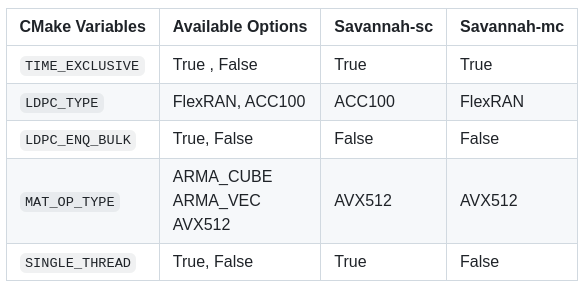
Key CMake flags and their meaning:
TIME_EXCLUSIVE— should always beTruefor best performance; suppresses non-timing metric calculations.LDPC_TYPE— selects the LDPC decoder:FlexRAN(software) orACC100(hardware accelerator).LDPC_ENQ_BULK— whenTrue, delays OFDM symbols until the last uplink symbol before pushing into the ACC100 accelerator.MAT_OP_TYPE— selects the matrix operation compute scheme:AVX512(recommended when supported),ARMA_VEC(vectorized via Armadillo, for non-AVX512 systems), orARMA_CUBE(research/evaluation only, not performance-optimized).SINGLE_THREAD— whenTrue, merges the worker thread and main scheduling thread (worker count limited to 1). WhenFalse, uses a multi-thread model (worker threads + 1 scheduling/main thread), matching Agora's default behavior.RADIO_TYPE—SIMULATIONfor simulation mode;PURE_UHDfor over-the-air RRU mode.
¶ Step 1 — Simulation mode (Savannah-mc)
Verify the CMake flags in ~/Savannah/agora-mmwave/build. For simulation mode, RADIO_TYPE must be SIMULATION:
# you are expect to see the following results:
root@srv1-lg1:~/Savannah/agora-mmwave/build# cmake ../
-- Using GNU compiler, compiler ID GNU
-- Debugging is disabled
-- CMAKE_CXX_FLAGS: -std=c++17 -Wall -g -march=native -m64 -O3 -Ofast -DNDEBUG
-- CURRENT DIRECTORY: /root/Savannah/agora-mmwave
-- CMAKE_CURRENT_SOURCE_DIR: /root/Savannah/agora-mmwave
-- Processor supports AVX-512
-- Using FlexRAN's (i.e., not Agora's) AVX512 encoder
--
-- ----- Configuration values -----
-- DEBUG:            OFF
-- RADIO_TYPE:       SIMULATION
-- LOG_LEVEL:        info
-- USE_SPDLOG:       True
-- ENABLE_MAC:       False
-- ENABLE_CSV_LOG:   False
-- ENABLE_MAT_LOG:   False
-- USE_AVX2_ENCODER: False
-- ENABLE_HDF5:      False
-- TIME_EXCLUSIVE:   TRUE
-- LDPC_TYPE:        FlexRAN
-- LDPC_ENQ_BULK:    False
-- MAT_OP_TYPE:      AVX512
-- SINGLE_THREAD:    False
-- --------------------------------
--
-- Enabled SIMULATION radio type
-- Enabled SW Intel FlexRAN LDPC Decoding
-- LDPC: Sequential Enqueue Mode
-- Time-exlusive: Report only timing but not other characteristics
-- MAT_OP_TYPE: Enable AVX512 matrix operation
-- SINGLE_THREAD: Enable worker thread (use multi-thread model)
-- Using spdlog async logger as the default logger
-- Build spdlog: 1.11.0
-- Build type: Release
-- Disabled Csv/Mat Logger
-- Logging level = info.
-- Configuring done
-- Generating done
-- Build files have been written to: /root/Savannah/agora-mmwave/build
In terminal 1, generate the binary files:
root@srv1-lg1:~/Savannah/agora-mmwave/# ./savannah.sh -g -s
In terminal 1, bring up the UE (it enters standby mode waiting for the gNodeB):
root@srv1-lg1:~/Savannah/agora-mmwave/# ./savannah.sh -u -s
In terminal 2, bring up the gNodeB:
root@srv1-lg1:~/Savannah/agora-mmwave/# ./savannah.sh -x -s -r
Both gNodeB and UE should start running. On the gNodeB side, you will see per-frame timing output like:
[14:539488][I] Main [frame 5878 + 0.3376 ms]: Completed LDPC decoding (16 UL symbols)
[14:539508][I] Frame 5878 Summary: FFT (32 tasks): 0.0206114 ms (~0.00478991 + 0.00756673 + 0.00548272 ms), CSI (4 tasks): 0.0030098 ms (~0.000714161 + 0.00095141 + 0.00116174 ms), Beamweights (1 tasks): 0.00130209 ms (~4.04698e-05 + 0.0012592 + 0 ms), Equal (16 tasks): 0.0268793 ms (~0.00325447 + 0.0104146 + 0.0101594 ms), Demul (32 tasks): 0.0224507 ms (~5.13671e+12 + 0 + 0 ms), Decode (32 tasks): 0.228612 ms (~0.000104702 + 0.219754 + 0 ms), Total: 0.302866 ms
The total elapsed time for processing frame 5878 is 0.3376 ms, within the 5G FR2 Numerology-3 frame deadline of 0.375 ms.
Stop early with Ctrl+C, or let the program run to completion (default: 200,000 frames). Upon completion, you will see final statistics:
Uplink totals (tasks, frames): CSI (23524, 5881.00), [14:540519][Beamweights (5881, 5881.00), FFT (188186, 5880.81), Demul (188172, 15.00), Decode (188166, 5880.19)
Thread 0 performed (tasks, fraction of tasks): FFT (47136, 25.05%), CSI (6067, 25.79%), Beamweights (1584, 26.93%), Equal (23283, 24.75%), Demul (46566, 24.75%), Decode (47216, 25.09%), FFT (47136, 25.05%),
Thread 1 performed (tasks, fraction of tasks): FFT (46389, 24.65%), CSI (5707, 24.26%), Beamweights (1480, 25.17%), Equal (23770, 25.26%), I] Agora: printing stats and saving to file
Demul (47540, 25.26%), [14:540523][Decode (46632, 24.78%), FFT (46389, 24.65%),
Thread 2 performed (tasks, fraction of tasks): FFT (48401, 25.72%), CSI (5826, 24.77%), Beamweights (1257, 21.37%), Equal (23214, 24.67%), Demul (46428, 24.67%), Decode (46919, 24.93%), FFT (48401, 25.72%), I] Stats: total processed frames 5880

Thread 3 performed (tasks, fraction of tasks): FFT (46260, 24.58%), CSI (5924, 25.18%), Beamweights (1560, 26.53%), Equal (23822, 25.32%), Demul (47644, 25.32%), Decode (47405, 25.19%), FFT (46260, 24.58%),
[14:540621][I] Stats: Saving master timestamps to ./files/experiment/timeresult.txt
[14:563553][I] Stats: Printing detailed results to ./files/experiment/timeresult_detail.txt
[14:578927][I] UE 0: Uplink bit errors (BER) 0/79689632 (0.000000), block errors (BLER) 0/82324 (0.000000)
[14:578935][I] UE 1: Uplink bit errors (BER) 0/79689632 (0.000000), block errors (BLER) 0/82324 (0.000000)
[14:578936][I] Agora: terminating
=================================
          CORE LIST SUMMARY
=================================
Total Number of Cores: 48 : 48
|| Core ID:  3 || Requested: 24 || ThreadType: Master           || ThreadId: 140397163316672
|| Core ID:  5 || Requested: 25 || ThreadType: TXRX             || ThreadId: 140396821804800
|| Core ID:  7 || Requested: 26 || ThreadType: TXRX             || ThreadId: 140396799424256
|| Core ID:  9 || Requested: 27 || ThreadType: Worker           || ThreadId: 140396855375616
|| Core ID: 11 || Requested: 28 || ThreadType: Worker           || ThreadId: 140396846982912
|| Core ID: 13 || Requested: 29 || ThreadType: Worker           || ThreadId: 140396838590208
|| Core ID: 15 || Requested: 30 || ThreadType: Worker           || ThreadId: 140396830197504
=================================
In simulation mode, BER and BLER should be exactly 0% (no channel noise is applied).
¶ Step 2 — RRU mode (Savannah-mc, over-the-air)
Note: Ensure you have completed the PAAM configuration in the Setup section before running RRU mode.
Switch the CMake RADIO_TYPE flag from SIMULATION to PURE_UHD:
# you are expect to see the following results:
root@srv1-lg1:~/Savannah/agora-mmwave/build# cmake ../ -DRADIO_TYPE=PURE_UHD
-- Using GNU compiler, compiler ID GNU
-- Debugging is disabled
-- CMAKE_CXX_FLAGS: -std=c++17 -Wall -g -march=native -m64 -O3 -Ofast -DNDEBUG
-- CURRENT DIRECTORY: /root/Savannah/agora-mmwave
-- CMAKE_CURRENT_SOURCE_DIR: /root/Savannah/agora-mmwave
-- Processor supports AVX-512
-- Using FlexRAN's (i.e., not Agora's) AVX512 encoder
--
-- ----- Configuration values -----
-- DEBUG:            OFF
-- RADIO_TYPE:       PURE_UHD
-- LOG_LEVEL:        info
-- USE_SPDLOG:       True
-- ENABLE_MAC:       False
-- ENABLE_CSV_LOG:   False
-- ENABLE_MAT_LOG:   False
-- USE_AVX2_ENCODER: False
-- ENABLE_HDF5:      False
-- TIME_EXCLUSIVE:   TRUE
-- LDPC_TYPE:        FlexRAN
-- LDPC_ENQ_BULK:    False
-- MAT_OP_TYPE:      AVX512
-- SINGLE_THREAD:    False
-- --------------------------------
--
-- Enabled Pure UHD radio type
-- Enabled SW Intel FlexRAN LDPC Decoding
-- LDPC: Sequential Enqueue Mode
-- Time-exlusive: Report only timing but not other characteristics
-- MAT_OP_TYPE: Enable AVX512 matrix operation
-- SINGLE_THREAD: Enable worker thread (use multi-thread model)
-- Using spdlog async logger as the default logger
-- Build spdlog: 1.11.0
-- Build type: Release
-- Disabled Csv/Mat Logger
-- Logging level = info.
-- Enabled PURE_UHD radio
-- Found UHD: /usr/local/lib/libuhd.so (Required is at least version "3.15.0")
-- Using UHD Version: 4.1.0.HEAD-0-g25d617ca
-- Found Boost: /usr/lib/x86_64-linux-gnu/cmake/Boost-1.71.0/BoostConfig.cmake (found suitable version "1.71.0", minimum required is "1.65") found components: program_options system thread
-- Using Boost Version: 1.71.0
-- pure_uhd_lib library initialized
-- Configuring done
-- Generating done
-- Build files have been written to: /root/Savannah/agora-mmwave/build
Confirm that UHD is linked (Using UHD Version: 4.1.0.HEAD-0-g25d617ca), then recompile:
root@srv1-lg1:~/Savannah/agora-mmwave/build# make -j
In terminal 1, generate the binary files:
root@srv1-lg1:~/Savannah/agora-mmwave/# ./savannah.sh -g -r
In terminal 1, bring up the gNodeB (it enters standby mode waiting for the UE to send beacons):
root@srv1-lg1:~/Savannah/agora-mmwave/# ./savannah.sh -x -r -r
In terminal 2, bring up the UE:
root@srv1-lg1:~/Savannah/agora-mmwave/# ./savannah.sh -u -r
Both gNodeB and UE should start running. The per-frame timing output is similar to simulation mode, but with additional host-USRP jitter causing slightly higher total elapsed times.
Upon completion, the BER/BLER output will show non-zero values for the first few frames due to initial synchronization overhead:
[53:029073][I] UE 0: Uplink bit errors (BER) 32491/2639736 (0.012308), block errors (BLER) 67/2727 (0.024569)
The default USRP and PAAM gain settings yield approximately 26 dB SNR, resulting in very low steady-state BER and BLER. To vary the SNR, modify the gain settings in Savannah/agora-mmwave/files/experiments/ul-usrp.json.
¶ Step 3 — EVM and SNR printouts (optional)
To enable EVM and SNR metrics per frame, disable the TIME_EXCLUSIVE CMake flag (set it to False) and recompile. Note that these calculations introduce additional computation overhead and will affect real-time performance.
After recompiling with TIME_EXCLUSIVE=False, you will see output like:
[15:462812][I] Main [frame 5309 + 0.63 ms]: Completed demodulation
[15:462817][I] Frame 5309 Constellation:
  EVM    7.1707
, SNR    11.4444
True SNR is: 27.0316
¶ Step 4 — ACC100 DPDK BBDev (reference only)
Notice: The COSMOS testbed currently does not have an ACC100 card installed in the servers. The following is provided as reference for users who have installed the card on their own system.
The Savannah.zip attachment contains a README file called BBDev_testcase.md with detailed instructions on:
- ACC100 system requirements
- Initialization and configuration
- Running the default validation test
- Building custom test cases
The mcs_enc_dec_pair folder inside Savannah.zip contains encoding and decoding test cases for different MCS configurations, specifically for 5G mmWave FR2 Numerology-3 100 MHz. A program test_bbdev_perf.c based on DPDK's bbdev program and expected encoding/decoding test results are included.
To run Savannah in single-core accelerated mode (Savannah-sc), update the CMake flags:
- Set
LDPC_TYPEtoACC100 - Set
SINGLE_THREADtoTrue
After compiling, the framework links to the ACC100 hardware LDPC decoder. The experimental steps are otherwise identical to Savannah-mc mode.
¶ Verification
uhd_find_devicesreturns both USRP N310s with their serial numbers and data-plane addresses (10.114.2.x and 10.115.2.x).- PAAM
curlconfiguration commands return<response status="OK">XML with valid ADC readings. - In simulation mode: BER and BLER for all UEs are
0.000000at the end of the run. - In RRU mode: steady-state BER is very low (approximately 26 dB SNR with default gain settings); initial frames may show non-zero BER due to synchronization.
- Per-frame total processing time stays below the 5G FR2 Numerology-3 deadline of 0.375 ms.
¶ Cleanup
omf tell -a offh -t sdr1-s1-lg1,sdr1-md1,rfdev2-1,rfdev2-2,srv1-lg1
Do not run omf save unless you have made changes to the image that you wish to preserve.
¶ Troubleshooting
| Symptom | Likely cause | Fix |
|---|---|---|
uhd_find_devices returns fewer than 2 devices |
DATA1 or DATA2 interface not configured, or MTU not set | Verify with ifconfig DATA1 / ifconfig DATA2; re-run the ifconfig and sysctl setup commands |
PAAM curl returns error or no response |
PAAM board not powered on, or wrong AM proxy URL | Confirm omf tell -a on completed for rfdev2-1/rfdev2-2; verify omf stat; check the AM proxy address |
cmake fails to find UHD when building for PURE_UHD |
oneAPI environment not sourced | Run source /opt/intel/oneapi/setvars.sh --force --config="/opt/intel/oneapi/renew-config.txt" in the terminal before running cmake |
| gNodeB or UE does not start after the other | Startup order issue | In RRU mode, start gNodeB first (it waits for UE beacons); in simulation mode, start UE first (it waits for gNodeB) |
| High BER in RRU mode beyond initial frames | Low SNR / gain settings | Adjust gain values in Savannah/agora-mmwave/files/experiments/ul-usrp.json; default settings target ~26 dB SNR |
| Processing time exceeds 0.375 ms deadline | Insufficient CPU resources or wrong build flags | Ensure TIME_EXCLUSIVE=True and MAT_OP_TYPE=AVX512; confirm no other workloads are running on srv1-lg1 |
¶ References
- RENEW project license and Savannah.zip download
- COSMOS getting started guide
- SSH access to console
- Available SDR hardware
- Z. Qi, Z. Gao, C. Tung, and T. Chen, "Programmable Millimeter-Wave MIMO Radios with Real-Time Baseband Processing". in Proc. ACM MobiCom '23 WiNTECH Workshop, 2023.
- Z. Qi*, C. Tung*, A. Kalia, and T. Chen, "Savannah: Efficient mmWave Baseband Processing with Minimal and Heterogeneous Resources". in Proc. MobiCom'24, 2024.
Author(s): COSMOS team (Zhenzhou Qi, Chung-Hsuan Tung, Zhihui Gao, Tingjun Chen — Duke University) · Last verified: Not re-tested (migrated 2026-06-20) · Tested image/release: Savannah.ndz / UHD 4.1.0 · Tags: mmwave, paam, usrp, n310, savannah, agora, 5g, fr2, ldpc, acc100