¶ Duranta (OAI) 5G SA with a soft O-RU: O-DU ↔ nr-oru on a USRP over O-RAN 7.2 fronthaul
Part of: Duranta on COSMOS · 4G / 5G & O-RAN tutorials
Split the Duranta gNB at the O-RAN 7.2 fronthaul and put a software O-RU on the far side: an O-DU (nr-softmodem + DPDK/xran) on one osc server, the OAI soft O-RU (nr-oru) driving a USB USRP B210 on a second osc server, eCPRI over VLAN 4 between them, OAI CN5G behind the O-DU and a commercial Quectel modem as the UE. At the end the modem is registered, holds a PDU session and passes traffic through a working 7.2 split with no vendor O-RU in the loop.
Works end to end on osc (verified 2026-09-16). O-DU on an osc server,
nr-oruon a second osc server driving its local USRP B210 over USB 3.0, UE onnode1.osc: the modem registers, gets an IP and passes traffic — DL 30.7–34.3 / UL 7.3 Mbit/s, 0 % ping loss to the local DN and to the internet, RSRP −91, SINR 18.nr-orusupports only an uncompressed 16-bit U-plane (upstreamdoc/ORAN_FHI7.2_ORU_Tutorial.md§7.5), so the O-DU must not use BFP. On sb1 the packaged tutorial (cosmos-tutorial run duranta-72-nroru) runs the same split with a networked N310 instead of the B210 (alternative); it was verified on 2026-11-21 onduranta.ndz=duranta-w44-20261120b: registered, DL 35.4 / UL 0.71 Mbit/s, 0 % ping loss.
¶ Overview
In steps 1 and 2 of the learning path the gNB was one program that did everything from the protocol stack down to the samples sent to the radio. The O-RAN 7.2 split cuts that program in two. The O-DU (Open Distributed Unit) keeps the protocol stack and the "high" PHY — coding, modulation, resource mapping. The O-RU (Open Radio Unit) takes the "low" PHY — the IFFT/FFT, cyclic prefix and PRACH extraction — plus the RF. Between them runs the Open Fronthaul: frequency-domain IQ samples and scheduling messages carried as eCPRI frames over Ethernet, timed by PTP.
Duranta ships both halves. The O-DU is the ordinary nr-softmodem with the fhi_72 transport (the Intel xran library on a DPDK-bound Intel E810 virtual function). nr-oru is a software O-RU: it implements the O-RU side of the same protocol and uses a USRP as its RF front end, sending it time-domain samples (a "Split 8" southbound interface). Running the O-RU in software lets you study the 7.2 timing model — T1a/T2a/Ta4 windows, C-plane/U-plane sequencing, PRACH C-plane — with counters and logs on both ends of the link, which a commercial O-RU never exposes. It also exposes the work a hardware O-RU does in its FPGA: sample-to-frame anchoring, TDD switching and gain handling.
The pieces talk as the Topology figure shows: the O-DU and the core share one server (as in step 2); the O-DU sends C-plane and U-plane packets over VLAN 4 to the O-RU server's virtual functions; both servers take time from the fabric's PTP grandmaster; the O-RU server feeds the B210 over USB 3.0; the modem hears the cell over the air.
What is new compared with the Duranta over-the-air tutorial: two real-time hosts instead of one, a fronthaul link that has to be configured identically on both ends, a PTP time base, and DPDK virtual functions. The same fronthaul path is what the commercial O-RUs in the next tutorial use, with a vendor radio in the O-RU role.
¶ Background
- What crosses the fronthaul. Four planes: the C-plane (control messages that tell the O-RU which symbols and resource blocks come next), the U-plane (the IQ samples themselves), the S-plane (PTP time and frequency synchronisation), and the M-plane (management;
nr-orudoes not use one). Each stream is addressed by an eAxC identifier; PRACH has its own eAxC offset. The concepts are explained on O-RAN and the 7.2x fronthaul. - Compression must match on both ends. A 7.2 O-DU usually compresses IQ with block floating point (BFP), for example 9 bits per sample.
nr-oruimplements only uncompressed 16-bit IQ. If the O-DU sends BFP-9 and decodes the O-RU's uncompressed uplink as BFP, the result is noise — the cell radiates and the UE camps, but every Msg3 fails. - Timing windows. Each downlink packet must reach the O-RU inside its receive window: no earlier than T2a_max and no later than T2a_min before its air time. The O-DU chooses when to send with its T1a values. Uplink packets must reach the O-DU inside its Ta4 window. Packets outside a window are counted early or late and discarded.
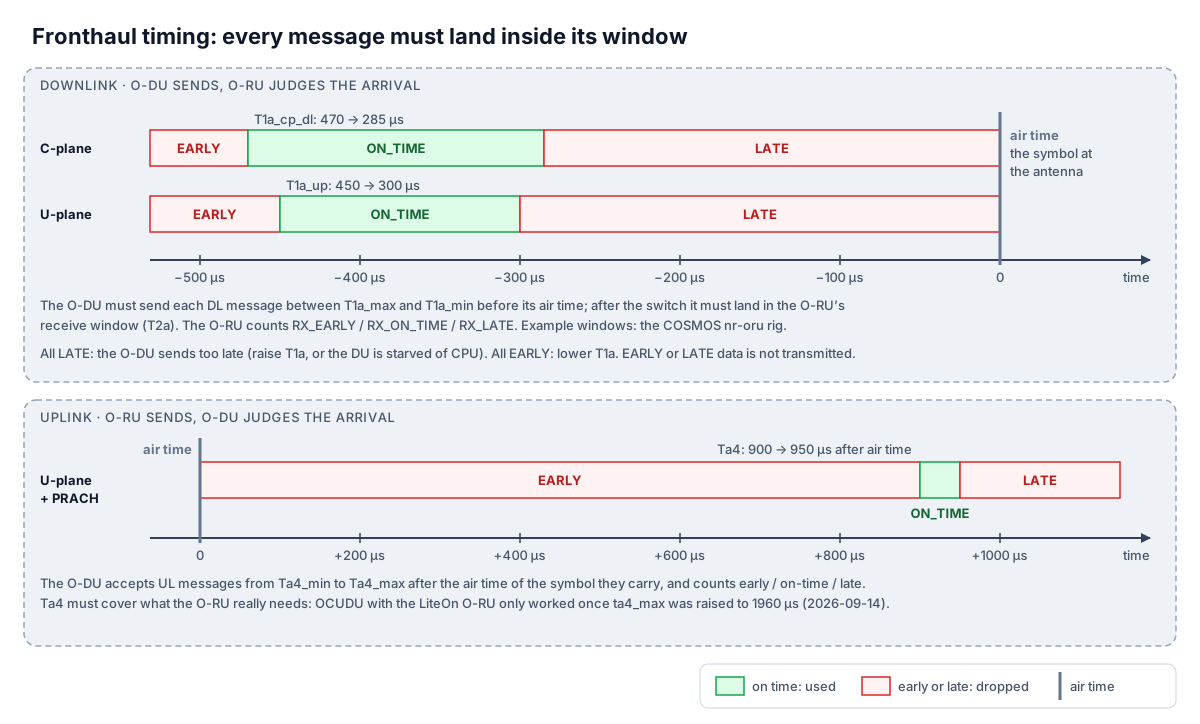
Figure — downlink C/U-plane packets must land inside the O-RU's receive window before air time; a T1a lead larger than the window puts every packet in the "early" zone, which is what the O-RU's early-error counters report.
- Host preparation. Both servers need per-host CPU isolation, SR-IOV virtual functions bound to
vfio-pci, hugepages and PTP. The bring-up scripts below do all of it except the isolation, which needs a reboot. Why each item exists is explained on Preparing a real-time host.
¶ Learning outcomes
- Bring up a Duranta O-DU + OAI CN5G on one server and the
nr-orusoft O-RU + USRP on another, connected by eCPRI over VLAN 4 with PTP (G.8275.1) on both ends. - Read the 7.2 fronthaul health on both sides: xran counters on the O-DU (
drop/ecpri/cp/up/pusch/prach errors), and the O-RU's packet-processor statistics and timing histograms. - Size a cell for a USRP O-RU (bandwidth vs sample rate) and match the O-RU and O-DU parameter pair (PRACH index, TDD pattern, eAxC, compression, timing windows).
- Diagnose the classic 7.2 failure modes: no C-plane, late/early U-plane, compression mismatch, wrong VLAN/MAC, dead RX gain, frame-counter offsets.
¶ At a glance
| Learning path | Optional, between Duranta over the air and Duranta with a commercial O-RU · Same step on the other platforms: 5G SA platforms overview |
| Difficulty | Advanced |
| Estimated time | 90–120 min |
| Domain / sandbox | osc (two E810 servers, one with a USB-3 B210, + node1.osc modem host). Alternative: sb1 with an N310 (packaged tutorial, verified 2026-11-21) |
| Topic group | Cellular (4G/5G/O-RAN) |
| Last verified | 2026-09-16 on osc (O-DU srv19.osc ↔ O-RU srv20.osc + its USB-3 B210, UE node1.osc), image duranta-20260916 + the nr-oru fix set (Duranta 2026.w37) — registration, PDU session and data plane all verified; 2026-11-21 on sb1 (O-DU srv1-lg1 ↔ O-RU srv2-lg1 + N310 sdr1-s1-lg1, UE sdr1-in3), packaged tutorial duranta-72-nroru on duranta-w44-20261120b (Duranta 2026.w44 + COSMOS patches, including the nr-oru fix set) — registration, PDU session and data plane verified |
| Upstream source | Duranta tag 2026.w37 (commit 1143f75) + the COSMOS patch set, including the nr-oru fixes (osc B210 run on image duranta-20260917, since retired; the fix set is in every later image). sb1 N310 run: tag 2026.w44, image duranta-w44-20261120b |
¶ Prerequisites
Background knowledge
- The Duranta soft-only tutorial (RFsim) — the same gNB and core, no radio.
- The Duranta over-the-air tutorial — the modem and USRP handling.
- O-RAN and the 7.2x fronthaul: C-plane/U-plane, eAxC ids, T1a/T2a windows, PTP S-plane, compression.
- Preparing a real-time host: CPU isolation, VFs, hugepages, PTP.
- Upstream doc: ORAN_FHI7.2_ORU_Tutorial.md.
Account & access
- A COSMOS account — register here.
- An approved reservation on osc for two E810 servers and the modem host — see Make a reservation.
- SSH access to
console.osc.cosmos-lab.org— see SSH access.
¶ Resources required
Devices / nodes (verified rig, osc)
| Resource | Role | Qty | Notes |
|---|---|---|---|
srv19.osc (O-DU host) |
O-DU (nr-softmodem + fhi_72) + OAI CN5G |
1 | Intel E810 DATA1a on the fronthaul VLAN 4; VFs 0000:12:01.0 / 0000:12:01.1, MACs 00:11:22:33:64:68/69 |
srv20.osc (O-RU host) |
soft O-RU (nr-oru) |
1 | E810 DATA1a on VLAN 4, VFs 0000:12:01.0 / 0000:12:01.1, MACs 00:11:22:33:64:66/67; local B210 on USB |
USRP B210 (serial 3080C7F) |
RF front end of the soft O-RU | 1 | must link at USB 3.0 (speed=5000Mbps in sysfs); 30.72 Msps |
node1.osc |
UE host (Quectel RM520N-GL, IMSI 001010000000033) |
1 | AT on /dev/ttyUSB2, QMI on /dev/cdc-wdm0 |
In the commands below, <o-du-node> is the O-DU host (srv19 on the verified rig) and <o-ru-node> the O-RU host (srv20).
Disk images
| Image | Load onto | Provides |
|---|---|---|
duranta.ndz (the newest promoted build; verified on duranta-w44-20261120b with the sb1 N310 tutorial on 2026-11-21; the osc B210 steps were last run on duranta-20260917) |
both servers | nr-softmodem (fhi_72/xran), nr-oru, OAI CN5G, /root/oru/ configs, bring-up scripts, cosmos-ofh-isolation |
(duranta.ndz is a symlink to the latest dated build. The node1 modem host keeps its own image.)
Software components
| Component | Version | Source |
|---|---|---|
Duranta nr-softmodem / nr-oru |
tag 2026.w37 + COSMOS patches (TA-alias guard, M-Plane get-xml/get-yang, the nr-oru fix set) |
/opt/duranta in the image |
| Intel xran (fhi_lib) | K release 11.1.6, DPDK 23.11 | built into the image |
| UHD | 4.9 | image |
linuxptp (ptp4l, phc2sys) |
image, G.8275.1 profile /etc/linuxptp/ptp4l-g8275.conf |
image |
| OAI CN5G | docker images in /opt/oai-cn5g |
image |
| O-DU / O-RU config pair | configs/nroru-b210/gnb-b210oru.conf + configs/nroru-b210/ru-b210.conf in oai/duranta-cosmos |
copied to /root/oru/ on each host (see Setup 6) |
Spectrum / RF / special
Band n78, 51 PRB / 20 MHz at 3550.08 MHz (SSB ARFCN 636672, pointA 636060), 30 kHz SCS, TDD DDDSU (2.5 ms). The B210 runs at 30.72 Msps; OAI's B200/B210 driver cannot run the 106-PRB / 61.44 Msps carrier of the upstream reference, which is why the cell is 51 PRB. Gains for a UE a few metres away: OAI_ORU_TX_GAIN=10 (79.75 dB actual) and OAI_ORU_RX_GAIN=114 (70 dB actual) — see "The three settings" below for what the knobs mean.
¶ Topology
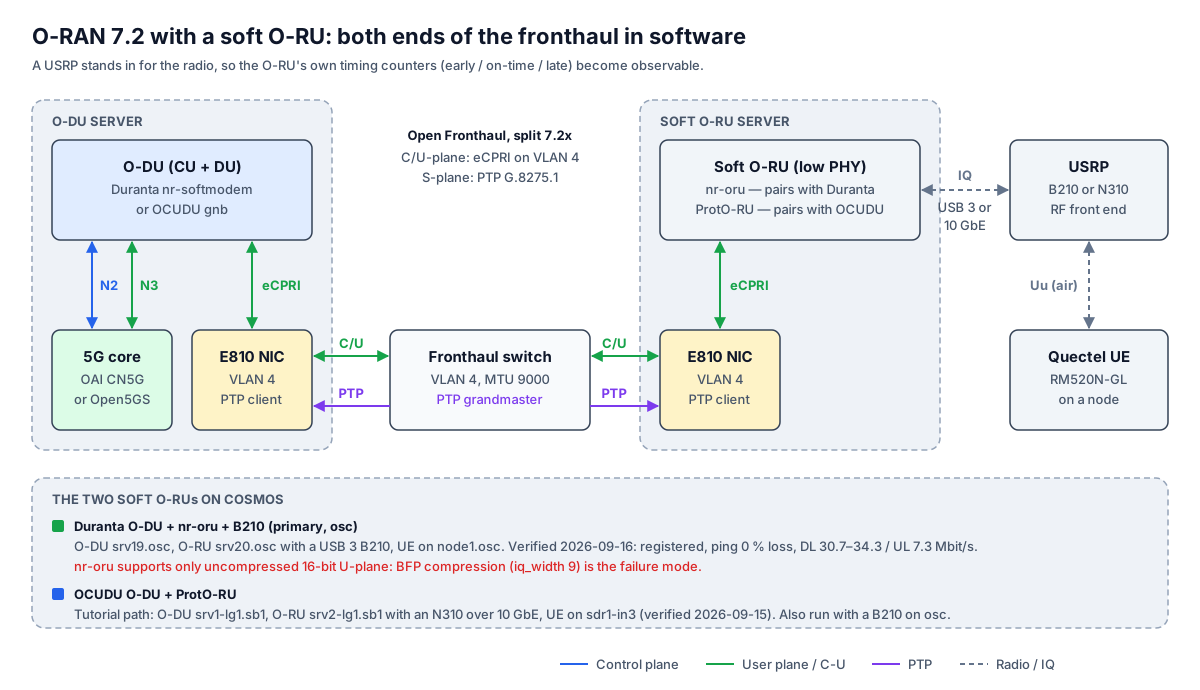
Figure — the soft O-RU rig: the O-DU server and the O-RU server are joined only by the fronthaul VLAN and the PTP time base; the USRP hangs off the O-RU server, so every sample that reaches the air has passed through nr-oru.
Walk through it plane by plane:
- Control plane of the network: the modem's NAS messages reach the gNB over the air and the O-RU, and the O-DU passes them over N2 to the AMF container on the same server — unchanged from step 2.
- Fronthaul (C-plane and U-plane): two SR-IOV virtual functions on each server's E810 port, bound to
vfio-pci, tagged VLAN 4. The O-DU addresses the O-RU VF MACs (00:11:22:33:64:66/67); the O-RU addresses the O-DU VF MACs (00:11:22:33:64:68/69). - S-plane:
ptp4lon each server locks the E810's clock to the fabric grandmaster (G.8275.1 profile);phc2syssteers the system clock from it. - Radio path:
nr-oruturns frequency-domain IQ into time-domain samples and writes them to the B210 over USB 3.0; the reverse in the uplink. - User plane: modem → air → B210 →
nr-oru→ fronthaul → O-DU → GTP-U (N3) → UPF →oai-ext-dn→ internet. - Management of the hosts: both servers from
console.oscover their control interfaces.
¶ Setup
These steps image both servers, give each a per-host CPU isolation set (which needs a reboot), and put the verified config pair on the hosts.
- Reserve the resources (see Prerequisites) and log into the console:
ssh <username>@console.osc.cosmos-lab.org - Make sure the two servers are off before imaging (never
omf tellthe modem host — it has its own power policy; leave it as it is):omf tell -a offh -t <o-du-node>,<o-ru-node> - Load the Duranta image on both servers.
-r 0expands the root partition to the full disk; without it the build tree and PTP logs can fill a small partition:omf load -i duranta.ndz -t <o-du-node>,<o-ru-node> -r 0 -o 2400 -b 600 - Turn them on and confirm — the power-on after a load is sometimes dropped, so check
omf statand repeat theonif needed:omf tell -a on -t <o-du-node>,<o-ru-node> sleep 30; omf stat -t <o-du-node>,<o-ru-node> - Apply per-host CPU isolation on both servers and reboot them. The image deliberately ships no
isolcpus;cosmos-ofh-isolationderives the right set from each host's NUMA and NIC layout and writes it into GRUB. This is needed once after everyomf load; the command and its output are explained under Command 1 —cosmos-ofh-isolation:
Wait ~2 min, thenfor h in <o-du-node> <o-ru-node>; do ssh root@$h 'cosmos-ofh-isolation --apply && systemctl reboot'; donessh root@<o-du-node> 'grep -o "isolcpus=[^ ]*" /proc/cmdline'should print the host's set. On srv19.osc it is3-11,27-35; the bring-up scripts and the config pair assume cores 3–11 are isolated. - Copy the verified config pair to the hosts:
configs/nroru-b210/gnb-b210oru.conffrom theoai/duranta-cosmosrepo to/root/oru/on the O-DU host, andconfigs/nroru-b210/ru-b210.confto/root/oru/on the O-RU host (withscp). These carry the uncompressed and reference-timing values. The image'snr-orucarries the COSMOS fix set (frame-counter anchoring after the USRP's start-up backlog, dropping pre-anchor downlink symbols at start, the USRPget_timestamphook gated byOAI_ORU_DEV_TS, and applying the RX gain), so no rebuild is needed. - Confirm that the B210 links at USB 3.0 on the O-RU host. At USB 2.0 the 30.72 Msps stream overflows (UHD prints
Operating over USB 2); a host power cycle does not change the link speed — reseat or replace the cable.
¶ Instructions
¶ The three settings that decide whether this works
nr-oru is not a drop-in for a vendor O-RU: it accepts only an uncompressed U-plane, and its timing
windows are its own. With these wrong the cell can still radiate and the UE camp and reach Msg3, but every
Msg3 fails to decode.
| Where | Setting | Value | Why |
|---|---|---|---|
O-DU fhi_72.fh_config.[0] |
iq_width, iq_width_prach |
16 | nr-oru supports uncompressed IQ only (upstream doc/ORAN_FHI7.2_ORU_Tutorial.md §7.5). With BFP-9 the O-DU decompresses the O-RU's uncompressed uplink as if it were BFP — pure noise |
O-RU fronthaul |
comp_type |
"none" |
the matching half of the same rule |
O-DU fhi_72.fh_config.[0] |
T1a_cp_dl / T1a_cp_ul / T1a_up / Ta4 |
(285,470) / (285,429) / (300,450) / (900,950) | the upstream reference pair (gnb.band77.mu1.106rb.fhi.1x1.conf). A larger lead (for example T1a up to 2400 µs) falls outside the O-RU's T2a window, so every DL packet is discarded and nothing reaches the air |
Gains for a UE a few metres away: OAI_ORU_TX_GAIN=10 (→ 79.75 dB actual — the knob is an attenuation
from the B210's 89.75 dB maximum) and OAI_ORU_RX_GAIN=114 (→ 70 dB actual — this one passes through a
~44 dB offset). oru-bringup.sh exports both to nr-oru; its built-in defaults (60 and 30) are not
the B210 values, so pass the B210 values explicitly (Step 3).
This experiment has two hosts, PTP, DPDK VFs and a radio to sequence; there is no useful command-by-command block beyond the two bring-up scripts, which are themselves the manual path. There is no Ansible mode for this modality.
¶ Step 1 — O-DU and O-RU configuration
The O-DU and O-RU each have their own configuration file, and a 7.2 link only works when the two agree on the carrier, PRACH, TDD pattern, fronthaul addressing, compression and timing. The verified pair is gnb-b210oru.conf (O-DU) and ru-b210.conf (O-RU). They are derived from the upstream reference pair gnb.sa.band77.106prb.fhi72.1x1-oru.conf / ru.sa.band77.106prb.fhi72.1x1-oru.conf, resized to 51 PRB because a USRP O-RU cannot run the 106-PRB / 61.44 Msps carrier of the reference on a B210, and the 20 MHz cell keeps the O-RU CPU budget comfortable. The parts that must agree on both sides, as they stand in the two files:
| parameter | O-DU (gnb-b210oru.conf) |
O-RU (ru-b210.conf) |
|---|---|---|
| carrier | SSB 636672 / pointA 636060, 51 PRB, band 78 | carrier_tx/rx = [3550080] kHz, tx_bw/rx_bw = [51] |
| PRACH | prach_ConfigurationIndex = 157 (format B4, the only one nr-oru supports) |
prach_config_index = 157, prach_eaxc_offset = 1, prach_kbar = 4 |
| TDD | period 5, 3 DL / 1 UL slots, 6/0 symbols (nrofDownlinkSymbols = 6, nrofUplinkSymbols = 0) |
tdd_period 5, num_dl_slots 3, num_ul_slots 1, num_dl_symbols 6, num_ul_symbols 0 |
| fronthaul | dpdk_devices = ("0000:12:01.0", "0000:12:01.1"), ru_addr = 64:66/67, iq_width = 16, iq_width_prach = 16, comp_hdr_type = "dynamic", kbar = 4 |
dpdk_devices = ("0000:12:01.0", "0000:12:01.1"), du_mac_addr = 64:68/69, comp_type = "none" |
| timing | T1a_cp_dl = (285, 470), T1a_cp_ul = (285, 429), T1a_up = (300, 450), Ta4 = (900, 950) |
T2a_up = (300, 1200), T2a_cp = (285, 1200) |
| cores (isolated set) | xran system 3 / io 5 / worker 7; L1 rx 8 / tx 10; ru_thread_core 6 |
rx_core 5, north_cores (4), south_core 7, ul_worker_cores (6, 8), tx_core 9, tp_cores [10,11] |
| radio | — | sdr_addrs = "type=b200,master_clock_rate=30.72e6,num_send_frames=256,num_recv_frames=256" |
Two libconfig rules for the O-RU file: the O-RU's core lists must be written as lists ( … ), not arrays [ … ]; and the O-RU reads the numerology key as mu, while the shipped reference file still says numerology.
Two O-DU keys look like radio settings but only matter to a time-domain radio: tx_amp_backoff_dB = 36 (DL attenuation that the 7.2 path ignores) and phase_compensation = 0 (the soft O-RU rotates in its own IFFT). Leave them as they are for 7.2; reset them only if you feed this cell config to RFsim.
The PCI addresses and the
DATA1ainterface name belong to the osc servers. On any other host check the E810 PF withbasename $(readlink /sys/class/net/<pf>/device)and editdpdk_devicesin both files; the VFs appear as…:01.0/…:01.1after the bring-up creates them.
¶ Step 2 — bring up the O-DU
The O-DU goes first: it brings the core up, starts transmitting downlink C/U-plane towards the O-RU MACs and then waits for uplink. The script stops any running DU, sets the performance governor, selects the static fronthaul library, creates the two VFs (MAC set after the vfio bind — the bind wipes it), pins all NIC IRQs off the isolated cores (otherwise the PF stalls), mounts 2 MB hugepages, starts ptp4l/phc2sys (step once, then slew), brings up OAI CN5G with the AMF address rewritten into the conf, and launches the DU with /root/oru/gnb-b210oru.conf. Each host-preparation item (VFs and vfio-pci, IRQ pinning, hugepages, PTP step-then-slew) is explained on Real-time host preparation.
ssh root@<o-du-node> 'bash /root/du-oru-bringup.sh'
Expected tail:
=== [4] PTP: step ONCE, then slew ===
  stepped: |offset| = 69 ns after 5s
  slewing: |offset| = 48 ns
=== [7] core ===
  AMF OK
=== [8] launch DU (O-DU for nr-oru) ===
  DU-ALIVE
=== [9] verify ===
  NGSetupResponse
  in service
  fronthaul: [o_du0][drop errors 0 ecpri errors 0 cp errors 0 up errors 0 pusch errors 0 prach errors 0]
===== DU-ORU-BRINGUP-DONE =====
What to look for: PTP offsets in the tens of nanoseconds (the S-plane is locked), NGSetupResponse and in service (the O-DU is associated with the AMF and its cell is configured), and all six o_du0 error counters at 0. [o-du 0][rx 0 pps …] in /tmp/du_oru.log is normal until the O-RU is up — nothing is sending uplink yet.
¶ Step 3 — bring up the soft O-RU
The O-RU host gets the same host preparation as the O-DU (VFs with the O-RU MACs, IRQ pinning, hugepages, PTP). The script then waits for the USRP to be unclaimed, launches nr-oru with the configuration named by CONF, and checks that uplink U-plane actually flows within 60 s, restarting the O-RU once if not. On the B210 rig pass the B210 configuration and gains; the script's defaults are the N310 file and N310-era gains:
ssh root@<o-ru-node> 'CONF=/root/oru/ru-b210.conf OAI_ORU_TX_GAIN=10 OAI_ORU_RX_GAIN=114 bash /root/oru-bringup.sh'
What to look for: RU-ALIVE (the process survived its first 45 s), usrp: lines reporting the B210 at 30.72 Msps, UL live: U-plane sent <n> with a non-zero count, and ORU-BRINGUP-DONE. The [10] UL-LIVENESS check comes after the DONE marker — wait for it. An example of the full tail from the N310 rig is in the alternative section.
¶ Step 4 — check the fronthaul on both ends
With both ends running, the fronthaul counters show whether packets arrive and whether they arrive inside their windows. Read both sides: a clean O-DU and a noisy O-RU (or the reverse) points at the direction of the problem.
O-DU side (every second in /tmp/du_oru.log):
ssh root@<o-du-node> 'grep -a "o-du 0\]\[rx" /tmp/du_oru.log | tail -1; grep -a "o_du0\]\[drop" /tmp/du_oru.log | tail -1'
[o-du 0][rx 1145688 pps 21504 kbps 86688][tx 1912379 pps 31872 kbps 225022][Total Msgs_Rcvd 1145688]
[o_du0][drop errors 0 ecpri errors 0 cp errors 0 up errors 0 pusch errors 0 prach errors 0]
What to look for: a steady non-zero rx … pps (uplink U-plane arriving from the O-RU) and every error counter at 0.
O-RU side — the packet-processor statistics are printed every 256 frames in /root/nr-oru.log (a COSMOS addition; upstream prints them only at exit):
ssh root@<o-ru-node> 'grep -aE "Total C-Plane|U-Plane Packets sent|Timing (Early|Late)|Application Too Slow|DL U-Plane \(mean" /root/nr-oru.log | tail -7'
Total C-Plane Packets received: 700822 (DL: 448525, UL: 224264, PRACH: 28033, Other: 0)
Total U-Plane Packets sent: 2326530
C-Plane Timing Early Errors: 945      C-Plane Timing Late Errors: 31
U-Plane Timing Early Errors: 984      U-Plane Timing Late Errors: 59738
Application Too Slow Errors: 223185
DL U-Plane (mean: 61.00 symbols) window [114, 8]: >=+31:49152
What to look for: read the counters as deltas between two prints. The early/late and "Too Slow" counters must stop growing after start-up (a few thousand at start are the pre-anchor backlog); the DL U-plane histogram must sit inside the [T2a_max, T2a_min] window. The O-RU's self-diagnosis report (OVERALL STATUS: PASS, DL/UL symbol processing time and safety margin) appears in the same log.
¶ Step 5 — attach the UE
The modem helper from the over-the-air bundle puts the Quectel into SA mode with a band mask that includes n78, sets the APN oai, locks PLMN 00101 and waits for registration. The general procedure and recovery steps are on COTS UE: the Quectel RM520N-GL.
ssh root@node1.osc 'systemctl stop ModemManager
python3 /root/duranta-ota_modem.py configure /dev/ttyUSB2 00101 77:78 oai
python3 /root/duranta-ota_modem.py wait-reg /dev/ttyUSB2 240 00101'
+QENG: "servingcell","NOCONN","NR5G-SA","TDD",001,01,000000003,3,1,636672,78,3,-91,-10,18,1,-
REGISTERED
What to look for: NR5G-SA on cell id 3 / PCI 3, ARFCN 636672, band 78, RSRP −91 and SINR 18 in the serving-cell line, then REGISTERED. Registration succeeding means Msg3 decoded — the step that fails when compression is mismatched.
¶ Step 6 — data plane
Start the QMI data call and read the address the network assigned:
ssh root@node1.osc 'D=$(readlink -f /sys/class/tty/$(basename $(readlink -f /dev/quectel-at))/device/../..); QMI=/dev/$(ls $D/*/usbmisc); WWAN=$(ls $D/*/net); ip link set $WWAN down; echo Y > /sys/class/net/$WWAN/qmi/raw_ip; ip link set $WWAN up
qmicli -p -d $QMI --wds-start-network="apn=\'oai\',ip-type=4" --client-no-release-cid
qmicli -p -d $QMI --wds-get-current-settings | grep -E "IPv4 (address|gateway)"'
Add the address and per-target routes (never a default route via the modem — it black-holes the node's management SSH; see Routing without cutting off the node), then measure against the
oai-ext-dn container on the O-DU host:
UE IP 192.168.100.3 gw 192.168.100.4
ping local  10/10 received, 0 % loss, 22.7 ms      ping remote 10/10, 0 % loss, 23.8 ms
DL 30.7–34.3 Mbit/s      UL 7.3 Mbit/s
What to look for: an address in 192.168.100.0/22 and 0 % loss to both targets. The throughput is set by the 51 PRB, 1×1, DDDSU cell rather than by the fronthaul.
¶ Alternative: N310 on sb1 (packaged tutorial)
Verified 2026-11-21 with the packaged tutorial. A networked USRP N310 takes the B210's place as the soft O-RU's radio, on sb1: O-DU
srv1-lg1.sb1, O-RUsrv2-lg1.sb1driving the N310sdr1-s1-lg1, UE onsdr1-in3.sb1. The packagecosmos-experiments-durantaships the sb1 cell (band n41, 51 PRB, uncompressed U-plane, PCI 5) and its own O-DU / O-RU configuration pair, applies the CPU isolation, powers the N310 if needed, attaches the modem and measures traffic. The hand steps further down use the osc configuration pair and have not completed a registration on sb1: use the package.
ssh <username>@console.sb1.cosmos-lab.org
omf tell -a offh -t srv1-lg1,srv2-lg1
omf load -i duranta.ndz -t srv1-lg1,srv2-lg1 -r 0 -o 2400 -b 600
omf tell -a on -t srv1-lg1,srv2-lg1
export OMF_NODES=srv1-lg1,srv2-lg1,sdr1-in3        # O-DU server, O-RU server, UE node
cosmos-tutorial check duranta-72-nroru
cosmos-tutorial run duranta-72-nroru --mode manual
cosmos-tutorial run duranta-72-nroru --mode teardown
The end of the manual run on 2026-11-21 (15 min, duranta-w44-20261120b):
  "registered": true,
  "pci": 5,
  "band": 41,
  "rsrp_dbm": -83,
  "sinr_db": 19,
  "ue_ipv4": "192.168.100.2",
  "ping_loss_pct": 0.0,
  "ping_remote_loss_pct": 0.0,
  "dl_mbps": 35.4,
  "ul_mbps": 0.71,
  "oru_status": "PASS"
## duranta-72-nroru (manual) exit 0 - record: /home/<username>/cosmos-runs/duranta-72-nroru/sb1-20261121T161924Z-nsqgfe/run_record.json
What to look for: registered: true, an address in 192.168.100.0/22, 0 % loss to both targets and oru_status: PASS (no late or Too Slow growth on the O-RU during the traffic). The uplink is low on this radio (0.71 Mbit/s against 7.3 on the osc B210) and is under investigation.
The older hand-built sb1 route follows for reference.
Resources (sb1)
| Resource | Role | Qty | Notes |
|---|---|---|---|
srv1-lg1.sb1 |
O-DU (nr-softmodem + fhi_72) + OAI CN5G |
1 | Intel E810 (ens5f0, PCI 0000:86:00.0) on the fronthaul VLAN 4 |
srv2-lg1.sb1 |
soft O-RU (nr-oru) |
1 | E810 ens5f0 on VLAN 4 (eCPRI) + ens5f1 on the 10.39/16 data net to the N310 |
USRP N310 (e.g. sdr1-s1-lg1.sb1, sfp0 10.39.2.1) |
RF front end of the soft O-RU | 1 | 122.88 MHz master clock; RX on RX2, TX on TX/RX; 10 GbE, MTU 9000, frame size 7900 |
sdr1-in3.sb1 |
UE host (Quectel RM520N-GL, IMSI 001010000000032) |
1 | AT on /dev/ttyUSB2, QMI on /dev/cdc-wdm0 |
Topology (sb1)
 sdr1-in3.sb1 ───(air, n78)──► N310 (sdr1-s1-lg1)  ◄── 10 GbE (10.38/16, MTU 9000) ── srv2-lg1.sb1 : nr-oru (soft O-RU)
 Quectel …032                    TX/RX out, RX2 in                                              │  E810 VF pair, VLAN 4 (eCPRI C/U-plane), PTP slave
                                                                                                │
                                                                     fronthaul fabric (VLAN 4, G.8275.1 grandmaster)
                                                                                                │
                                                                                srv1-lg1.sb1 : nr-softmodem O-DU (fhi_72/xran, DPDK VF pair, PTP slave)
                                                                                               + OAI CN5G (docker, AMF/SMF/UPF) + NAT to the lab/internet
The fronthaul is the same as on osc; the radio differs. The O-RU host reaches the N310's SFP over the sb1 10 GbE data net (no gateway), so the O-RU host and the radio must be in the same domain: the osc↔sb1 data gateway cannot carry a 30.72 Msps IQ stream alongside other users' streams. Keep the O-RU's own TX leakage in mind: with the antennas 1 m apart the uplink noise floor rises ~10 dB while transmitting.
Setup (sb1). Follow the main Setup with console.sb1.cosmos-lab.org and these hosts. The sb1 commands are:
ssh <username>@console.sb1.cosmos-lab.org
omf tell -a offh -t srv1-lg1,srv2-lg1
omf load -i duranta.ndz -t srv1-lg1,srv2-lg1 -r 0 -o 2400 -b 600
omf tell -a on -t srv1-lg1,srv2-lg1
sleep 30; omf stat -t srv1-lg1,srv2-lg1
for h in srv1-lg1 srv2-lg1; do ssh root@$h 'cosmos-ofh-isolation --apply && systemctl reboot'; done
Never omf tell sdr1-in3 — it is a modem host with its own power policy. After the reboot, ssh root@srv1-lg1 'grep -o "isolcpus=[^ ]*" /proc/cmdline' prints the host's set (srv1-lg1: 7,9,…,23). Then power on the N310 and wait for its management port, then its SFP:
omf tell -a on -t sdr1-s1-lg1
ssh root@srv2-lg1 'for i in $(seq 1 30); do ping -c1 -W1 10.39.2.1 >/dev/null && break; sleep 5; done; uhd_find_devices --args addr=10.39.2.1'
Expected: serial: 3176DF5 … product: n310 … claimed: False.
Configuration (sb1). The O-RU file for the N310 is ru-n310.conf. It differs from ru-b210.conf in the radio (sdr_addrs = "addr=10.39.2.1,master_clock_rate=122.88e6,recv_frame_size=7900,send_frame_size=7900,num_recv_frames=64,num_send_frames=256"), in its receive windows (T2a_up = (300, 4000), T2a_cp = (285, 4000)) and in num_ul_symbols = 4. The repository copy carries comp_type = "bfp": set it to "none", and keep the O-DU at iq_width = 16 with the reference T1a/Ta4 windows — the three settings apply to every nr-oru radio. Check the PCI addresses against the host: ssh root@srv1-lg1 'basename $(readlink /sys/class/net/ens5f0/device)' (E810 PF); the VFs appear as …:01.0/…:01.1 (0000:86:01.0 / 0000:86:01.1 on these hosts) after the bring-up creates them. Edit dpdk_devices in both files if they differ, and replace PF=DATA1a at the top of both bring-up scripts with the sb1 interface name (ens5f0).
Bring-up (sb1). O-DU as in Step 2 (ssh root@srv1-lg1 'bash /root/du-oru-bringup.sh'), then the O-RU. oru-bringup.sh defaults to /root/oru/ru-n310.conf, and on the N310 the gain knobs mean something different from the B210: OAI_ORU_RX_GAIN is the USRP RX gain in dB (40 is right for the sb1 N310; 75 is beyond its range) and OAI_ORU_TX_GAIN is an attenuation from the maximum (65 dB on the N310), so 30 gives 35 dB, which covers a UE in the same room:
ssh root@srv2-lg1 'OAI_ORU_RX_GAIN=40 OAI_ORU_TX_GAIN=30 bash /root/oru-bringup.sh'
For a networked USRP the script also waits for the radio to be unclaimed (an MPM session from a previous run makes UHD fail with socket closed), re-applies the data route to the radio, and restarts the O-RU once if its RX stream comes up dead (the UL-liveness check). Expected tail:
=== [8] launch nr-oru (soft O-RU on the N310) ===
  RU-ALIVE
=== [9] verify ===
  usrp: Actual master clock: 122.880000MHz
  usrp: Actual RX sample rate: 30.720000MSps
  usrp: Actual TX sample rate: 30.720000MSps
=== [10] UL-LIVENESS ===
  UL live: U-plane sent 23188
===== ORU-BRINGUP-DONE =====
Steps 4–6 are the same, with srv1-lg1 / srv2-lg1 in place of the osc hosts and the modem on sdr1-in3.
Cleanup (sb1) — as in the main Cleanup below, with the stop_exe helper defined on each server:
ssh root@srv2-lg1
stop_exe /opt/duranta/cmake_targets/ran_build/build/nr-oru
stop_exe /usr/sbin/ptp4l; stop_exe /usr/sbin/phc2sys
ssh root@srv1-lg1
stop_exe /opt/duranta/cmake_targets/ran_build/build/nr-softmodem
stop_exe /usr/sbin/ptp4l; stop_exe /usr/sbin/phc2sys
cd /opt/oai-cn5g/oai-cn5g-fed/docker-compose && docker compose -f docker-compose-basic-nrf.yaml down
ssh root@sdr1-in3 'systemctl start ModemManager'
omf tell -a offh -t srv1-lg1,srv2-lg1        # leave the N310 and sdr1-in3 powered on
¶ Verification
| Check | Where / command | Expected |
|---|---|---|
| O-DU associated and on air | /tmp/du_oru.log on the O-DU host |
NGSetupResponse, cell … is in service |
| Fronthaul uplink, O-DU side | grep -a "o-du 0\]\[rx" /tmp/du_oru.log |
[o-du 0][rx N pps 21504] with all six o_du0 error counters at 0 |
| O-RU alive and sending | /root/nr-oru.log on the O-RU host |
RU-ALIVE, Total U-Plane Packets sent increasing, timing-error counters flat, OVERALL STATUS: PASS |
| UE camps on the cell | AT+QENG="servingcell" |
NR5G-SA on cell id 3 / PCI 3 (…,000000003,3,…) with RSRP ≈ −91 and SINR ≈ 18; the O-DU logs Initiating RA procedure on each attempt |
| UE registered | AT+C5GREG? / the modem helper |
+C5GREG: 0,1 / REGISTERED; the O-DU logs UE RNTI … in-sync PH 38 dB PCMAX 23 dBm |
| Data plane | ping and iperf3 against oai-ext-dn |
PDU session address on wwan0, 0 % ping loss to the ext-DN and to 8.8.8.8, iperf3 receiver lines DL 30.7–34.3 / UL 7.3 Mbit/s (51 PRB, 1×1, DDDSU) |
Measured results (iperf3 receiver lines, Quectel RM520N-GL on node1.osc, band n78, 51 PRB / 20 MHz, 1×1, DDDSU):
| CPU platform (O-DU host) | O-RU radio | DL (Mbit/s) | UL (Mbit/s) | Ping (local / internet) | Measured |
|---|---|---|---|---|---|
2× Intel Xeon Gold 6126, 24 cores / 48 threads (srv19.osc) |
nr-oru on srv20.osc + USRP B210 (USB 3.0) |
30.7–34.3 | 7.3 | 22.7 / 23.8 ms | 2026-09-16 · duranta-20260916 + nr-oru fix set |
2× Intel Xeon Gold 6226, 24 cores / 24 threads (srv1-lg1.sb1) |
nr-oru on srv2-lg1.sb1 + USRP N310 (n41, 51 PRB) |
35.4 | 0.71 | 24.3 / 26.0 ms | 2026-11-21 · duranta-w44-20261120b, packaged tutorial |
| 1× AMD EPYC 9355P | — | not measured | not measured | — | — |
¶ Cleanup
Stop the O-RU, then the O-DU and core, give the modem back to ModemManager, and power the servers off. The bring-up scripts launch nr-oru, nr-softmodem, ptp4l and phc2sys each with setsid, so stop each one as a process group identified by its executable — never with pkill -x or pkill -f, which match by name or command line and can hit another user's process or your own shell. Define this helper in your shell on each server you log into:
stop_exe() {   # signal the process GROUP of every process executing exactly $1 (default TERM)
  local exe sig=${2:-TERM} d st pgid
  exe=$(readlink -f "$1")
  for d in /proc/[0-9]*; do
    [ "$(readlink "$d/exe" 2>/dev/null)" = "$exe" ] || continue
    st=$(cat "$d/stat" 2>/dev/null) || continue
    st=${st##*) }                            # drop "pid (comm) ", safe for any comm
    pgid=$(echo "$st" | awk '{print $3}')    # remaining fields: state ppid pgrp
    kill -"$sig" -- "-$pgid" 2>/dev/null
  done
}
The function identifies a process by the binary it is executing (/proc/<pid>/exe), which a command line cannot fake, and signals its whole process group. It sends TERM first; if something is still running after a few seconds, repeat the call with KILL as the second argument.
On the O-RU host, then on the O-DU host:
ssh root@<o-ru-node>
stop_exe /opt/duranta/cmake_targets/ran_build/build/nr-oru
stop_exe /usr/sbin/ptp4l; stop_exe /usr/sbin/phc2sys
ssh root@<o-du-node>
stop_exe /opt/duranta/cmake_targets/ran_build/build/nr-softmodem
stop_exe /usr/sbin/ptp4l; stop_exe /usr/sbin/phc2sys
cd /opt/oai-cn5g/oai-cn5g-fed/docker-compose && docker compose -f docker-compose-basic-nrf.yaml down
Then give the modem back and power the servers off:
ssh root@node1.osc 'systemctl start ModemManager'
omf tell -a offh -t <o-du-node>,<o-ru-node>        # leave the modem host powered on
¶ Troubleshooting
| Symptom | Cause | Fix |
|---|---|---|
Msg3 never decodes (RA failed at state WAIT_Msg3) while PRACH and RAR work |
the O-DU compresses (BFP-9) but nr-oru only does uncompressed |
set iq_width/iq_width_prach to 16 on the O-DU and comp_type = "none" on the O-RU |
Cell never radiates; O-RU reports hundreds of thousands of U-Plane Timing Early Errors |
the O-DU's T1a lead is outside the O-RU's T2a window |
use the upstream reference windows above; check the O-RU's DL C-Plane/DL U-Plane means land inside its printed window |
| UE sees the cell at RSRP ≈ −111 with SINR ≈ 3 | OAI_ORU_TX_GAIN raised instead of lowered — it is an attenuation |
lower the value (10 ≈ 79.75 dB actual) |
| O-RU's UL floor looks like noise and Msg3 has no SNR | OAI_ORU_RX_GAIN is not the actual gain (≈ 44 dB offset): 50 gives 6 dB |
use 114 for ≈ 70 dB actual; check Actual RX gain in /root/nr-oru.log |
nr-oru: Assertion (num_dpdk_devices > 0 …) at start |
the script launched with the wrong -O conf (e.g. the DU's) |
check CONF= (default at the top of oru-bringup.sh); the O-RU conf is ru-b210.conf (B210) or ru-n310.conf (N310) |
O-DU rx 0 pps, O-RU PRACH UP: Missing C-Plane forever |
DU frames go to another RU's MAC (wrong conf) or wrong VLAN | tcpdump on the O-RU VF (re-bind one VF to iavf briefly): the destination MAC must be the O-RU VF MAC; both VFs vlan 4 |
UHD Operating over USB 2 (B210) → ERROR_CODE_OVERFLOW at 30.72 Msps |
the B210 linked at USB 2.0 | reseat/replace the USB-3 cable; a host power cycle does not help |
IOError: socket closed or Timed out getting recv buff for management transaction at start |
N310 still claimed by the previous instance, or the data route to the radio went via the 1 GbE control path | wait for uhd_find_devices … claimed: False; sdr_net_setup <addr> (route via the 10 GbE data NIC, MTU 9000) — both are in the bring-up |
nr_symbol_fep_ul / get_freq_range_from_freq assertions |
carrier not on the CLI (Duranta ≥ 2026.w36 soft UE/RU) | pass -C/-r/--band/--ssb as the gNB log's "Command line parameters for OAI UE" line says |
| Other users' USRP streams show underflows when the O-RU starts | the O-RU's IQ stream crossed the osc↔sb1 data gateway | keep O-RU host and radio in the same domain (main rig: both osc; alternative: both sb1) |
¶ References
On this wiki
- O-RAN and the 7.2x fronthaul — planes, eAxC, compression, timing windows.
- Preparing a real-time host — isolation, VFs, hugepages, PTP.
- COTS UE: the Quectel RM520N-GL · OAI CN5G · Duranta overview.
- Related tutorials: Duranta soft-only (RFsim) · Duranta over-the-air (USRP + modem) · Duranta with a commercial O-RU · 5G SA platforms overview.
- SDR hardware · OMF commands · Reservations.
- COSMOS configs, scripts and patches: GitLab
oai/duranta-cosmos,configs/nroru-b210/(README = the runbook).
External
- Duranta — project page lfnetworking.org/projects/duranta · source github.com/duranta-project/openairinterface5g · upstream soft O-RU doc ORAN_FHI7.2_ORU_Tutorial.md (§7.5: uncompressed U-plane only).
- OAI 7.2 fronthaul tutorial (O-DU side) — gitlab.eurecom.fr/…/ORAN_FHI7.2_Tutorial.md.
- O-RAN ALLIANCE specifications (Open Fronthaul CUS-plane) — specifications.o-ran.org.
- linuxptp — linuxptp.sourceforge.net · DPDK guides — doc.dpdk.org/guides.
- Ettus USRP — ettus.com · UHD manual files.ettus.com/manual.
Author(s): COSMOS team · Last verified: 2026-11-21 (sb1 N310 packaged tutorial: registration + PDU + data plane) and 2026-09-16 (osc B210 rig) · Tested image/release: duranta-w44-20261120b (Duranta tag 2026.w44 + COSMOS patches) for the N310 tutorial; duranta-20260916 + the nr-oru fix set (tag 2026.w37) for the B210 rig · Tags: duranta, oai, oran, 7.2, fronthaul, nr-oru, soft-oru, usrp, b210, n310, xran, dpdk, 5g, sa