¶ O-RAN architecture and the 7.2x fronthaul
O-RAN breaks the monolithic base station into separately sourced pieces joined by open
interfaces, so a radio from one vendor can be driven by baseband software from another. This page
explains why that is done, names the parts and interfaces, and then goes deep on the one interface
where COSMOS work concentrates: the 7.2x fronthaul between the distributed unit and the radio
unit. Read it after 5G SA fundamentals
and before any O-RAN 7.2 tutorial.
¶ Why this matters
COSMOS runs O-RAN for real: commercial O-RUs from several vendors, open and commercial O-DU stacks,
and software O-RUs. The 7.2x boundary between O-DU and O-RU is where multi-vendor interoperability is
tested. Both sides must agree on stream identifiers, compression, timing windows and management mode,
and a disagreement often leaves every fronthaul counter clean. The concepts on this page (planes,
eAxC, compression, timing windows, management modes, the golden O-RU rule) are the vocabulary the 7.2
tutorials assume.
¶ Why disaggregate the RAN
A classic base station is one vendor's box: radio, baseband processing and control software, joined
by proprietary internal interfaces. An operator who buys it cannot replace the software without
replacing the radio, and a researcher cannot inspect or modify what runs inside.
O-RAN, specified by the O-RAN ALLIANCE, keeps the 3GPP gNB functions (see the
protocol stack) but requires the
boundaries between them to be open, published interfaces. Three consequences follow:
- Multi-vendor RANs. A radio unit from one vendor can be driven by a distributed unit from
another. On COSMOS, the same Benetel, LiteOn and Foxconn radios are driven by both OCUDU (srsRAN)
and Duranta (OAI). - Software on general-purpose servers. The baseband runs on ordinary x86 servers with Ethernet
NICs rather than on custom hardware. This is what makes an open-source O-DU possible, and it is
also why real-time host preparation
matters. - Programmability. New control points, the RAN Intelligent Controllers, can observe and steer the
RAN through standard interfaces without being part of any vendor's software.
The price is that every interface that is internal to a monolithic base station must be configured
consistently on two sides, often by two pieces of software that were not developed together.
¶ Components and interfaces
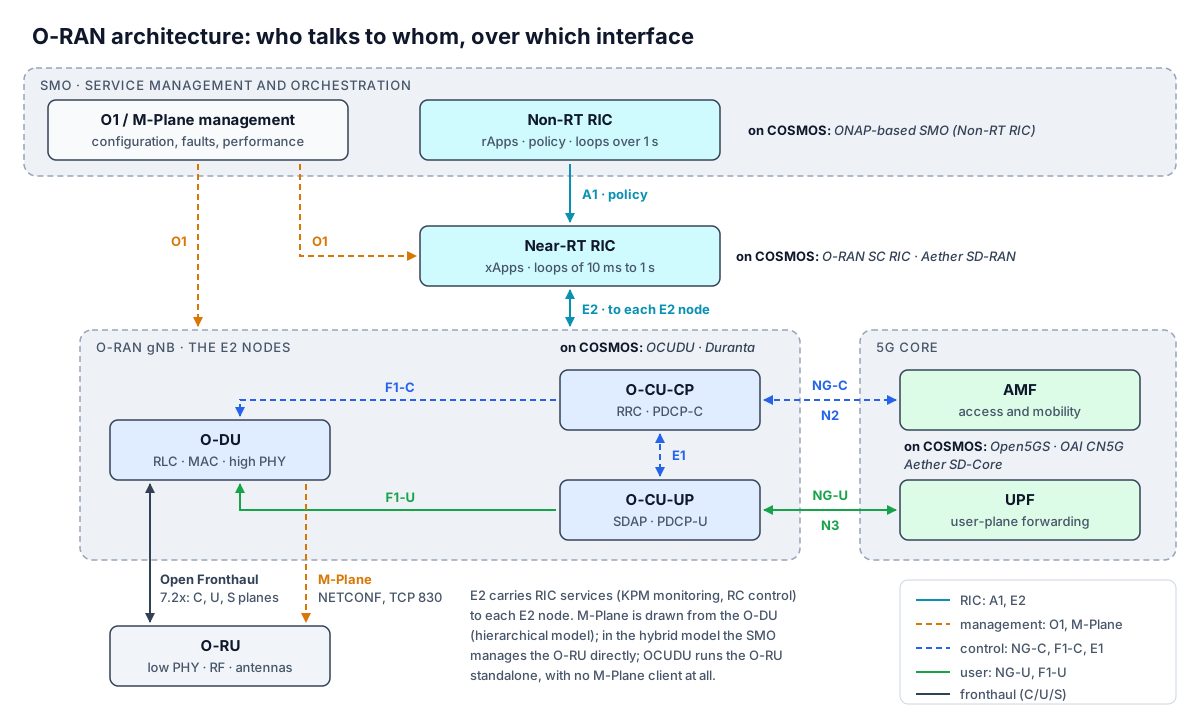
Figure — The O-RAN components and their interfaces. The O-DU ↔ O-RU link (Open Fronthaul, 7.2x) is the one the COSMOS 7.2 tutorials exercise; E2 is the RIC's view into the RAN.
| Piece | What it does | On COSMOS |
|---|---|---|
| O-RU — O-RAN Radio Unit | Low PHY + RF. Converts frequency-domain IQ to radio and back. | Commercial: Benetel RAN650, LiteOn FlexFi, Foxconn RPQN-7801. Software: OAI nr-oru, ProtO-RU. |
| O-DU — O-RAN Distributed Unit | High PHY, MAC, RLC. Drives the fronthaul. | OCUDU (srsRAN) and Duranta (OAI). |
| O-CU — O-RAN Central Unit (O-CU-CP for control, O-CU-UP for user plane) | PDCP, RRC, SDAP; talks N2/N3 to the core. | Same two stacks; usually run combined with the O-DU. |
| near-RT RIC — near-real-time RAN Intelligent Controller | Closed-loop control on 10 ms–1 s timescales, over E2. | Running on COSMOS — see Near-RT RIC and the E2/KPM tutorial. Monitoring works (SD-RAN and FlexRIC); control is not supported by the OCUDU build. |
| non-RT RIC / SMO — non-real-time RIC / Service Management and Orchestration | Policy, orchestration, > 1 s loops, over A1/O1. | O-RAN SMO on COSMOS · O-RAN/ONAP deployment. |
The interfaces between them:
| Interface | Between | Carries | Defined by |
|---|---|---|---|
| Open Fronthaul (7.2x) | O-DU ↔ O-RU | IQ samples, per-slot control, timing, management | O-RAN WG4 |
| F1 (F1-C, F1-U) | O-CU ↔ O-DU | RRC and user data between PDCP and RLC | 3GPP TS 38.47x |
| E1 | O-CU-CP ↔ O-CU-UP | bearer setup between the CU's control and user parts | 3GPP TS 38.46x |
| NG (N2, N3) | O-CU ↔ 5G core | control (NGAP) and user data (GTP-U) | 3GPP |
| E2 | near-RT RIC ↔ O-CU/O-DU (the "E2 nodes") | measurements up, control requests down | O-RAN WG3 |
| A1 | non-RT RIC ↔ near-RT RIC | policies and enrichment information | O-RAN WG2 |
| O1 | SMO ↔ all managed elements | configuration, fault and performance management | O-RAN WG10 |
On COSMOS the O-CU and O-DU normally run as one process (gnb or nr-softmodem), so F1 and E1 exist
inside the software but not on the wire. The Open Fronthaul, by contrast, is a real Ethernet network
between two machines, and it is what the rest of this page is about.
¶ Functional split options, and why 7.2x
3GPP studied eight numbered places where a base station could be cut into a central and a remote
part. The choice trades fronthaul bandwidth and latency against how much processing the remote radio
must do.
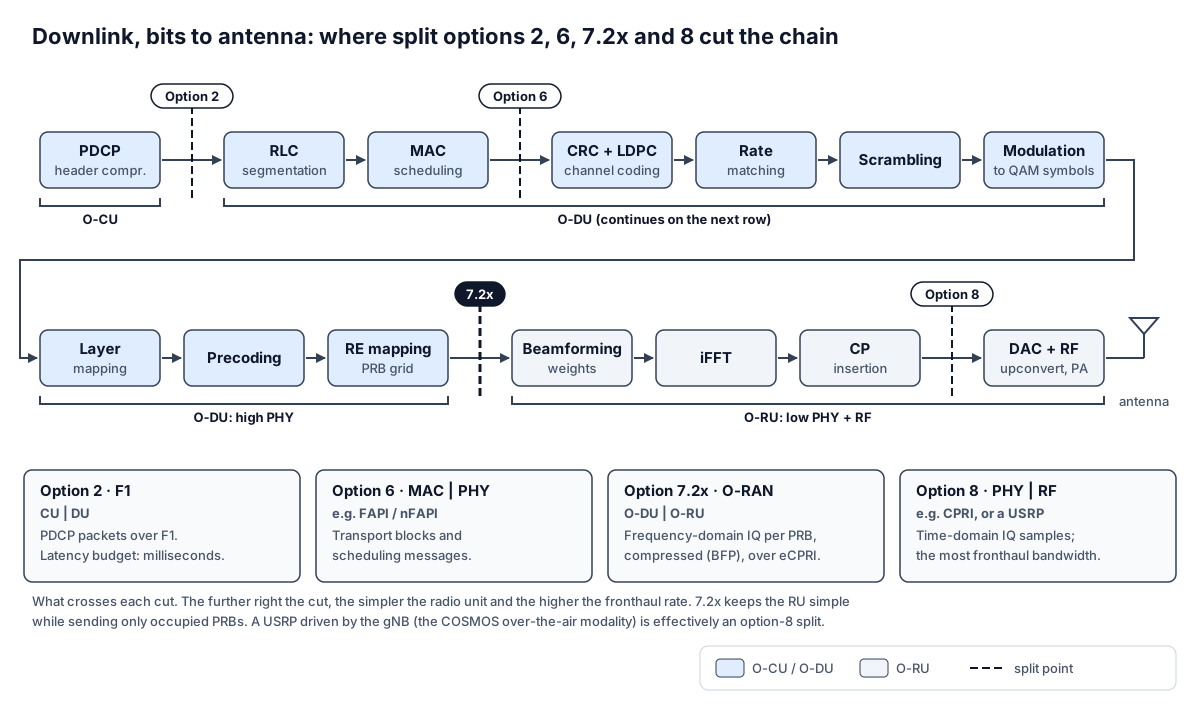
Figure — The downlink physical-layer chain from bits to antenna, with split points 2, 6, 7.2x and 8. In 7.2x the O-DU keeps coding, modulation and layer mapping; the O-RU does the inverse FFT, cyclic prefix and RF.
| Split | Cut between | What crosses the link | Consequence |
|---|---|---|---|
| 2 | PDCP ↔ RLC | packets | Low bandwidth, relaxed latency. This is the 3GPP CU/DU split (F1). |
| 6 | MAC ↔ PHY | transport blocks | The radio unit needs the whole PHY, so it is expensive and hard to upgrade. |
| 7.2x | inside the PHY: after precoding / resource-element mapping, before the inverse FFT | frequency-domain IQ for the occupied subcarriers only | The O-RAN choice: moderate bandwidth that scales with load and layers; a simple O-RU. |
| 8 | PHY ↔ RF | time-domain IQ samples | The simplest radio, but a constant, very high bit rate regardless of traffic (the CPRI model). |
A worked example shows the difference. A 100 MHz, 30 kHz carrier has 273 PRBs = 3,276 subcarriers
and 28,000 OFDM symbols per second. At 16-bit I and 16-bit Q, the 7.2x U-plane for one antenna stream
at full load is about 3,276 × 28,000 × 32 bit ≈ 2.9 Gbit/s, and less when PRBs are empty, because only
occupied resource elements are sent. A split-8 link for the same carrier must carry the full
122.88 Msps sample stream (≈ 3.9 Gbit/s per antenna at 16+16 bits) all the time, busy or idle.
Four antennas and compression change these numbers, but the scaling is the point: 7.2x fronthaul
fits on commodity 10 and 25 Gbit/s Ethernet.
The "x" in 7.2x refers to O-RAN's two O-RU categories. A Category A O-RU receives
already-precoded data and does no precoding itself; a Category B O-RU performs precoding
(beamforming) locally. ProtO-RU, for example, is a Category-A O-RU.
¶ The Open Fronthaul and its four planes
Everything between O-DU and O-RU is eCPRI over Ethernet: evolved Common Public Radio Interface
messages carried directly in Ethernet frames, usually on a dedicated VLAN with jumbo frames. The
traffic is divided into four planes.
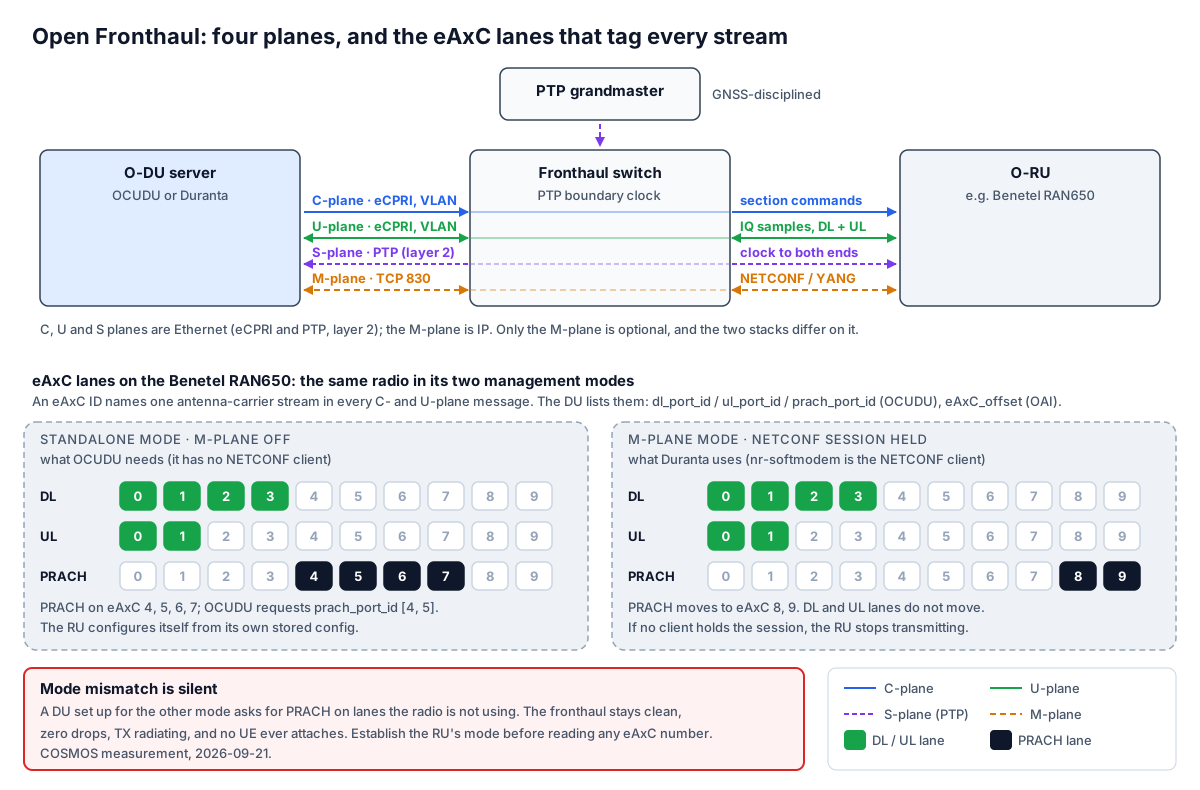
Figure — The four planes between O-DU, switch and O-RU. C- and U-plane ride eCPRI on the fronthaul VLAN; the S-plane comes from the PTP grandmaster; the M-plane is NETCONF on TCP 830. Note the Benetel's PRACH lanes move with its management mode.
| Plane | Carries | Notes |
|---|---|---|
| U-plane (user) | the IQ samples themselves | compressed, typically BFP at 9 bits |
| C-plane (control) | per-slot scheduling commands that tell the O-RU what to expect | the O-DU requests a PRACH window here |
| S-plane (synchronisation) | PTP (IEEE 1588) + SyncE | non-negotiable; without lock, nothing else works |
| M-plane (management) | NETCONF/YANG over port 830 | optional, and this is where the stacks differ |
The C-plane always leads the U-plane: before the O-DU sends a slot's downlink IQ, it sends a C-plane
message describing which PRBs and symbols the data covers; before the O-RU returns uplink IQ, the
O-DU must have asked for it. This includes the PRACH: the O-RU extracts PRACH samples only for
occasions the O-DU has requested on the C-plane, on the eAxC the O-DU named.
On COSMOS the fronthaul does not get its own interface or IP address. It rides as tagged VLANs on
the server's data-plane switch port: VLAN 4 for eCPRI C/U-plane and VLAN 5 for the PTP
S-plane, with the node's data VLAN untagged, MTU 9216 on the switch, and the port acting as a
G.8275.1 PTP boundary-clock master in domain 24 (see the
5G SA platforms page for the switch
configuration and the data-plane MTU reference).
¶ eAxC: which stream is which
Every U-plane and C-plane flow is tagged with an eAxC identifier (extended Antenna-Carrier) that
says which antenna and which channel it belongs to. It is a 16-bit field subdivided into a DU port,
a band sector, a component carrier and an RU port; the O-DU and O-RU must agree on the subdivision
and on which values mean downlink, uplink and PRACH. The O-DU config lists them explicitly —
dl_port_id, ul_port_id, prach_port_id in srsRAN, eAxC_offset in OAI.
COSMOS examples: the Foxconn uses eAxC IDs 0–3 for DL/UL and 4–7 for PRACH; the LiteOn is
configured with PRACH eAxC 4–7; ProtO-RU at 1×1 uses prach_port_id: [4] and needs [4, 5] at 2×2,
because srsRAN requires one PRACH eAxC per receive antenna.
Warning: The eAxC map is a property of the radio's current configuration, not of the vendor.
Putting the same Benetel RAN650 into M-Plane mode moves PRACH from
eAxC 4,5,6,7 to 8,9. A DU configured for the other mode then requests PRACH on identifiers
the radio is not listening to, receives nothing, and every counter still reads healthy — a clean
fronthaul, zero drops, and no PRACH. Always confirm the map against the wire, and note that a
capture tells you which eAxC carries traffic, never what that traffic is.
¶ Compression: block floating point
Uncompressed 16-bit IQ is expensive, so the U-plane is normally compressed with block floating
point (BFP). The samples of one PRB (12 subcarriers, each an I and a Q value) share a single
exponent, and each value is sent as a short mantissa. With 9-bit mantissas ("BFP-9"), a PRB costs
12 × 2 × 9 bits plus a small exponent field, a little over half of the 384 bits it costs
uncompressed, with negligible loss of signal quality.
Both sides must agree on two things: the mantissa width (iq_width: 9 for BFP-9, 16 for
uncompressed) and whether the compression parameters travel in every message (dynamic
compression headers) or are fixed out of band (static). The two open stacks run the Benetel
with different settings — Duranta static_compressed, OCUDU dynamic_compressed — which is another
item in the golden O-RU state below.
OAI's soft O-RU nr-oru supports only uncompressed 16-bit U-plane (upstream
doc/ORAN_FHI7.2_ORU_Tutorial.md §7.5), so the
Duranta soft O-RU tutorial sets
iq_width = 16 on the O-DU and comp_type = "none" on the O-RU. With BFP-9 on the O-DU, PRACH and
the random access response still work but Msg3 never decodes.
¶ Timing: transmission and reception windows
The O-RU transmits each symbol at an exact air time derived from its PTP-disciplined clock. The data
for that symbol must already be in the O-RU's buffer, but not so early that the buffer overflows.
O-RAN expresses this as windows, measured in microseconds relative to the symbol's air time.
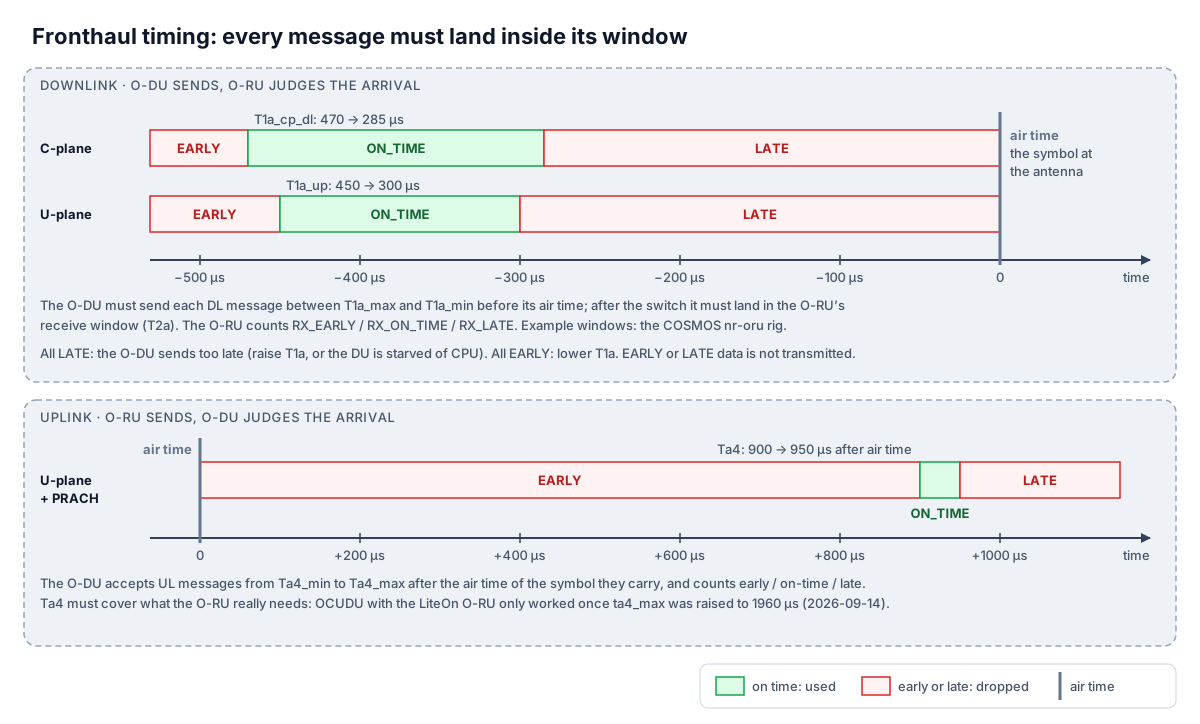
Figure — The downlink C/U-plane must arrive inside the O-RU's receive window; the uplink must reach the O-DU inside Ta4. Packets outside a window are counted as early or late and discarded.
| Parameter | Side | Meaning |
|---|---|---|
| T1a (max, min) | O-DU transmit | How far ahead of air time the O-DU sends downlink C-plane and U-plane. Configured separately for C-plane DL (T1a_cp_dl), C-plane UL (T1a_cp_ul) and U-plane (T1a_up). |
| T2a (max, min) | O-RU receive | The window in which the O-RU accepts that traffic. The O-DU's T1a window, minus the transport delay, must fall inside it. |
| Ta3 | O-RU transmit | When the O-RU sends uplink U-plane after the symbol's air time. |
| Ta4 (min, max) | O-DU receive | The window after air time in which the O-DU accepts uplink U-plane, including PRACH. |
Each side classifies every packet as early, on time or late, and the counters are the
first thing to read on a 7.2 rig:
| Stack / device | Counter names |
|---|---|
| OCUDU O-DU | OFH sector#0 metrics: … rx_total … rx_early … rx_on_time … rx_late |
| ProtO-RU | per-second table with RX_ON_TIME, RX_LATE, RX_SEQ_ERR |
| Duranta O-DU (xran) | RX_ON_TIME, RX_LATE |
OAI nr-oru |
C-Plane Timing Early/Late Errors, U-Plane Timing Early/Late Errors, a DL U-plane arrival histogram |
| Foxconn O-RU | c_early, c_on, c_late |
Worked examples from COSMOS:
- Wide uplink window. Under OCUDU, the LiteOn and the Foxconn deliver uplink (including PRACH)
after the referenceta4_max: 500has closed the window; withta4_max: 1960rx_lateis 0.
With 500, the O-DU logsmissed incoming User-Plane PRACH messages. - Narrow downlink window.
nr-oru's T2a window is narrow, so the Duranta soft O-RU uses
T1a_cp_dl = (285, 470),T1a_cp_ul = (285, 429),T1a_up = (300, 450),Ta4 = (900, 950).
Larger T1a values (up to 2400 µs, as for a routed N310) arrive early, show as
U-Plane Timing Early Errors, and the cell does not radiate. - A software O-RU needs a wider window. ProtO-RU needs
t1a_max_cp_dl: 2435; stock OCUDU caps
T1a/Ta4 at 1960 µs, so the COSMOSocudu.ndzbuild carries a patch raising the range to 5000 µs.
Timing windows are the reason the S-plane is non-negotiable. The windows are hundreds of
microseconds wide; a clock error of the same order puts every packet outside them. On COSMOS a
GPS-disciplined grandmaster feeds a G.8275.1 telecom-profile PTP tree through the fronthaul
switches to every O-RU and every O-DU server. On the server, ptp4l locks the NIC's hardware clock
and phc2sys disciplines the system clock from it. One trap is specific to this profile: the PHC is
on the TAI timescale, 37 s ahead of UTC, so phc2sys -O 0 leaves the system clock 37 s off and the
O-DU and O-RU disagree about frame numbers. The Foxconn tutorial uses phc2sys -s DATA1a -w -n 24
instead: -w waits for ptp4l and takes the UTC offset from it.
¶ M-Plane and O-RU management modes
The M-plane configures the O-RU: carrier frequency, bandwidth, TDD pattern, compression, eAxC map.
O-RAN specifies it as NETCONF (a configuration protocol over SSH, TCP port 830) with YANG data
models. In the hierarchical model the O-DU is the NETCONF client that configures and supervises
its O-RU. Supervision is a heartbeat: under O-RAN supervision, the O-RU stops transmitting once no
subscribed client remains.
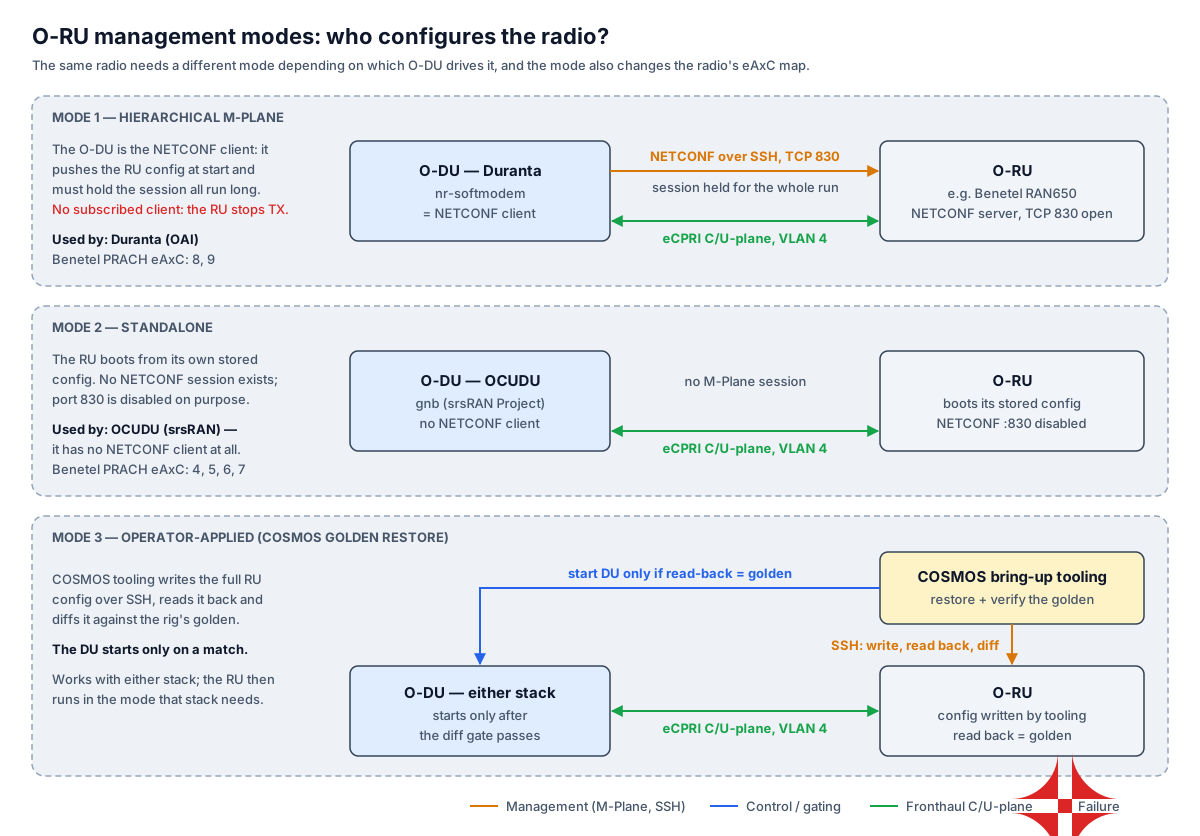
Figure — Three ways an O-RU gets its configuration on COSMOS: from the O-DU over M-Plane, from its own stored configuration (standalone), or from COSMOS tooling that writes and verifies the configuration before the O-DU starts.
¶ M-Plane: the biggest difference between the two stacks
| Stack | M-Plane | Consequence |
|---|---|---|
| OCUDU (srsRAN) | the gnb has no NETCONF client; a separate tool, ocudu_o1_adapter, is an O-RU M-Plane client (tutorial, simulated O-RU) |
On COSMOS the O-RU runs standalone under OCUDU, configured from its own local file |
| Duranta (OAI) | nr-softmodem is a NETCONF client — it provisions the O-RU and must hold the session |
Under O-RAN supervision the O-RU stops transmitting once no subscribed client remains |
So the same radio needs opposite management modes depending on which O-DU drives it — and, as
above, the mode also changes the eAxC map.
The COSMOS radios fall into three management styles:
| Mode | How the O-RU is configured | COSMOS radios |
|---|---|---|
| Hierarchical M-Plane | The O-DU is the NETCONF client and holds the session for as long as the cell runs | Benetel RAN650 under Duranta |
| Standalone | The O-RU boots from its own stored configuration; nothing talks NETCONF to it. In this mode the Benetel's NETCONF server (:830) is disabled on purpose |
Benetel RAN650 under OCUDU (nomplane) |
| Operator-applied | COSMOS tooling writes the configuration into the O-RU over its own management channel and verifies it before the O-DU starts | LiteOn FlexFi (static configuration; liteon-ru-config.py applies and verifies it, including the jumboframe setting that resets on every RU boot); Foxconn RPQN-7801 (file mode: RRHconfig_xran.xml + activation script) |
Per-radio details, including which stack drives which radio today, are on the
O-RAN radio units page.
¶ The golden O-RU rule
Restore the O-RU's state before every bring-up. A commercial O-RU is a stateful
device: it keeps whatever the last stack wrote into it, and the open stacks need different values
on the same radio (Duranta mimo_mode 4x4 + DDDSU + M-Plane on; OCUDU 4x2 + DDDDDDDSUU +
M-Plane off). A mismatch is silent — the fronthaul counters stay clean while the radio gates
TX/RX on the wrong frame, or answers PRACH on eAxC lanes the DU never asks about. So: capture the
full O-RU state when a rig works, commit it as that rig's golden, and make every bring-up restore
it and refuse to start the DU on a mismatch. A Benetel left in the other stack's state delivers
about 3 Mbit/s downlink on a fronthaul with no errors.
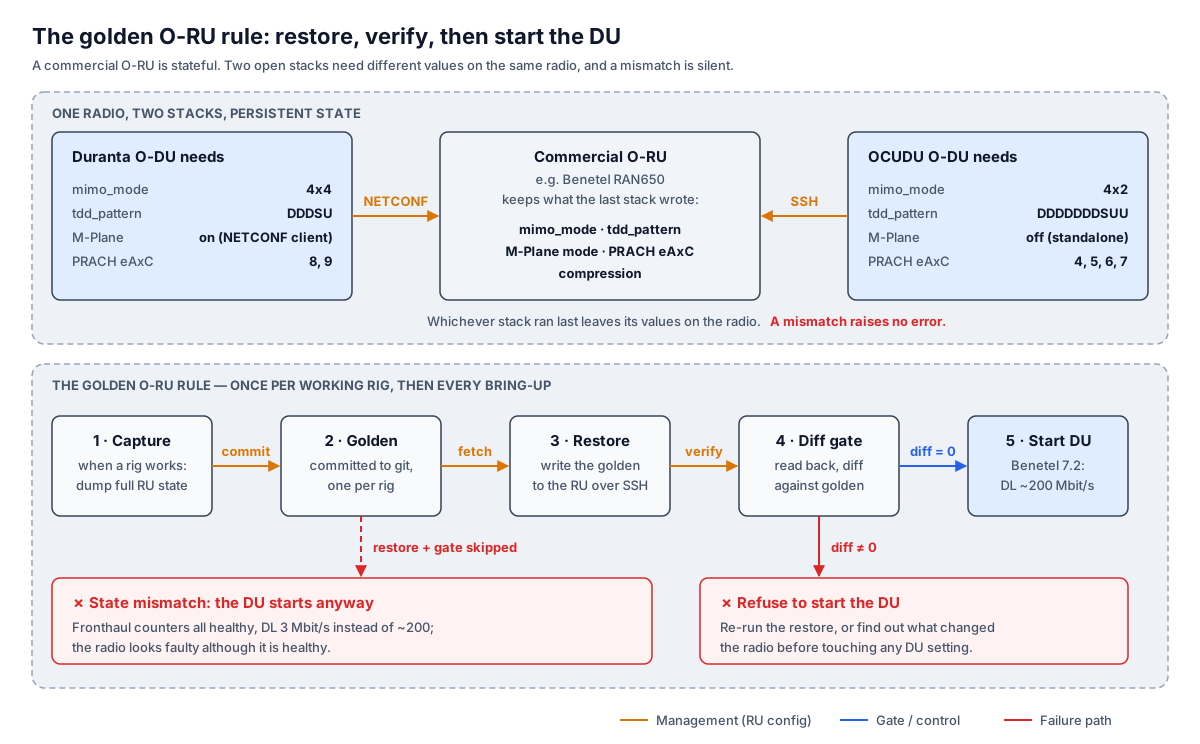
Figure — Capture, commit, restore, diff, then start the DU. The failure branch is the one to remember: every counter healthy, downlink at 3 Mbit/s.
The values that differ on the Benetel:
| Duranta (OAI) | OCUDU (srsRAN) | |
|---|---|---|
mimo_mode |
1_2_3_4_4x4 |
1_2_3_4_4x2 |
tdd_pattern_1/2 |
DDDSU |
DDDDDDDSUU |
compression |
static_compressed |
dynamic_compressed |
| M-Plane | enabled — the DU is the NETCONF client and holds the session | disabled (nomplane) — the OCUDU gnb has no NETCONF client |
The LiteOn needs the same state for both stacks, so only the Benetel changes hands. The capture,
diff and restore commands, and the exit codes that tell you whether the RU needs a power cycle, are
in the OCUDU O-RAN 7.2 tutorial.
¶ Practical preconditions
Each of these is invisible in the obvious places. The
real-time host preparation page has
the commands and checks for all of them.
- PTP must be locked before anything else. The S-plane is a precondition, not a feature. Verify
the servo, not just that the daemon is running. - The fronthaul NIC needs promiscuous mode for srsRAN's OFH, which binds a raw socket and does
not set it itself. Without it the O-DU receives zero frames — whiletcpdumpstill shows every
frame, because a capture tap sits before protocol demux. - A clean fronthaul does not imply RF. All counters can be perfect with the radio silent. Check
transmit power on the O-RU itself. - Real-time threads need exclusive physical cores. Isolating cores is not enough if the worker
pool is pinned to their hyperthread siblings; no counter reports the contention. - Only one O-RU may be powered at a time on a shared RF space.
¶ How this maps onto COSMOS
The O-RUs park in the instrument domain and are powered with omf tell from the console of the domain your O-RU reservation targets (O-RU scheduler); the O-DU runs on a fronthaul-capable server with an Intel E810 NIC in osc or
sb1. Both halves of the fronthaul can also be run in software, which is the best way to see the
interface — the O-RU's own timing counters become observable.
¶ O-RAN 7.2 split with commercial O-RUs
| Tutorial | O-DU stack | O-RUs | Status |
|---|---|---|---|
| ocudu-72: OCUDU over O-RAN 7.2 | OCUDU (srsRAN) | Benetel, LiteOn, Foxconn | all three working |
| OCUDU over a commercial Foxconn O-RU | OCUDU (srsRAN) | Foxconn RPQN-7801 | working |
| duranta-72: Duranta over O-RAN 7.2 | Duranta (OAI) | Benetel, LiteOn | working; Foxconn not supported yet |
| Amarisoft 5G SA over O-RAN 7.2 | Amarisoft (trx_s72) |
LiteOn FlexFi | working |
¶ O-RAN 7.2 split with a software O-RU
| Tutorial | O-DU stack | Soft O-RU |
|---|---|---|
| OCUDU 5G SA with a soft O-RU — ProtO-RU on a USRP N310 | OCUDU (srsRAN) | ProtO-RU |
Duranta 5G SA with a soft O-RU — nr-oru on a USRP |
Duranta (OAI) | OAI nr-oru |
¶ RIC / SMO
| Page | About |
|---|---|
| Near-RT RIC | The two near-RT RICs on COSMOS and what E2 monitoring and control do. |
| Near-RT RIC + OCUDU — E2 KPM monitoring | Monitor a live rig over E2. |
| FlexRIC + OCUDU · FlexRIC + Duranta | KPM monitoring with the FlexRIC near-RT RIC. |
| O-RAN SMO on COSMOS — O-RAN SC N release | Load or build the OSC SMO (non-RT RIC, SDN-R, TEIV) and explore A1 and O1. |
¶ Common misconceptions and pitfalls
- "Zero fronthaul errors means the radio works." Counters describe the Ethernet side. A radio in
the wrong management mode, with the wrong TDD pattern or the wrong number of transmitters, can sit
behind a perfect fronthaul and transmit nothing useful. - "A reboot is a reset." On the Benetel, a warm in-RU
rebootis not equivalent to a power
cycle: after it, much of the uplink arrives outside the timing window. A genuine power cycle is
recognised by the RU's:830reopening after about 300 s, not about 80 s. - "The eAxC map comes from the datasheet." It comes from the radio's current mode. Confirm it
on the wire. - "Wider timing windows are always safer." Only if both ends accept them: values that suit a
routed network path putnr-oru's downlink outside its receive window, and a MAC allowed to run
too far ahead (max_proc_delay 15) misses the random-access response window. - "A capture shows what the DU received."
tcpdumpsees frames before the kernel's protocol
demultiplexing; a raw socket on a non-promiscuous NIC can still receive nothing.
¶ Where to go next
- Real-time host preparation — make a server fit to run an O-DU.
- O-RAN radio units — the COSMOS O-RU pool.
- Duranta soft O-RU or OCUDU with ProtO-RU — see both ends of the fronthaul.
- OCUDU over O-RAN 7.2 or Duranta over O-RAN 7.2 — a commercial radio.
¶ Further reading
- O-RAN ALLIANCE specifications — the Control/User/Synchronization plane specification (O-RAN.WG4.CUS) defines the four planes, eAxC and the timing windows; the M-Plane specification (O-RAN.WG4.MP) defines the NETCONF/YANG management.
- O-RAN ALLIANCE — the organisation, its working groups and architecture overview.
- 3GPP TS 38.401 — NG-RAN architecture: the CU/DU split and the F1 and E1 interfaces.
- 3GPP TS 38.211 — the physical-layer processing that the 7.2x split cuts through.
- OAI 7.2 fronthaul tutorial — OAI's O-DU configuration for commercial O-RUs.
- srsRAN Project documentation — the
ru_ofhOpen Fronthaul configuration used by OCUDU. - ProtO-RU — the open software O-RU used in the OCUDU soft O-RU tutorial.
- O-RAN Software Community · documentation — open implementations of the RIC, SMO and O-DU components.
- linuxptp —
ptp4landphc2sys, the S-plane on COSMOS servers.
Author(s): COSMOS team · Last verified: 2026-09-21 (introduction page; see each linked tutorial for its own verification date) · text revised 2026-09-24 · Tags: oran, o-ran, 7.2, fronthaul, ecpri, o-du, o-ru, ric, smo, overview