¶ OCUDU 5G SA with a soft O-RU: O-DU ↔ ProtO-RU on a USRP N310 over O-RAN 7.2 fronthaul
Part of: OCUDU on COSMOS · 4G / 5G & O-RAN tutorials
Split the OCUDU gNB at the O-RAN 7.2 fronthaul with no vendor radio: the OCUDU O-DU (gnb with ru_ofh) and Open5GS on one sb1 server, ProtO-RU — a software O-RU — driving the sb1 USRP N310 from a second sb1 server, eCPRI over VLAN 4 between them, and a commercial 5G modem as the UE. Both servers run the same ocudu.ndz image; one command per host renders its configuration. At the end a Quectel modem is registered, has an IP address, and moves about 100 Mbit/s downlink through a fronthaul you can observe from both ends.
¶ Overview
In the previous tutorials on the learning path the gNB (the 5G base station) did everything itself: OCUDU drove a USRP software-defined radio directly, so the whole physical layer ran in one process on one host. Real deployments increasingly cut the gNB in two. The O-RAN 7.2x split moves the low physical layer (PHY) — the FFT/IFFT, cyclic-prefix handling, and extraction of the random-access (PRACH) samples — out of the gNB into a separate O-RAN Radio Unit (O-RU), and carries frequency-domain IQ samples as eCPRI (enhanced Common Public Radio Interface) frames over ordinary Ethernet. What stays behind is the O-RAN Distributed Unit (O-DU), which runs the high PHY, MAC and RLC and talks to the O-RU over the Open Fronthaul. OCUDU (srsRAN Project) implements the O-DU side of that split; with a commercial O-RU (see OCUDU with an O-RAN 7.2 O-RU) the radio is a closed box.
ProtO-RU (NUS CIR) is the open counterpart: a Category-A O-RU written on the OCUDU/srsRAN code base (its ru_emulator application), that terminates the Open Fronthaul C-plane/U-plane and PRACH streams, runs the low PHY in software and uses an ordinary USRP (B210, N310, X410) as its RF front end. Because both halves are software you get counters and logs on both ends of the fronthaul — on-time/early/late windows, sequence errors, lower-PHY real-time failures — which a hardware O-RU never shows you. That is why this tutorial sits before the commercial-O-RU tutorials: you learn what a healthy fronthaul looks like from the radio's side, where a commercial O-RU only gives you a few vendor counters.
Everything runs on sb1: two servers with Intel E810 fronthaul NICs on the shared VLAN-4 fabric, the N310 sdr1-s1-lg1 as the radio, and the Quectel modem on sdr1-in3 as the UE (user equipment).
The pieces talk to each other as shown in the Topology figure. The UE's control-plane messages reach the Open5GS core's Access and Mobility Management Function (AMF) through the O-DU; its user-plane packets leave the O-DU host through the core's ogstun interface. Between the O-DU and the O-RU, every slot of radio time is described by C-plane (control) messages and carried by U-plane (IQ data) messages, all tagged with VLAN 4, while both servers take time from the fabric's Precision Time Protocol (PTP) boundary clock. The O-RU then streams time-domain samples to the N310 over a second 10 GbE link.
¶ Background
Two fronthaul concepts decide whether this rig works; both are explained in depth on O-RAN and the 7.2x fronthaul.
- Timing windows. Every downlink C/U-plane message must reach the O-RU inside its receive window — no earlier than T1a max and no later than T1a min before the air time of the symbol it describes. A message that arrives outside the window is counted as early or late and dropped. In the uplink the O-DU applies the mirror-image window, Ta4. A software O-RU needs more processing time than a hardware one, so it asks for a much wider window than stock OCUDU allows (Step 4).
- eAxC identifiers. Each fronthaul stream — a downlink antenna, an uplink antenna, a PRACH receiver — is labelled with an extended Antenna-Carrier identifier (eAxC). Both ends must agree on the numbering; here the PRACH stream is eAxC 4 (
prach_port_id: [4]).
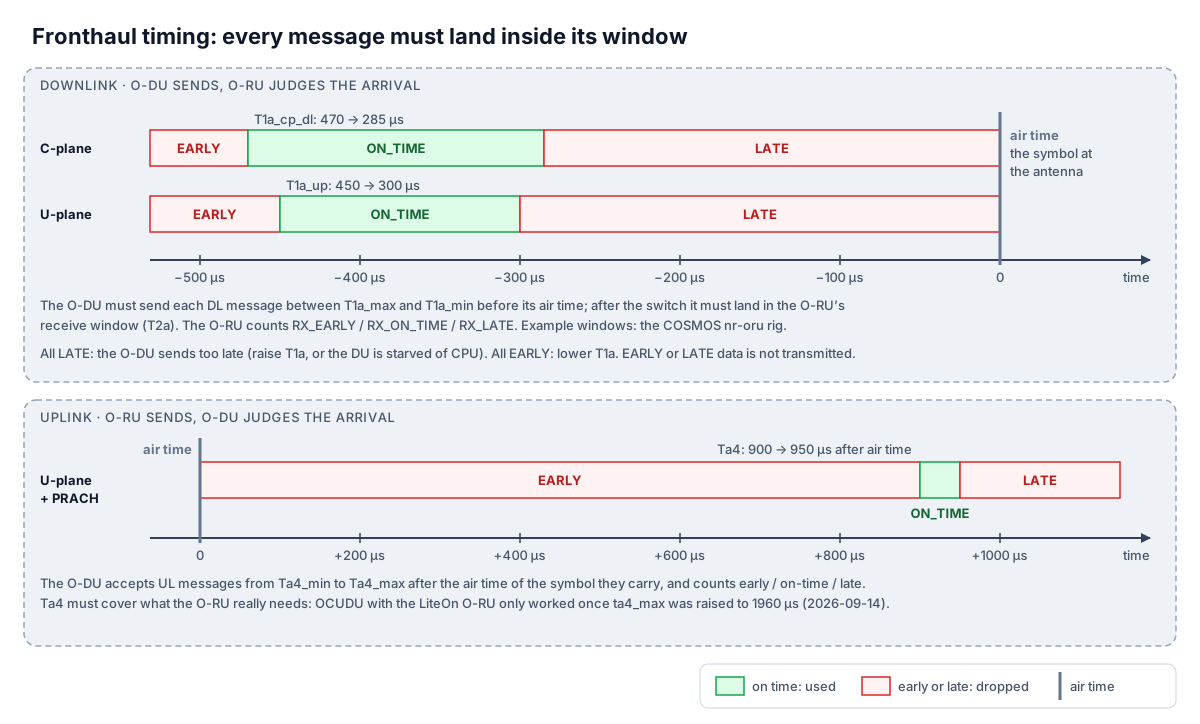
Figure — Downlink messages must land inside the O-RU's T1a receive window to count as ON_TIME; ProtO-RU's RX_ON_TIME column and OCUDU's rx_on_time counter report exactly this zone.
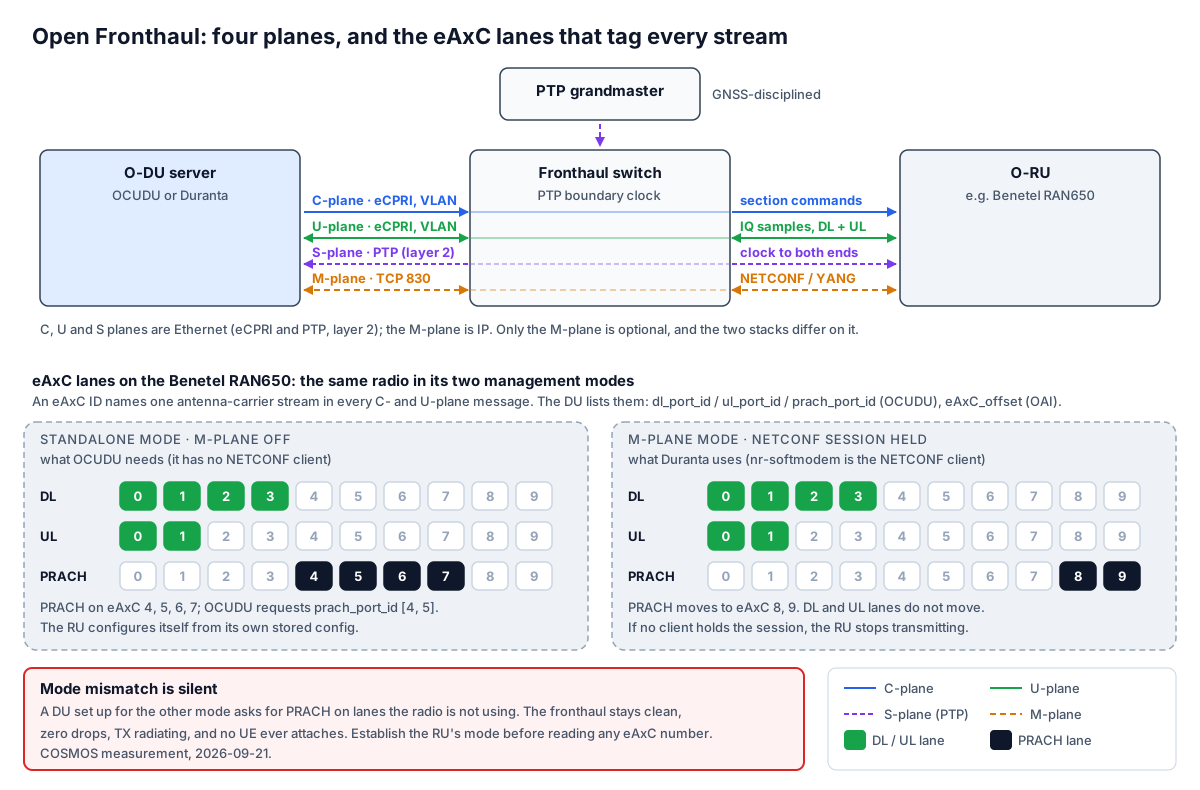
Figure — The C-plane and U-plane share VLAN 4 on the eCPRI link, the S-plane (PTP) comes from the fabric, and each stream is identified by its eAxC; this rig uses no M-Plane.
¶ Learning outcomes
After completing this tutorial you will be able to:
- Bring up an OCUDU O-DU + Open5GS on one server and ProtO-RU + a USRP N310 on another, connected by eCPRI over VLAN 4, both following the fabric's PTP (G.8275.1) boundary clock.
- Render a matched O-DU / O-RU configuration pair for any COSMOS 7.2 server from its live topology (fronthaul MAC, isolated real-time cores).
- Read the fronthaul health on both sides: ProtO-RU's per-second RX window table and OCUDU's
OFH sectormetrics. - Explain the timing and capacity limits of a software O-RU: the T1a window it needs, the lower-PHY core budget, and why 1×1 beats 2×2 on three cores.
¶ At a glance
| Learning path | Optional, between ocudu-ota and ocudu-72 — O-RAN 7.2 with a soft O-RU. Previous: OCUDU over the air · Next: OCUDU with a commercial O-RU |
| Difficulty | Advanced |
| Estimated time | 60–90 min (including one reboot per server for CPU isolation) |
| Domain / sandbox | sb1 (two E810 servers + the N310 sdr1-s1-lg1 + the sdr1-in3 modem host) |
| Topic group | Cellular (4G/5G/O-RAN) |
| Last verified | 2026-11-21 on sb1 (srv1-lg1 O-DU ↔ srv2-lg1 O-RU, N310 sdr1-s1-lg1, modem on sdr1-in3), packaged tutorial on ocudu.ndz = ocudu-20261120b; first verified 2026-09-15 · text revised 2026-11-21 |
| Upstream source | OCUDU gitlab.com/ocudu/ocudu dev @ 36128c56ef + one COSMOS patch (T1a/Ta4 range to 5000 µs); ProtO-RU github.com/NUS-CIR/ProtO-RU branch dev @ a3ba4b9 |
¶ Prerequisites
Background knowledge
- 5G SA fundamentals and O-RAN and the 7.2x fronthaul — the concepts this tutorial exercises: C-plane/U-plane, eAxC ids, T1a/T2a/Ta4 windows, PTP S-plane.
- The soft-only OCUDU tutorial (ZMQ soft UE) — the same gNB and core, no radio — and the previous step on the path, OCUDU over the air — the same gNB driving a USRP directly.
- Real-time host preparation for PTP and CPU isolation, and COTS UE: the Quectel modem for the modem handling.
- ProtO-RU's own guides ship on the image in
/opt/proto-ru/proto-ru/(ARCHITECTURE.md,TIME_SYNC.md,TROUBLESHOOTING.md,KNOWN_ISSUES.md).
Account & access
- A COSMOS account — register here.
- An approved reservation on sb1 — see Make a reservation.
- SSH access to the domain console — see SSH access.
¶ Resources required
Devices / nodes
| Resource | Role | Qty | Notes |
|---|---|---|---|
srv1-lg1.sb1 |
O-DU (gnb) + Open5GS core |
1 | 2× Xeon Gold 6226, E810 DATA1a on NUMA 1 |
srv2-lg1.sb1 |
O-RU (ru_emulator) |
1 | same hardware; reaches the N310 over DATA2a |
sdr1-s1-lg1.sb1 |
USRP N310 (radio of the O-RU) | 1 | 10.39.2.1, XG FPGA (2× 10GbE) |
sdr1-in3.sb1 |
UE | 1 | Quectel RM520N-GL, SIM IMSI 001010000000032 |
Any two COSMOS 7.2 servers work (Xeon Gold 6126/6226, AMD EPYC); nothing below is specific to these two.
Disk images
| Image | Load onto | Provides |
|---|---|---|
ocudu.ndz |
srv1-lg1, srv2-lg1 |
OCUDU gnb (T1a/Ta4 up to 5000 µs), ProtO-RU ru_emulator, Open5GS, UHD 4.9, PREEMPT_RT kernel, protoru-render, cosmos-ofh-isolation |
Software components
| Component | Version | Source |
|---|---|---|
OCUDU gnb |
dev @ 36128c56ef + T1a/Ta4 range patch, -march=skylake-avx512 |
/opt/ocudu/build/apps/gnb/gnb |
ProtO-RU ru_emulator |
dev @ a3ba4b9, -march=skylake-avx512 |
/usr/local/bin/ru_emulator → /opt/proto-ru |
| Open5GS | as baked | /root/open5gs/start.sh |
| UHD | 4.9 | image |
| Renderer / launcher | COSMOS | /root/proto-ru/protoru-render.py, protoru-run.sh, protoru-host-prep.sh |
Spectrum / RF / special
- Band n41, 40 MHz, SCS (subcarrier spacing) 30 kHz, DL ARFCN 519000 (SSB ARFCN 516030), PCI (physical cell id) 3, TAC (tracking area code) 7, PLMN 00101, TDD DDDSU (2.5 ms).
- The UE is a few metres from the N310 antennas; keep the gains at the values below.
¶ Topology
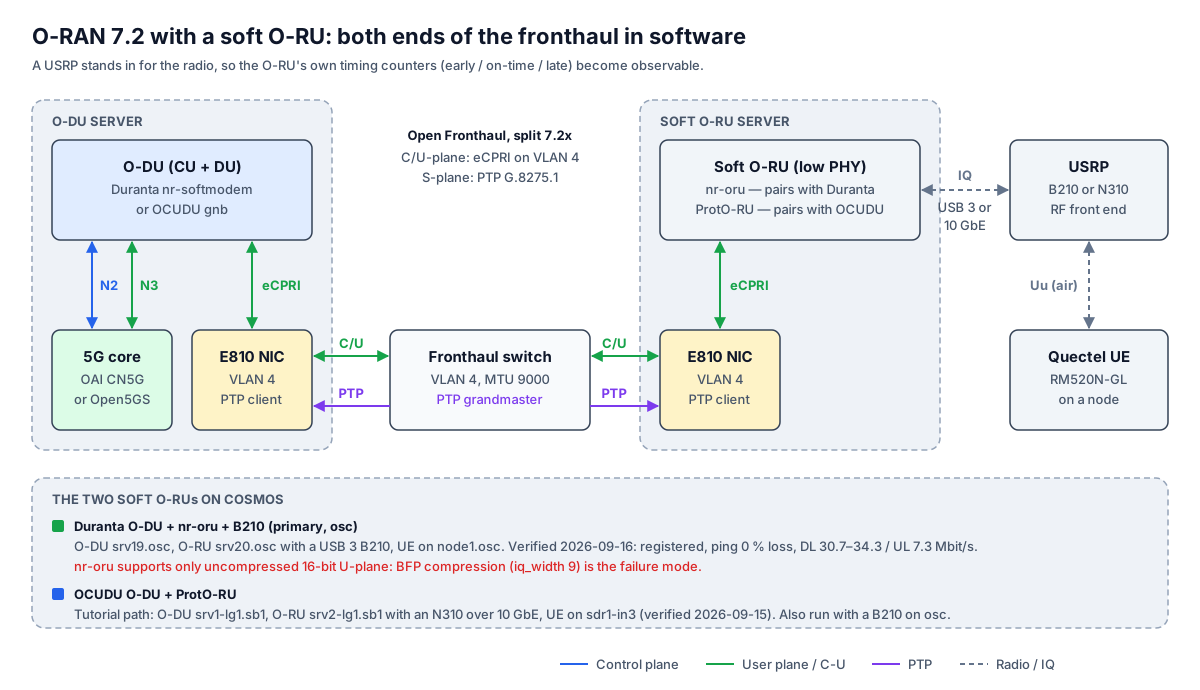
Figure — The O-DU server and the soft O-RU server are joined only by the VLAN-4 fronthaul; the O-RU server, not the O-DU, owns the USRP. ProtO-RU sits where a commercial O-RU would.
            sb1 VLAN-4 fronthaul fabric (eCPRI, PTP G.8275.1 boundary clock)
   ┌────────────────────────────┐  DATA1a            DATA1a ┌─────────────────────────────┐
   │ srv1-lg1  O-DU             │<========================>│ srv2-lg1  O-RU              │
   │  Open5GS (AMF 127.0.0.5)   │   C/U-plane + PRACH       │  ProtO-RU ru_emulator       │
   │  OCUDU gnb (ru_ofh)        │   BFP-9, VLAN 4           │  low PHY in software        │
   │  ogstun 192.168.100.1/22   │                           │        │ DATA2a (10GbE)     │
   └────────────────────────────┘                           └────────┼────────────────────┘
                                                                     │ UHD, 61.44 Msps
                                                           ┌─────────▼─────────┐   n41 OTA   ┌──────────────┐
                                                           │ N310 sdr1-s1-lg1  │ ~~~~~~~~~~> │ sdr1-in3     │
                                                           │ 10.39.2.1         │ <~~~~~~~~~~ │ Quectel UE   │
                                                           └───────────────────┘             └──────────────┘
Walk the figure from the core outwards:
- Control plane. Open5GS runs on
srv1-lg1; the gNB reaches its AMF at127.0.0.5on the same host. The UE's registration and session signalling travels over the air to the O-RU, over the fronthaul to the O-DU, and from there to the AMF. - User plane. Once a PDU session exists, UE packets leave the O-DU host through
ogstun(192.168.100.1/22), which is where the iperf3 server listens. - Fronthaul.
DATA1aon each server carries the C-plane, U-plane and PRACH streams as eCPRI on VLAN 4, with IQ compressed as BFP-9 (9-bit block floating point). - Synchronisation. Both servers take their time from the fabric's G.8275.1 boundary clock on
DATA1a(LLS-C3: the O-DU and O-RU each follow the switch). - Radio path. The O-RU's real-time cores sit on the
DATA1aNUMA node, so the USRP stream is routed overDATA2a(the E810 on the same node) rather than the defaultDATA2. The N310 radiates in n41 to the Quectel modem a few metres away.
¶ Setup
Setup gets both servers to the same starting point: the image loaded, the radio reachable, and the CPU cores that will carry real-time threads isolated from the Linux scheduler.
-
Reserve sb1 and log into the console:
ssh <username>@console.sb1.cosmos-lab.org -
Load the image onto both servers (multi-GB image: raise the timeouts), then power them on:
omf load -i ocudu.ndz -t srv1-lg1,srv2-lg1 -o 2400 -b 600 omf tell -a on -t srv1-lg1,srv2-lg1 omf stat -t srv1-lg1,srv2-lg1omf loadsometimes leaves a node powered off: ifomf statsaysPOWEROFF, sendomf tell -a onagain. -
Make sure the N310 is on, and check you can reach it from the O-RU server. Only the O-RU server talks to the radio:
omf tell -a on -t sdr1-s1-lg1 ssh root@srv2-lg1 'uhd_find_devices --args addr=10.39.2.1'serial: 3176DF5 fpga: XG name: ni-n3xx-3176DF5 product: n310What to look for:
product: n310andfpga: XG— the XG image provides the two 10 GbE ports the 61.44 Msps stream needs. -
CPU isolation, once per server. Both the O-DU and the O-RU busy-poll their fronthaul threads, and a slot is missed if the kernel schedules anything else on those cores.
isolcpusis a boot parameter and the right set differs per host, so the image carries none. Run/root/ofh-isolation-ensure.sh DATA1aon bothsrv1-lg1andsrv2-lg1and follow Real-time host preparation — Command 2: the helper derives the set for the fronthaul NIC and writes GRUB; reboot each server that reportsREBOOT-NEEDED, then re-run until it printsISOLATED 7,9,11,13,15,17,19,21,23(the set on these two servers).What to look for: the odd-numbered cores are the ones on NUMA node 1, the node that holds
DATA1a. Every real-time CPU list in Steps 3 and 4 is drawn from this set.
¶ Instructions
The order matters: prepare timing on both hosts, exchange the addresses each side needs, start the radio side first so it is listening, then start the O-DU and core, check the fronthaul from both ends, and only then attach the UE.
¶ Step 1 — prepare both hosts (PTP, fronthaul NIC, IRQs)
A 7.2 fronthaul only works if both ends agree on time to within a fraction of a microsecond and the fronthaul NIC delivers every frame to the real-time threads. Run the same prep on both servers. It sets the performance governor, disables deep C-states, puts DATA1a in promiscuous mode with MTU 9000, moves NIC IRQs off the isolated cores, raises the socket buffers UHD needs at 61.44 Msps, and locks PTP to the fabric (step once, then slew, UTC timescale). Each of these items is explained on Real-time host preparation; this script is the ProtO-RU rig's own wrapper and stays the command to run here.
ssh root@srv1-lg1 'bash /root/proto-ru/protoru-host-prep.sh DATA1a'
ssh root@srv2-lg1 'bash /root/proto-ru/protoru-host-prep.sh DATA1a'
   pinned 54 IRQs to 1,3,5
== PTP G.8275.1 from the switch BC (step once, then slew; UTC timescale -w, same as the O-DU)
   ptp4l: ptp4l[128.920]: rms    6 max   15 freq  -1134 +/-   9 delay   246 +/-
   phc2sys: phc2sys[128.586]: CLOCK_REALTIME phc offset        25 s2 freq  -91473 delay    4
===== HOST-PREP-DONE
What to look for: rms in single-digit nanoseconds on both hosts is what you want. ptp4l reports how closely the NIC's hardware clock follows the switch; phc2sys ... s2 means the system clock has locked to the NIC clock.
¶ Step 2 — exchange fronthaul MACs
The Open Fronthaul is plain Layer-2 Ethernet: there is no IP address and no discovery. Each side's configuration names the other side's DATA1a MAC:
ssh root@srv1-lg1 'protoru-render mac'      # the O-DU MAC
ssh root@srv2-lg1 'protoru-render mac'      # the O-RU MAC
50:7c:6f:6c:76:9c
50:7c:6f:6c:76:38
Use your own two values in Steps 3 and 4; these are from the verification run.
¶ Step 3 — start the O-RU (ProtO-RU + N310)
Start the radio side first so it is already listening when the O-DU begins to send. The argument is the O-DU's MAC from Step 2.
ssh root@srv2-lg1 'bash /root/proto-ru/protoru-run.sh ru 50:7c:6f:6c:76:9c'
wrote /root/proto-ru/ru.yml
RU-UP pid 2857
protoru-run.sh ru routes 10.39.2.1 over DATA2a, renders /root/proto-ru/ru.yml for this host and starts ru_emulator under a taskset covering every CPU. The rendered file carries the host-derived parts:
ru_emu:
  timing_cpus: [7]
  cells:
    - network_interface: DATA1a
      ru_mac_addr: 50:7c:6f:6c:76:38
      du_mac_addr: 50:7c:6f:6c:76:9c
      vlan_tag: 4
      bandwidth: 40
      dl_arfcn: 519000
      band: 41
      prach_port_id: [4]
      ofh_cpus: [9, 11, 13]
      sdr:
        device_args: type=n3xx,addr=10.39.2.1,master_clock_rate=122.88e6,recv_frame_size=7900,send_frame_size=7900
        srate: 61.44
        tx_gain: 37
        rx_gain: 40
        ru_cpus: [15, 17, 19]
Read it as three groups of threads, all on isolated cores: timing_cpus keeps the O-RU's notion of slot time, ofh_cpus send and receive fronthaul frames, and the sdr.ru_cpus run the software low PHY that feeds the N310. Those three ru_cpus are the capacity limit that makes 2×2 slower than 1×1 (see Troubleshooting).
Until the O-DU starts, ProtO-RU prints its per-second RX table with all zeros.
¶ Step 4 — start the O-DU and core
Now start the core and the O-DU. The argument is the O-RU's MAC from Step 2.
ssh root@srv1-lg1 'bash /root/proto-ru/protoru-run.sh du 50:7c:6f:6c:76:38'
open5gs: inventory (cosmos-sim-db 2026-08-28) 73 SIMs on 00101 incl. soft pool; provisioned 73; missing 0
wrote /root/proto-ru/du.yml
DU-UP pid 3235
This starts Open5GS (if it is not running), reconciles the COSMOS SIM catalogue into it, renders /root/proto-ru/du.yml and starts gnb. The O-DU uses ProtO-RU's timing windows (t1a_max_cp_dl: 2435 and friends); stock OCUDU caps these at 1960 µs, the ocudu.ndz build accepts up to 5000 µs. The O-DU's cores come from the same isolated set: ru_cpus 7,9; OFH txrx_cpus 11,13,15,17; the main pool everywhere else.
What to look for: provisioned 73; missing 0 — every SIM in the COSMOS catalogue, including the modem's, is in the core. A non-zero missing means the UE will be rejected at registration.
The wide T1a value is the software O-RU's price: the O-DU must send each slot's messages up to 2435 µs ahead of air time so that ProtO-RU has time to run the low PHY and hand samples to UHD.
¶ Step 5 — check the fronthaul on both ends
This is the step a hardware O-RU cannot give you. Check the fronthaul from each side before involving a UE: if messages are late or out of sequence here, no radio setting will fix it.
On the O-RU, the RX_ON_TIME column should carry the traffic and RX_LATE / RX_SEQ_ERR stay 0:
ssh root@srv2-lg1 'grep -a "^| " /root/proto-ru/ru-stdout.log | tail -2 | cut -c1-110'
| 11:03:52 |  0  |    4555     |    3398     |      0      |      0      |        0        |      257      |
| 11:03:53 |  0  |    4542     |    3386     |      0      |      0      |        0        |      256      |
On the O-DU, the OFH metrics count every received message as on time:
ssh root@srv1-lg1 'grep -a "OFH sector#0" /tmp/ocudu-protoru-du.log | tail -1 | cut -c1-140'
[METRICS ] OFH sector#0 metrics: pci=3 received messages stats: rx_total=7600 rx_early=0 rx_on_time=7600 rx_late=0
What to look for: rx_on_time equal to rx_total, with rx_early=0 and rx_late=0 — every uplink message from the O-RU arrived inside the O-DU's Ta4 window. On the O-RU side, non-zero counts in the on-time columns with zeros in the late and sequence-error columns mean the same for the downlink.
¶ Step 6 — attach the UE and measure
The general modem procedure, and recovery when the modem misbehaves, is on COTS UE: the Quectel modem; the values specific to this rig are band n41, access point name (APN) COSMOS-O and PLMN 00101.
On sdr1-in3, the modem needs SA-only, band n41, the COSMOS-O APN and a PLMN lock; then a QMI data call. Use the OCUDU 7.2 bundle's modem helper (ocudu-72_modem.py, from the OCUDU O-RU tutorial bundle) as in Option A on COTS UE: the Quectel modem — which also lists the AT commands it sends — with ModemManager stopped and these arguments: configure /dev/quectel-at 00101 41 COSMOS-O, then wait-reg /dev/quectel-at 240 00101. Expected on this rig:
+QENG: "servingcell","NOCONN","NR5G-SA","TDD",001,01,00066C000,3,7,516030,41,1,-97,-10,18,1,42
REGISTERED
What to look for: NR5G-SA, PLMN 001,01, PCI 3, TAC 7, SSB ARFCN 516030, band 41 — the modem is camped on this cell — followed by REGISTERED. The -97 is RSRP in dBm and 18 the SINR in dB.
Data call and routes (never a default route via the modem — the host's management traffic uses the default):
# the Quectel's own QMI device + netdev; never assume cdc-wdm0/wwan0: a UE node can carry two modems
D=$(readlink -f /sys/class/tty/$(basename $(readlink -f /dev/quectel-at))/device/../..)
QMI=/dev/$(ls $D/*/usbmisc); WWAN=$(ls $D/*/net); echo "Quectel: $QMI $WWAN"
ip link set $WWAN down; echo Y > /sys/class/net/$WWAN/qmi/raw_ip; ip link set $WWAN up   # raw_ip only changes while $WWAN is DOWN
qmicli -p -d $QMI --wds-start-network="apn='COSMOS-O',ip-type=4" --client-no-release-cid
S=$(qmicli -p -d $QMI --wds-get-current-settings)
UE_IP=$(echo "$S" | awk '/IPv4 address/{print $3}'); GW=$(echo "$S" | awk '/IPv4 gateway/{print $4}'); echo "UE $UE_IP gw $GW"
ip addr flush dev $WWAN; ip addr add $UE_IP/22 dev $WWAN; ip link set $WWAN mtu 1400
ip route replace 192.168.100.0/22 dev $WWAN
ip route replace 8.8.8.8/32 via $GW dev $WWAN
ping -I $WWAN -c 10 192.168.100.1; ping -I $WWAN -c 10 8.8.8.8
iperf3 -c 192.168.100.1 -B $UE_IP -t 10 -R      # DL (the O-DU host runs iperf3 -s)
iperf3 -c 192.168.100.1 -B $UE_IP -t 10         # UL
UE 192.168.100.3 gw 192.168.100.4
10 packets transmitted, 10 received, 0% packet loss, time 2707ms
10 packets transmitted, 10 received, 0% packet loss, time 2707ms
[  5]   0.00-10.01  sec   123 MBytes   103 Mbits/sec                  receiver
[  5]   0.00-10.09  sec  46.9 MBytes  39.0 Mbits/sec                  receiver
The commands read the address and gateway from --wds-get-current-settings instead of hard-coding them, because they change between runs: after a reconnect the core can hand out the next address (for example .4 with gateway .5). The values above are from the verification run. Read the iperf3 receiver line — it is the measurement.
What to look for: 0 % loss to both 192.168.100.1 (the core's gateway on the O-DU host) and 8.8.8.8 (the Internet through the core's NAT), then the two receiver lines — downlink first (-R), uplink second.
¶ Verification
| Check | Where / command | Expected |
|---|---|---|
| PTP locked | both hosts, protoru-host-prep.sh output |
rms < 20 ns |
| Fronthaul RX | O-RU table (grep -a "^| " /root/proto-ru/ru-stdout.log) |
RX_LATE 0, RX_SEQ_ERR 0 |
| Fronthaul RX | O-DU OFH sector#0 in /tmp/ocudu-protoru-du.log |
rx_late=0 |
| Cell | O-DU /tmp/ocudu-protoru-du.log |
==== gNB started ===, scheduler metrics pci=3 |
| UE | modem (ocudu-72_modem.py wait-reg) |
NR5G-SA, PCI 3, ARFCN 516030, band 41, +C5GREG: 0,1 |
| Data | UE (ping -I $WWAN) |
ping 0 % loss to 192.168.100.1 and 8.8.8.8 |
Performance (iperf3 TCP, receiver line, 10 s; n41 40 MHz 1×1, DDDSU):
| CPU platform (O-DU and O-RU hosts) | Logical CPUs | Radio | DL Mbit/s | UL Mbit/s | RSRP / SINR | Date | Image |
|---|---|---|---|---|---|---|---|
| 2× Intel Xeon Gold 6226 (24C/24T) | 24 | USRP N310, tx_gain 37 | 88–103 | 38–39 | −97 dBm / 18 dB | 2026-09-15 | ocudu-20260915 (4 runs: 1 on the build host, 3 from the loaded image) |
| 2× Intel Xeon Gold 6226 (24C/24T) | 24 | USRP N310, tx_gain 37 | 47.8 | 32.7 | −106 dBm / 0 dB | 2026-11-21 | ocudu-20261120b (1 run, packaged tutorial; the radio link was weaker than on 2026-09-15, not investigated) |
UL is bounded by the TDD pattern: one uplink slot (plus two symbols) in every five.
¶ Cleanup
The CPU isolation from Setup step 4 stays on both servers until you remove it. Remove it before running the direct-USRP OTA tutorial on the same server, as described in Removing isolation on Real-time host preparation.
Then stop the run. The data call is released first so the modem does not keep retrying against a cell that is about to disappear:
ssh root@sdr1-in3 'D=$(readlink -f /sys/class/tty/$(basename $(readlink -f /dev/quectel-at))/device/../..); QMI=/dev/$(ls $D/*/usbmisc); WWAN=$(ls $D/*/net); qmicli -p -d $QMI --wds-stop-network=disable-autoconnect; ip link set $WWAN down'
ssh root@srv1-lg1 'for p in $(pgrep -x gnb); do case "$(readlink /proc/$p/exe)" in /opt/ocudu/*) kill $p;; esac; done; bash /root/open5gs/stop.sh'
ssh root@srv2-lg1 'kill $(pgrep -x ru_emulator)'
omf tell -a offh -t srv1-lg1,srv2-lg1
¶ Troubleshooting
| Symptom | Cause | Fix |
|---|---|---|
gnb exits: Invalid CPU core selected '16'. Valid CPU ids: [0, …, 14] |
the process was started under a mask without the isolated cores. nproc counts only the caller's mask, so taskset -c 0-$(($(nproc)-1)) shrinks to the non-isolated CPUs |
launch under taskset -c 0-$(($(nproc --all)-1)) (the launcher does); see Real-time host preparation |
gnb rejects t1a_max_cp_dl: 2435 |
stock OCUDU caps T1a/Ta4 at 1960 µs | use the ocudu.ndz build (range patched to 5000 µs) |
RU number of PRACH ports=1 must be equal or greater than the number of reception antennas=2 |
2×2 needs one PRACH eAxC per antenna | prach_port_id: [4, 5] on both sides (protoru-render --layers 2 does it) |
2×2 gives less DL than 1×1 (45.6 vs 103), Real-time failure in lower PHY hundreds of times |
two 61.44 Msps chains overrun ProtO-RU's three lower-PHY cores | stay 1×1 at 40 MHz, or 2×2 at 20 MHz |
| UE camps at RSRP ≈ −112 / SINR ≈ 4, DL ~38 Mbit/s | tx_gain too low: ProtO-RU applies a 12 dB gain_backoff, so a USRP gain such as 25 radiates 12 dB less than it would from a direct-USRP gNB |
tx_gain 37 (the renderer's default) |
echo Y > …/qmi/raw_ip fails: Device or resource busy (kernel: wwan0: Cannot change a running device) |
wwan0 is already up — systemd-networkd raises it at boot, or an earlier run left it up — and the driver only changes raw_ip while the interface is down. Rebooting the UE host does not help |
ip link set $WWAN down first (the Step 6 block does this); if a stale data call is still open, release it with the Cleanup command qmicli -p -d $QMI --wds-stop-network=disable-autoconnect |
UE address is not the one in this page (e.g. 192.168.100.4, gateway .5) |
the core hands out the next free address after a reconnect | expected — use what --wds-get-current-settings prints (the Step 6 block reads it into $UE_IP / $GW); a host route via a hard-coded gateway would point at the modem itself |
UHD: The recv buffer could not be resized sufficiently |
kernel socket-buffer ceiling too low for 10GbE streaming | sysctl -w net.core.rmem_max=33554432 net.core.wmem_max=33554432 (host prep does it) |
==== gNB started === never appears on stdout although the cell is up |
srsRAN block-buffers stdout | read the file log /tmp/ocudu-protoru-du.log |
O-DU rx_total = 0 while tcpdump shows frames |
the AF_PACKET socket needs the NIC in promiscuous mode |
enable_promiscuous: true + ip link set DATA1a promisc on (both done); see Real-time host preparation |
O-RU RX_LATE climbing |
PTP not locked on one side, or O-RU OFH threads sharing a core | re-run host prep; keep ofh_cpus ≥ 3 isolated cores |
Direct-USRP OTA gNB on the same server floods Real-time failure in RF: late |
the host is still isolated from this tutorial, and the unpinned OTA gNB gets only the non-isolated CPUs | remove the isolation (Cleanup) before the OTA tutorial |
For modem-side failures (no registration, registered but no data) see COTS UE: the Quectel modem.
¶ References
On this wiki
- O-RAN and the 7.2x fronthaul — timing windows, eAxC, planes.
- Real-time host preparation · COTS UE: the Quectel modem
- OCUDU overview, OCUDU with a commercial O-RU, O-RU hardware, SDRs on COSMOS.
External
- ProtO-RU: github.com/NUS-CIR/ProtO-RU (use branch
dev; the default branch is older) — on the image in/opt/proto-ru/proto-ru/. - OCUDU: gitlab.com/ocudu/ocudu, docs docs.ocudu.org.
- srsRAN Project documentation (OCUDU's upstream lineage): docs.srsran.com/projects/project
- O-RAN ALLIANCE specifications (Open Fronthaul CUS-plane): specifications.o-ran.org
- linuxptp (
ptp4l,phc2sys): linuxptp.sourceforge.net - UHD manual (USRP N310): files.ettus.com/manual
- iperf3: iperf.fr
Topic group: Cellular (4G/5G/O-RAN) · Last verified: 2026-11-21 on sb1 (first 2026-09-15) · text revised 2026-11-21 · Image: ocudu.ndz (ocudu-20261120b)