¶ SB5
SB5 is a two-node ORBIT sandbox at WINLAB (Route 1, North Brunswick, NJ). The two nodes (node1-1.sb5.cosmos-lab.org, node1-2.sb5.cosmos-lab.org) are connected over a short RF coax loop so you can run SDR experiments without contending for grid time or radiating into the lab.
SB5 is a sandbox for development and debugging. For full-scale wireless work, move to the Grid. For the COSMOS main testbed in NYC, see BED.
¶ Per-node hardware
Both nodes are identical Q87T-class ORBIT nodes:
| Component | Value |
|---|---|
| Mainboard | ASUSTeK Q87T |
| CPU | Intel Core i7-4790 @ 3.60 GHz (4 cores / 8 threads) |
| RAM | 16 GB DDR3-1600 |
| Disk | Samsung SSD 850 (~111 GB) |
| WiFi 0 | Qualcomm Atheros AR928X (PCIe) |
| WiFi 1 | Intel Centrino Advanced-N + WiMAX 6250 |
| SDR | USRP B210 (USB 3.0) |
| BIOS | 1001 |
The B210 is the differentiator versus the larger SDR-X310 sandbox (SB2) — B210 is a USB two-channel SDR (70 MHz – 6 GHz, up to 56 MS/s per channel), ideal for quick prototyping and FDD-style experiments without 10G ethernet host hardware.
¶ RF connections
The two B210s are wired together via coax with a 30 dB attenuator on the TX/RX side of each link for protection. This setup supports FDD-dependent experiments where TX and RX paths must be separated.
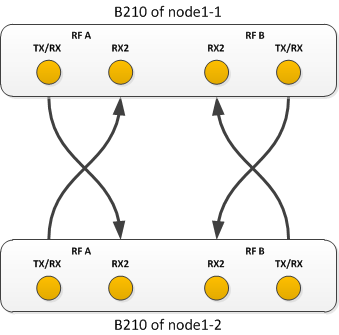 RF cabling between the two B210s.
¶ Choosing SB5
| If your experiment needs… | Use SB5 |
|---|---|
| A USB B210 (no 10G host adapter) | ✓ |
| Quick FDD-style two-radio prototyping | ✓ |
| Atheros 9K WiFi or Intel WiMAX 6250 baseline | ✓ |
| X310-class throughput / RFNoC | use SB2 instead |
| Repeatable RF attenuation matrix | use SB4 instead |
¶ Access
omf-tell -a on  -t system:topo:all   # power both nodes on
omf-load -i baseline.ndz -t all       # load an image
omf-stat -t all
omf-tell -a offh -t all              # power down when done
See Getting Started for the full walkthrough.