¶ Aether SD-Core — the Cloud-Native 5G Core on COSMOS
Aether SD-Core is the cloud-native 5G core on COSMOS: every network function runs as a container in a Kubernetes cluster on its own server, and the gNB reaches it across the testbed's data plane. This page explains how SD-Core is built, how it is deployed and operated on COSMOS, the operating rules that differ from the other two cores, and when it is the right choice. Read it before Deploy Aether SD-Core, which stands the core up on one server, and the two-server SD-Core tutorial, which connects a gNB and a UE to it — and whenever a PDU session fails on an SD-Core rig.
¶ What it is
A 5G Standalone (SA) core admits and authenticates UEs, sets up their data sessions and forwards their traffic; the 5G SA fundamentals page explains its role. Aether is an open-source private-5G platform hosted by the Linux Foundation (originally developed by the Open Networking Foundation). Its core, SD-Core, comes from the omec-project: a control plane of Go microservices derived from free5GC, and a user plane built on BESS, a software packet-processing dataplane. Aether also includes a management platform and OnRamp, the deployer. Its near-real-time RAN Intelligent Controller, SD-RAN, was evaluated on COSMOS and is not supported: it does not complete E2 Setup with a real gNB here; RAN intelligence on COSMOS uses the O-RAN SC near-RT RIC and FlexRIC.
The problem SD-Core solves is operating a core the way a production network does: as Kubernetes workloads, configured declaratively through Helm values, on a host separate from the radio. That makes the core itself something you can study — its scheduling, its service discovery, its failure and restart behaviour — rather than a dependency hidden on the gNB host. The price is more moving parts and operating rules that the single-host cores do not have.
¶ Architecture and components
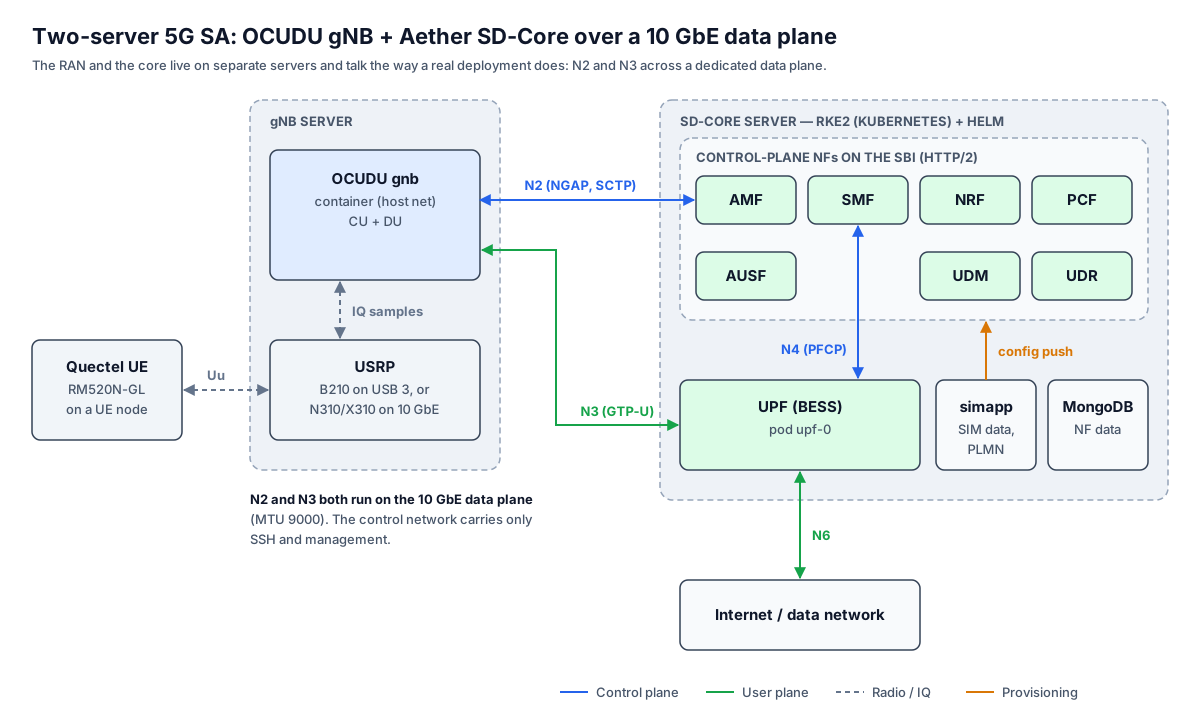
Figure — The two-server layout. The gNB server (OCUDU + radio) and the SD-Core server (RKE2 running AMF, SMF, UPF/BESS, NRF and the rest) are joined by a 10 GbE data plane that carries N2 (control) and N3 (user traffic). Notice that the core has its own host: nothing in it shares CPU with the radio.
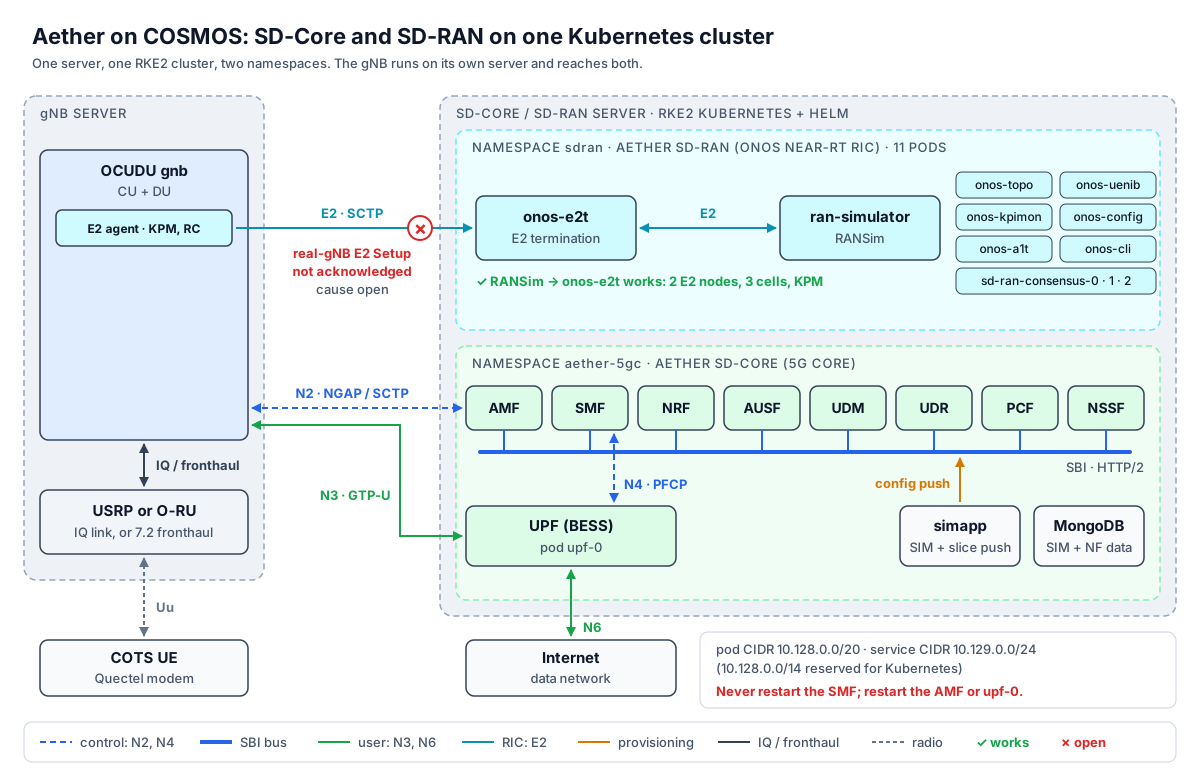
Figure — SD-Core runs in namespace aether-5gc on an RKE2 cluster; the gNB reaches the core over N2/N3.
¶ Kubernetes, Helm and OnRamp
Three layers deploy SD-Core, and knowing which one owns a setting tells you where to change it:
- RKE2 is the Kubernetes distribution. On COSMOS it is a single-node cluster on the core host. Its own settings — the node IP, the pod and service address ranges — live in
/etc/rancher/rke2/config.yaml. - Helm installs SD-Core from the chart
oci://ghcr.io/omec-project/sd-core. The chart's values file holds the whole core configuration: PLMN, TACs, slices, device groups, subscribers and per-NF settings. Helm renders it into one Kubernetes ConfigMap per NF. Ahelm upgradere-renders every ConfigMap from the values, so an edit made directly to a ConfigMap is lost at the next upgrade; persistent changes go in the values file. - Aether OnRamp is a set of Ansible roles and
maketargets that install RKE2 and run the Helm installs. On COSMOS it lives in/home/native/onramp;vars/main.ymlholds the deployment settings (data interface, AMF IP, UE pool) and a Jinja2 template renders the values file to/tmp/sdcore-5g-values.yaml.
¶ The network functions
Everything runs in the Kubernetes namespace aether-5gc.
| Component | What it does | Kubernetes object |
|---|---|---|
| AMF (Access and Mobility Management Function) | Terminates N2 (NGAP over SCTP) from the gNB; handles registration, authentication and NAS security. Exposed to the gNB through a Service with an externalIP on the core host's data address. |
deployment/amf |
| SMF (Session Management Function) | Creates PDU sessions, allocates UE addresses, and programs the UPF over N4 (PFCP). | deployment/smf |
| UPF (User Plane Function) | Carries user traffic between N3 (GTP-U from the gNB) and the data network. A five-container pod: bessd (the BESS dataplane), pfcp-agent (speaks PFCP to the SMF and programs bessd), routectl, web, arping. |
statefulset/upf → pod upf-0 |
| NRF (NF Repository Function) | Service discovery over HTTPS (port 29510); every NF registers here. | deployment/nrf |
| AUSF / UDM / UDR | Authentication (5G-AKA) and subscriber data. | deployment/ausf, udm, udr |
| PCF / NSSF | Policy and network-slice selection. | deployment/pcf, nssf |
| WebUI | The configuration front end that the provisioning path writes through. | deployment/webui |
| simapp | The provisioner: at start-up it pushes the values file's subscribers, device groups, slices and the served PLMN/TAC into the core, a few seconds after the NFs start. | deployment/simapp |
| MongoDB | Subscriber data (keys, sequence numbers, subscription profiles) and, with enableDBStore, NF runtime state such as the AMF's per-UE security context. |
statefulset/mongodb |
| Kafka | The event bus used by the metrics function (metricfunc). |
statefulset/kafka |
¶ The UPF behaves differently from the rest
bessd is a real packet dataplane, not a kernel module: it has its own worker threads pinned to cores, its own ports and its own counters. Its health is not visible from kubectl: a Running 5/5 upf-0 can still refuse every PFCP association. Inspect the dataplane directly:
kubectl -n aether-5gc exec upf-0 -c bessd -- bessctl show worker
kubectl -n aether-5gc exec upf-0 -c bessd -- bessctl show port
A healthy dataplane shows a RUNNING worker and the access and core ports Link UP with non-zero counters.
The pfcp-agent can lose its binding to bessd while bessd itself is healthy. It then answers every PFCP Association Setup with Error during Process: datapath down. That message describes the agent's binding, not BESS. The line that predicts whether a PDU session can be created is the association line in the agent's log:
kubectl -n aether-5gc logs upf-0 -c pfcp-agent --since=3m | grep -i association
# healthy:  association setup done between nodes local: <upf> remote: <smf-pod-ip>
¶ How it runs on COSMOS
¶ Images and hosts
SD-Core ships as a node image, aether-sdcore.ndz (currently aether-sdcore-4.0.0-20261106), with RKE2, the SD-Core 4.0.0 Helm release, the macvlan and iptables services the UPF needs, and the COSMOS package repository for cosmos-sim-db. The two-server tutorial loads it on the core host and ocudu.ndz on the gNB host:
omf load -i aether-sdcore.ndz -t <core-host> -r 0 -o 2400 -b 600
omf load -i ocudu.ndz -t <gnb-host> -r 0 -o 2400 -b 600
The core host's AMF is reached at its data-plane address (kubectl get svc amf -n aether-5gc shows it as the externalIP). /usr/local/sbin/core-stop.sh scales the NF deployments to 0 and keeps MongoDB and Kafka. Chart version 4.0.0 is the tested release: its UPF (upf-bess rel-2.4.2) is stable, while chart 4.1.0's UPF crash-loops after a pod restart. The tutorial replaces only the AMF, with rel-3.1.0 (parameter sdcore_amf_image), which removes a duplicate S-NSSAI from the Allowed NSSAI that some modems reject (omec-project/amf #703).
The O-RAN 7.2 rigs with the Benetel RAN650 and the LiteOn FlexFi also run OCUDU O-DUs against SD-Core; see OCUDU over O-RAN 7.2 for the radio side.
¶ The image is tied to the host it was built on
The aether-sdcore image records its build host in several places: the RKE2 node-ip in /etc/rancher/rke2/config.yaml; the network interface names used by the macvlan units and by OnRamp's data_iface; OnRamp's amf.ip; the etcd membership; the externalIPs on the amf Service; the master: interface of the multus network attachments access-net and core-net; the UPF's routes to the RAN subnet; and host-local IP-allocation files under /var/lib/cni/networks/k8s-pod-network/. Left unchanged, RKE2 hangs in activating and the UPF alone sticks in Init. The tutorial's bring-up script rewrites all of them for the server you pick and runs rke2 server --cluster-reset, which re-initialises the single-member etcd at the new address while keeping the cluster and the Helm release, so the SD-Core tutorial runs on any pair of servers in osc or sb1.
¶ Pod and service address ranges
Kubernetes gives pods and Services their own address ranges. The RKE2 defaults, 10.42.0.0/16 for pods and 10.43.0.0/16 for Services, lie inside COSMOS NJ's 10.0.0.0/10. They are not routed off the node, so nothing collides today, but a future testbed allocation in either range would be silently unreachable from any node hosting pods. COSMOS therefore reserves 10.128.0.0/14 for node-local virtualised workloads (Kubernetes and OpenStack). An SD-Core cluster takes cluster-cidr: 10.128.0.0/20 (pods) and service-cidr: 10.129.0.0/24 (Services); the next cluster takes 10.128.16.0/20 and 10.129.1.0/24. These values are set when a cluster is created — they cannot be changed on a running RKE2 cluster — so they apply to newly built aether-sdcore images, not to a running core.
¶ Provisioning subscribers
Subscribers and slices are defined in the Helm values (subscribers: and device-groups: in OnRamp's radio-5g-values.yaml template) and pushed into the core by simapp on every core start. The tutorial adds every usable COSMOS SIM from cosmos-sim-db through the core's own REST API on each run, and then waits for the UPF↔SMF PFCP association to settle, because a subscriber change makes the SMF re-associate and a PDU request in that window is rejected.
¶ Operating rules
¶ Never restart the SMF
One SMF pod restart breaks the PDU-session path two ways at once, and both failures are nearly silent:
- It wedges the UPF. The UPF keeps its association to the old SMF pod address, times it out, and then refuses every new Association Setup with
datapath downindefinitely, while the SMF re-sends a request every 10 s. The SMF reportsPfcpSessCreateFailurewithRemoteSEID 0, and the UE receives PDU Session Establishment Reject, 5GSM cause 0x1f (31). - It re-stales the AMF's NRF cache. With
enableNrfCaching: truethe AMF can serve an unusable cached SMF entry: it logstransport 5GSM Message to SMF, then does nothing for ~1.8 s and releases the UE context. A packet capture shows zero packets leaving the AMF toward the SMF.
| symptom | what to restart |
|---|---|
AMF logs transport 5GSM Message to SMF then goes silent, no error |
AMF — kubectl -n aether-5gc rollout restart deployment/amf |
UPF logs datapath down; SMF logs PfcpSessCreateFailure |
upf-0 — kubectl -n aether-5gc delete pod upf-0 |
| anything at all | never the SMF |
Warning: Restarting the AMF drops the SCTP association to the gNB. Restart it before starting the gNB, or restart the gNB afterwards so it repeats NG Setup.
¶ Other rules and behaviours
- Start order and the provisioning race.
simapppushes the served PLMN and TAC to the AMF a few seconds after the AMF starts. An OCUDU gNB that sends its one-shot NG Setup in that window is rejected withunknown-PLMNand does not retry. Start the gNB after the core reports ready, and restart it if NG Setup is rejected. - TAC. SD-Core serves only TAC 1 and 2, and says so in its NG Setup handling (
Supported Tai List in AMF Plmn: {001 01}, Tac: 1andTac: 2). A gNB configuration carryingtac: 7from an Open5GS rig fails in a way that is easy to misread as a radio fault. Set the TAC in both places in the OCUDU configuration:supported_tracking_areas[].tacandcell_cfg.tac. - MTU. The core hands the UE an MTU of 1460 while the GTP path carries 1440. At 1460 every full-size downlink segment is silently dropped while ACKs pass, so downlink measures exactly 0.00 Mbit/s. Set the UE's interface to 1400.
- Never run an iperf server on the core host. Traffic from the core host's own stack reaches the UPF over macvlan as
CHECKSUM_PARTIALand is forwarded into GTP without the checksum being completed; the UE discards every segment. Put the iperf server on the gNB host or any other host. - The UE's subnet prefix is not fixed. SD-Core can hand out
/30or/29on the same DNN, with the address and gateway swapping roles between sessions. Read both from the modem every session and derive the prefix from the mask. - NAS is readable on the wire. SD-Core ships
cipheringOrder: [NEA0]: NAS is integrity-protected but not encrypted, so an N2 capture on the core host decodes Registration Accept with no key material. Capture on the core's data interface rather than filtering on the gNB's address, because kube-proxy source-NATs the gNB's SCTP to the node address. - Helm upgrades on 4.x reuse a broken CA path.
helm upgradefails withbuildCustomCert: unable to decode base64 certificatewhen the CA secrets already exist. Delete5g-control-plane-caand5g-control-plane-ca-privateinaether-5gcfirst. - The O-RU must be in its golden state. An O-RU keeps whatever the last stack configured. A Benetel RAN650 left in another stack's TDD pattern under an OCUDU DU still registers and passes ping, but carries only a few Mbit/s downlink; in its golden state the same rig measures 189–214. The bring-up scripts diff the live O-RU against the rig's golden state and refuse to start the DU on a mismatch. The rule is explained on the O-RAN introduction.
¶ Known issue
- Registration stalling at T3550. Intermittently the AMF fails to encode the InitialContextSetupRequest (
build InitialContextSetupRequest failed: sequence of size is larger than upperbound); the request never reaches the wire, the gNB answers every downlink NAS message withErrorIndication (unknown-local-UE-NGAP-ID), and the Accept never reaches the UE. The bring-up restarts the AMF deployment before the gNB starts (about 20 s) as a precaution. Check the AMF log forupperboundbefore investigating the radio.
¶ When to choose it
| Open5GS | OAI CN5G | Aether SD-Core | |
|---|---|---|---|
| Pairs with | OCUDU (srsRAN) | Duranta (OAI) | OCUDU, as a separate core host |
| Deployment | native processes on the RAN host | Docker Compose on the RAN host | Kubernetes (RKE2) + Helm on its own host |
| Configuration | per-NF YAML files | one shared YAML + seed SQL | Helm values → ConfigMaps, pushed by simapp |
| Restart blast radius | one process | one container | a Helm upgrade re-renders every NF's config; an SMF restart wedges the UPF |
Choose SD-Core when the core is what you study, when the experiment needs a separate core host with N2 and N3 on a real data plane, or when you want to work with Kubernetes-native network functions. It is also the core behind the near-RT RIC measurements on the O-RAN 7.2 rigs. Choose Open5GS for radio experiments where the core should stay out of the way, and OAI CN5G for Duranta. SD-Core's limitations on COSMOS: the image must be adapted to each host (the tutorial does it, at the cost of about five extra minutes on the first run), and the operating rules above must be followed exactly.
¶ Tutorials
| Step | Tutorial | RAN stack | Radio | Status |
|---|---|---|---|---|
| 5 | Deploy Aether SD-Core — a Kubernetes-native 5G core on one server | none (core only) | none | working; verified 2026-09-19 |
| 5 | ocudu-sdcore: OCUDU over the Aether SD-Core on any two servers | OCUDU (srsRAN) | zmq soft UE (default), USRP B210 or N310; the 7.2 rigs with Benetel and LiteOn |
packaged (cosmos-tutorial run ocudu-sdcore); three-mode parity verified 2026-11-06 on an osc and an sb1 pair |
| 6 | Near-RT RIC + OCUDU — E2 KPM monitoring | OCUDU (srsRAN) | LiteOn FlexFi and Benetel RAN650 rigs on SD-Core | verified 2026-09-22 |
¶ Every page in this section
- Tutorials: Deploy Aether SD-Core · Two servers: gNB + SD-Core · Near-RT RIC + E2/KPM
¶ Performance
Throughput on these rigs tracks the CPU cores available for isolation on the RAN server, so each row names its platform. A = 2× Intel Xeon Gold 6226 @ 2.70 GHz (24 cores / 24 threads, HT off); B = 2× Intel Xeon Gold 6126 @ 2.60 GHz (24 cores / 48 threads), as on the OCUDU page.
| RAN configuration | UE | Platform | DL, Mbit/s | UL, Mbit/s | Date |
|---|---|---|---|---|---|
| OCUDU over the air, USRP B210 | Quectel RM520N-GL | B | 23.6–24.6 | 10.3–11.7 | 2026-09-18 |
| OCUDU O-RAN 7.2, LiteOn FlexFi (100 MHz n78) | Quectel RM520N-GL | B | 141–149 | 37.6–58.7 | 2026-09-20 |
| OCUDU O-RAN 7.2, Benetel RAN650 (100 MHz n78) | Quectel RM520N-GL | B | 189–214 | 74 | 2026-09-22 |
| OCUDU O-RAN 7.2, LiteOn FlexFi (100 MHz n78) | Quectel RM520N-GL | B | 117–121 | 76 | 2026-09-22 |
OCUDU soft (zmq, band 3, 10 MHz), osc pair |
srsUE | B | 25.9–26.4 | 4.95–5.02 | 2026-11-06 · aether-sdcore-4.0.0-20261106 |
OCUDU soft (zmq, band 3, 10 MHz), sb1 pair |
srsUE | A | 26.1–26.5 | 4.90–4.97 | 2026-11-06 · aether-sdcore-4.0.0-20261106 |
OCUDU over the air, USRP N310 (n41, 40 MHz), sb1 pair |
Quectel RM520N-GL | A | 114–116 | 35.3–35.4 | 2026-11-06 · aether-sdcore-4.0.0-20261106 |
Ping is 0 % loss on every row, about 28–36 ms.
¶ Further reading
- Aether documentation — the platform, OnRamp and SD-Core guides.
- omec-project on GitHub — SD-Core NF source and the
sd-coreHelm chart. - Aether OnRamp — the deployer used on COSMOS.
- RKE2 documentation and Kubernetes documentation — the cluster the core runs on.
- 3GPP TS 23.501 — the 5G system architecture.
- On this wiki: Deploy Aether SD-Core · 5G SA fundamentals · 5G SA platforms · OCUDU · Open5GS · OAI CN5G · Near-RT RIC · O-RAN introduction.
- Testbed access: Getting started · SSH access · OMF commands · Domains.
Author(s): COSMOS team · Last verified: 2026-09-22 · text revised 2026-09-24 · Tested image/release: aether-sdcore · SD-Core 4.0.0 · Tags: aether, sd-core, omec, 5gc, core, kubernetes, rke2, helm, 5g, sa, overview