¶ IBM 28-GHz Phased Array Board For COSMOS
One key building block of COSMOS is the IBM 28 GHz phased array antenna module (PAAM) [1, 2], which can enable unique mmWave experimentation at the PHY, link, and network layers with multi-beam support and agile beam steering capability, which is currently not supported by other testbeds. The PAAM employs phased array ICs fabricated in 130 nm SiGe BiCMOS technology (die photograph: Fig. 1 of reference \[1\]). The ICs are assembled with an antenna-in-package array to form the PAAM, which was extensively tested and characterized in lab environments.
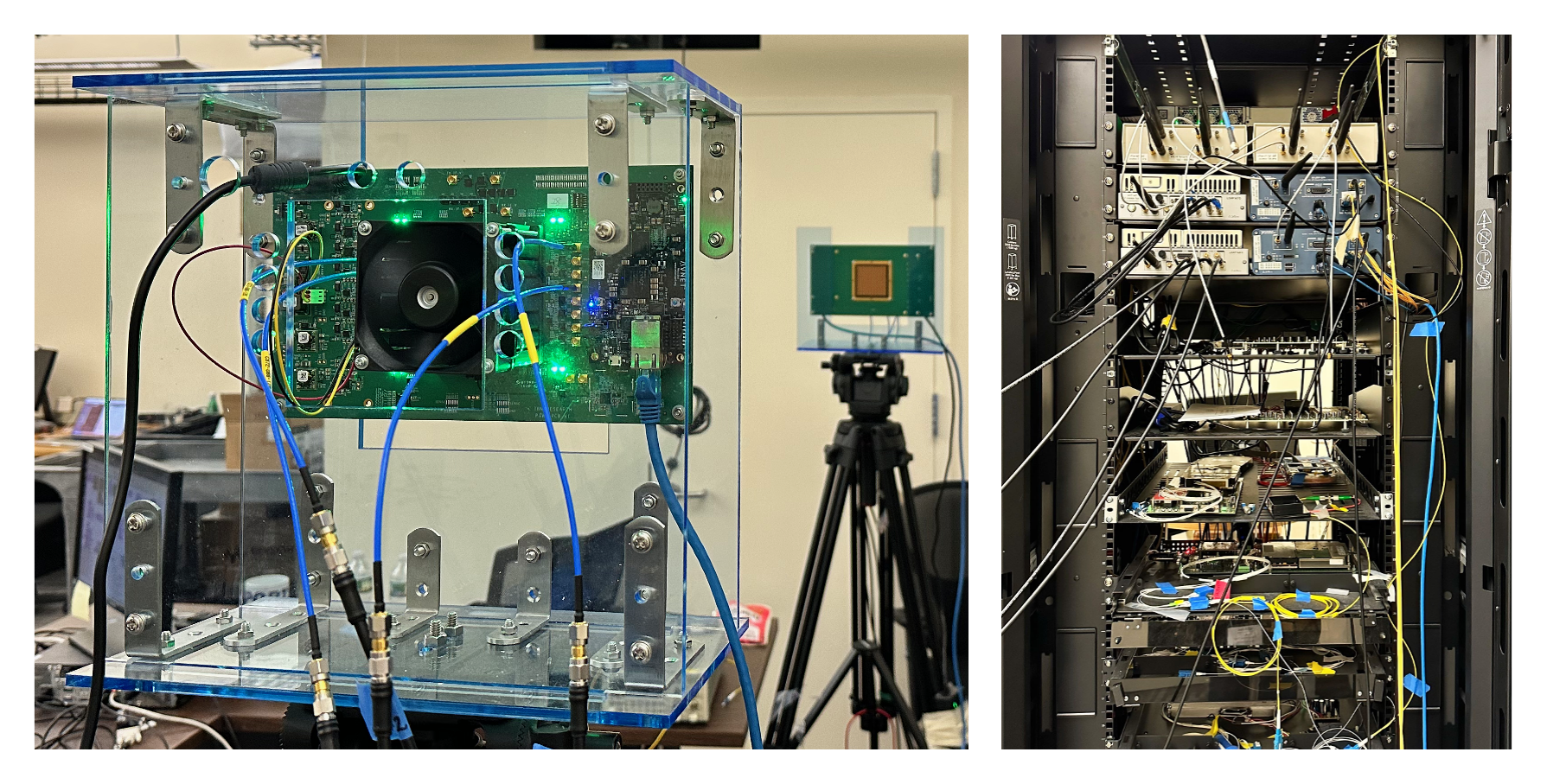
Figure 1: An IBM 28 GHz PAAM as deployed in COSMOS. Left: a PAAM in its
enclosure on an experimenter-controlled movable platform, with its IF and
control cabling attached and a second array in the background. Right: the
sandbox rack holding the USRPs and control hosts that feed it.
The die photograph and the bare-module views that originally illustrated this
section were lost in the wiki migration. They are published as Fig. 1 of
reference [1] and Fig. 2 of reference [2] below.
The PAAMs include complete radio front end functionality (e.g., PAs, LNAs, mixers, and orthogonal phase and amplitude control per element). Each IC includes 32 TRx phase shifting front end elements and features concurrent independent beams in two polarizations in either Tx or Rx operation. Each PAAM includes 4 such ICs and 64 dual-polarized antennas that provide eight 16-element or two 64-element concurrent beams with complex modulation formats (e.g., 256QAM). We adopt two design configurations for integration with a subset of COSMOS’ radio nodes:
(1) Two to eight 3 GHz IF interfaces: This design would enable direct coupling to USRP-2974 which can perform IQ down conversion of the 3 GHz IF;
(2) Two baseband interfaces (one for each polarization): This design would include 3 GHz IQ upconverters and downconverters on the board to enable coupling to FPGA-based PHY layer implementations where the signal bandwidth would not be limited by the USRPs. In particular, the high-performance Zynq UltraScale+ RFSoC platform with 16 channels of RF ADC and RF DAC will be used to implement a complete SDR.
Moreover, the baseband will be developed in phases with the initial phase targeting a minimal configuration for 28 GHz bands, which are likely to be allocated in 100MHz component carriers with a maximum allocation of 4 carriers. Once the PAAMs are integrated in COSMOS, their multi-beam support and agile beam steering capability can enable experimentation with unique mmWave wireless links and networks based on hybrid beamforming and MIMO.
The PAAM is controlled by a Zynq-7000 SoC device using a customized API via the USB interface. The following settings can be programmed by the experimenters: (i) number of ICs and number of elements in each IC to be activated, (ii) beamforming mode (e.g., Tx/Rx beamforming in H/V polarization), and (iii) beam steering directions and beamforming weights (amplitude and phase).
¶ Using the PAAMs on the testbed
| Control interface | the array_mgmt service - elements on or off, transmit or receive, polarization, LO source and beam direction, over HTTP from the sandbox console |
| Moving the mobile arrays | the xy_table service |
| Where the boards are, and every experiment that uses them | mmWave & PAAM |
| Start here | IBM 28 GHz PAAM Basics |
¶ References
[1] B. Sadhu, Y. Tousi, J. Hallin, S. Sahl, S. Reynolds, O. Renstrom, K. Sjogren, O. Haapalahti, N. Mazor, B. Bokinge, G. Weibull, H. Bengtsson, A. Carlinger, E. Westesson, J. Thillberg, L. Rexberg, M. Yeck, X. Gu, M. Ferriss, D. Liu, D. Friedman, and A. Valdes-Garcia, A 28-GHz 32-element TRX phased-array IC with concurrent dual-polarized operation and orthogonal phase and gain control for 5G communications, IEEE Journal of Solid-State Circuits, vol. 52, no. 12, pp. 3373-3391, Dec. 2017.
[2] X. Gu et al., Development, Implementation, and Characterization of a 64-Element Dual-Polarized Phased-Array Antenna Module for 28-GHz High-Speed Data Communications, in IEEE Transactions on Microwave Theory and Techniques, vol. 67, no. 7, pp. 2975-2984, July 2019, doi: 10.1109/TMTT.2019.2912819.
[3] X. Gu, A. Paidimarri, B. Sadhu, C. Baks, S. Lukashov, M. Yeck, Y. Kwark, T. Chen, G. Zussman, I. Seskar, and A. Valdes-Garcia, "Development of a compact 28-GHz software-defined phased array for a city-scale wireless research testbed," in Proc. IEEE International Microwave Symposium (IMS’21), June 2021. Finalist,
IMS’21 Advanced Practice Paper Competition. PDF
[4] T. Chen, P. Maddala, P. Skrimponis, J. Kolodziejski, A. Adhikari, H. Hu,
Z. Gao, A. Paidimarri, A. Valdes-Garcia, M. Lee, S. Rangan, G. Zussman, and
I. Seskar, Open-access millimeter-wave software-defined radios in the PAWR
COSMOS testbed: design, deployment, and experimentation, Computer Networks,
vol. 234, p. 109922, Oct. 2023. PDF — the deployed arrays, the PAAM API,
and measured beam patterns.