¶ IBM 28 GHz PAAM Basics
Transmit and receive a single tone at 28 GHz using IBM Phased Array Antenna Modules (PAAMs) and USRP N310 SDRs in the COSMOS sandbox (SB1 or SB2), and observe the received frequency response in GNU Radio Companion.
¶ Overview
This tutorial demonstrates the basic use of IBM 28 GHz Phased Array Antenna Modules (PAAMs) paired with USRP N310 software-defined radios in the COSMOS sandboxes SB1 and SB2.
One PAAM is configured as a transmitter and one as a receiver. Both are steered to broadside (0°,0°) using the COSMOS RESTful array management service. A GNU Radio Companion flowgraph running on a shared server node (srv1-lg1) drives the N310 SDRs to send a single tone, and the received spectrum is observed in a frequency-sink display.
The tutorial covers both sandbox variants: SB1 (which uses combined IC I/O) and SB2 (which uses split IC I/O), and shows how the array management API differs between them.
If you publish results obtained using the PAAMs deployed in COSMOS, please cite:
- T. Chen, P. Maddala, P. Skrimponis, J. Kolodziejski, X. Gu, A. Paidimarri, S. Rangan, G. Zussman, and I. Seskar, "Programmable and open-access millimeter-wave radios in the PAWR COSMOS testbed," in Proc. ACM MobiCom'21 Workshop on Wireless Network Testbeds, Experimental evaluation & CHaracterization (WiNTECH'21), 2021.
- X. Gu, A. Paidimarri, B. Sadhu, C. Baks, S. Lukashov, M. Yeck, Y. Kwark, T. Chen, G. Zussman, I. Seskar, and A. Valdes-Garcia, "Development of a compact 28-GHz software-defined phased array for a city-scale wireless research testbed," in Proc. IEEE International Microwave Symposium (IMS'21), 2021.
¶ Learning outcomes
After completing this tutorial you will be able to:
- Configure IBM 28 GHz PAAM devices for TX and RX using the COSMOS array management REST API.
- Use
omfcommands to image and power nodes and RF devices in a mmWave setup. - Configure USRP N310 Ethernet interfaces and verify connectivity with
uhd_find_devices. - Run a GNU Radio Companion flowgraph that drives N310 SDRs connected to PAAMs.
- Observe the received spectrum of a tone transmitted through 28 GHz phased array hardware.
¶ At a glance
| Difficulty | Intermediate |
| Estimated time | 90 min |
| Domain / sandbox | sb1.cosmos-lab.org or sb2.cosmos-lab.org |
| Topic group | mmwave-paam |
| Last verified | Not re-tested (migrated 2026-06-20) |
¶ Prerequisites
Background knowledge
- The six-step experiment life cycle.
- Basic RF concepts (carrier frequency, beamforming, phased arrays).
- Familiarity with GNU Radio Companion.
- Understanding of REST/HTTP APIs (for the array management service).
Account & access
- A COSMOS account — register here.
- An approved reservation on SB1 or SB2 — see Make a reservation.
- SSH access to the sandbox console — see SSH access.
¶ Resources required
Devices / nodes
| Resource | Role | Qty | Notes |
|---|---|---|---|
sdr1-in1 (SB1) or sdr1-s1-lg1 (SB2) |
USRP N310 — RX SDR | 1 | Connected to RX PAAM |
sdr1-in2 (SB1) or sdr1-md1 (SB2) |
USRP N310 — TX SDR | 1 | Connected to TX PAAM |
rfdev4-in1 (SB1) or rfdev2-1 (SB2) |
IBM 28 GHz PAAM — RX | 1 | 16 elements (SB1, all ICs); 4 elements IC0/1 (SB2) |
rfdev4-in2 (SB1) or rfdev2-2 (SB2) |
IBM 28 GHz PAAM — TX | 1 | 16 elements (SB1, all ICs); 4 elements IC0/1 (SB2) |
srv1-lg1 |
Experiment server (runs GNU Radio) | 1 | Shared across SB1 and SB2 |
Disk images
| Image | Load onto | Provides |
|---|---|---|
paam28GHz-tutorial-cosmos-tone-crd.ndz |
srv1-lg1 |
Ubuntu 20.04, UHD 4.1, GNU Radio 3.9, example GRC flowgraph |
Software components
| Component | Version | Source |
|---|---|---|
| UHD (USRP Hardware Driver) | 4.1 | preinstalled in paam28GHz-tutorial-cosmos-tone-crd.ndz |
| GNU Radio / GNU Radio Companion | 3.9 | preinstalled in paam28GHz-tutorial-cosmos-tone-crd.ndz |
| COSMOS Array Management Service | TODO: verify | REST API at http://am-rt1.cosmos-lab.org:5054/array_mgmt/ |
Spectrum / RF / special
28 GHz mmWave band, over-the-air within the shielded sandbox. The tutorial uses V-polarization (SB1) or H-polarization (SB2) with broadside beam steering (θ=0°, φ=0°). An IF carrier of 3 GHz (3e9) is used in the GNU Radio flowgraph; the PAAM up-converts to 28 GHz.
¶ Topology
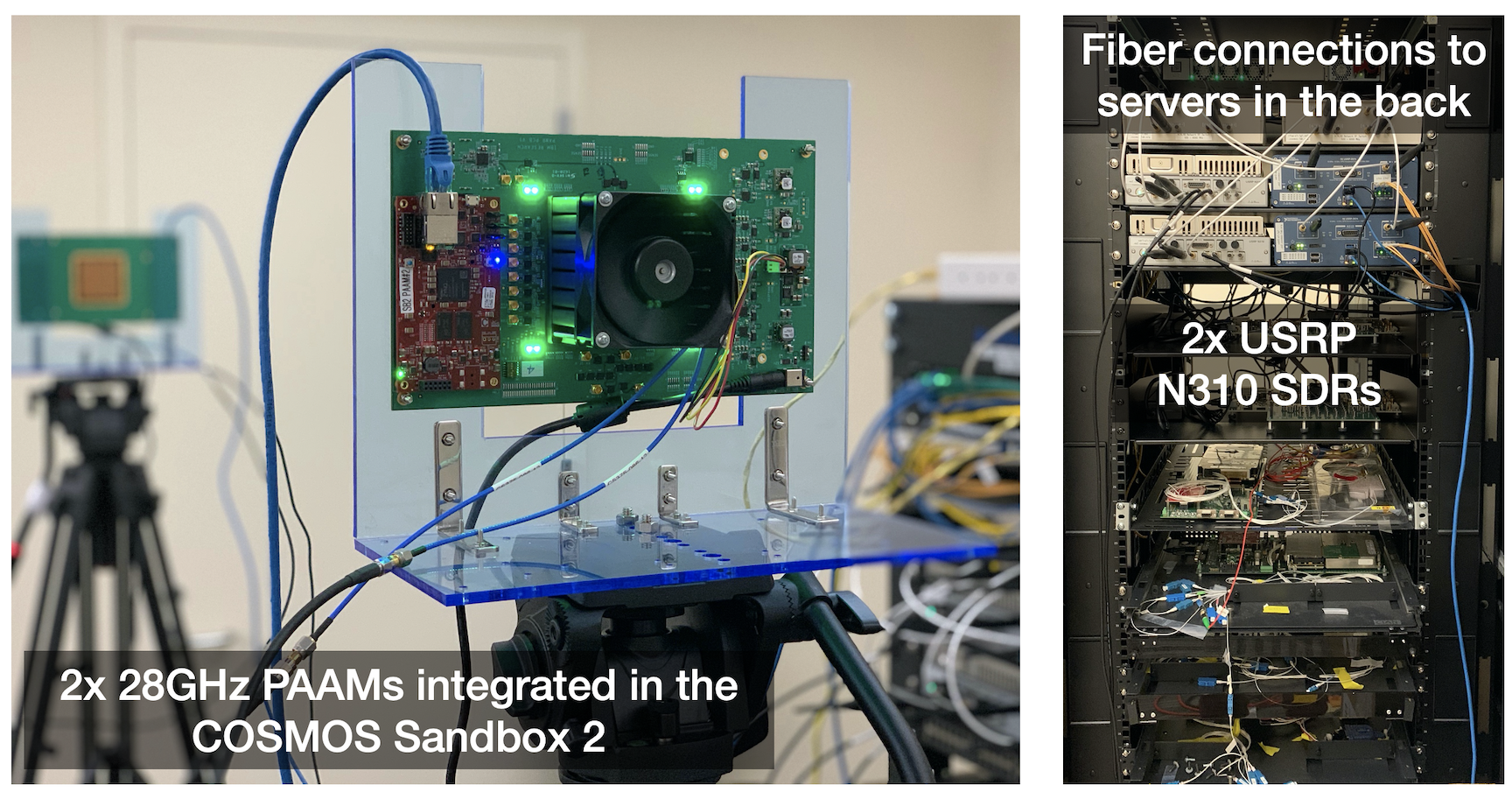
SB1 RF path connections:
sdr1-in1RF2 TX/RX →rfdev4-in1all ICs / TX / H
sdr1-in1RF2 RX2 →rfdev4-in1all ICs / RX / Hsdr1-in1RF3 TX/RX →rfdev4-in1all ICs / TX / V
sdr1-in1RF3 RX2 →rfdev4-in1all ICs / RX / Vsdr1-in2RF2 TX/RX →rfdev4-in2all ICs / TX / H
sdr1-in2RF2 RX2 →rfdev4-in2all ICs / RX / Hsdr1-in2RF3 TX/RX →rfdev4-in2all ICs / TX / V
sdr1-in2RF2 RX2 →rfdev4-in2all ICs / RX / V
SB2 RF path connections:
sdr1-s1-lg1RF2 TX/RX →rfdev2-1IC0 / TX / H
sdr1-s1-lg1RF2 RX2 →rfdev2-1IC1 / RX / Hsdr1-s1-lg1RF3 TX/RX →rfdev2-1IC0 / TX / V
sdr1-s1-lg1RF3 RX2 →rfdev2-1IC1 / RX / Vsdr1-md1RF2 TX/RX →rfdev2-2IC0 / TX / H
sdr1-md1RF2 RX2 →rfdev2-2IC1 / RX / Hsdr1-md1RF3 TX/RX →rfdev2-2IC0 / TX / V
sdr1-md1RF3 RX2 →rfdev2-2IC1 / RX / V
Note: SB1 uses combined IC I/O; SB2 uses split IC I/O.
SB1 full RF path configuration: SB1 RF Path Configurations for mmWave Development Platforms
IP address assignments: SB1 IP addresses · SB2 IP addresses
¶ Setup
-
Reserve SB1 or SB2 and log into the console (open two SSH sessions):
ssh <username>@console.sb1.cosmos-lab.orgor
ssh <username>@console.sb2.cosmos-lab.org -
Turn off all nodes and RF devices used in the experiment. Use the command that matches your sandbox:
SB1:
omf tell -a offh -t sdr1-in1,sdr1-in2,rfdev4-in1,rfdev4-in2,srv1-lg1SB2:
omf tell -a offh -t sdr1-s1-lg1,sdr1-md1,rfdev2-1,rfdev2-2,srv1-lg1 -
Load the PAAM tutorial image onto the server node:
omf load -i paam28GHz-tutorial-cosmos-tone-crd.ndz -t srv1-lg1 -
Turn all required resources on and check their status:
SB1:
omf tell -a on -t sdr1-in1,sdr1-in2,rfdev4-in1,rfdev4-in2,srv1-lg1SB2:
omf tell -a on -t sdr1-s1-lg1,sdr1-md1,rfdev2-1,rfdev2-2,srv1-lg1omf stat -t all -
SSH to the server with X11 forwarding enabled (for GNU Radio Companion GUI):
ssh -Y root@srv1-lg1As an alternative to X11 forwarding, you can use Chrome Remote Desktop to view GNU Radio Companion. Set up Chrome Remote Desktop access as shown here. Chrome Remote Desktop is already installed in the image. SSH as "native" to set up remote access; skip the installation step.
¶ Instructions
¶ Step 1 — Configure 10G data interfaces on the server
Upon logging into srv1-lg1, run the eth_config.sh script to configure the 10G data interfaces (eno1, eno2):
root@srv1-lg1:~# ./eth_config.sh
After running the script, verify the data interfaces have the correct IP addresses. Expected output for each sandbox:
SB1:
root@srv1-lg1:~# ifconfig eno1
eno1: flags=4163<UP,BROADCAST,RUNNING,MULTICAST>  mtu 9000
        inet 10.38.1.1  netmask 255.255.0.0  broadcast 10.38.255.255
        inet6 fe80::1e34:daff:fe42:c3c  prefixlen 64  scopeid 0x20<link>
        ether 1c:34:da:42:0c:3c  txqueuelen 1000  (Ethernet)
        RX packets 712  bytes 74814 (74.8 KB)
        RX errors 0  dropped 595  overruns 0  frame 0
        TX packets 42  bytes 9132 (9.1 KB)
        TX errors 0  dropped 0 overruns 0  carrier 0  collisions 0
root@srv1-lg1:~# ifconfig eno2
eno2: flags=4163<UP,BROADCAST,RUNNING,MULTICAST>  mtu 9000
        inet 10.39.1.1  netmask 255.255.0.0  broadcast 10.39.255.255
        inet6 fe80::1e34:daff:fe42:c3d  prefixlen 64  scopeid 0x20<link>
        ether 1c:34:da:42:0c:3d  txqueuelen 1000  (Ethernet)
        RX packets 643  bytes 51548 (51.5 KB)
        RX errors 0  dropped 599  overruns 0  frame 0
        TX packets 42  bytes 9132 (9.1 KB)
        TX errors 0  dropped 0 overruns 0  carrier 0  collisions 0
SB2:
root@srv1-lg1:~# ifconfig eno1
eno1: flags=4163<UP,BROADCAST,RUNNING,MULTICAST>  mtu 9000
        inet 10.114.2.11  netmask 255.255.255.0  broadcast 10.114.2.255
        inet6 fe80::1e34:daff:fe42:d4c  prefixlen 64  scopeid 0x20<link>
        ether 1c:34:da:42:0d:4c  txqueuelen 1000  (Ethernet)
        RX packets 254  bytes 20924 (20.9 KB)
        RX errors 0  dropped 185  overruns 0  frame 0
        TX packets 25  bytes 4642 (4.6 KB)
        TX errors 0  dropped 0 overruns 0  carrier 0  collisions 0
root@srv1-lg1:~# ifconfig eno2
eno2: flags=4163<UP,BROADCAST,RUNNING,MULTICAST>  mtu 9000
        inet 10.115.2.11  netmask 255.255.255.0  broadcast 10.115.2.255
        inet6 fe80::1e34:daff:fe42:d4d  prefixlen 64  scopeid 0x20<link>
        ether 1c:34:da:42:0d:4d  txqueuelen 1000  (Ethernet)
        RX packets 218  bytes 22274 (22.2 KB)
        RX errors 0  dropped 186  overruns 0  frame 0
        TX packets 25  bytes 4642 (4.6 KB)
        TX errors 0  dropped 0 overruns 0  carrier 0  collisions 0
Verify the IP addresses match the SB1 or SB2 IP address tables.
¶ Step 2 — Verify USRP N310s are reachable
Run uhd_find_devices to confirm both N310s can be reached:
root@srv1-lg1:~# uhd_find_devices --args "product=n310"
Expected output on SB1:
[INFO] [UHD] linux; GNU C++ version 9.3.0; Boost_107100; UHD_4.1.0.4-release
--------------------------------------------------
-- UHD Device 0
--------------------------------------------------
Device Address:
        serial: 3176DEB
        addr: 10.39.6.1
        claimed: False
        fpga: XG
        mgmt_addr: 10.37.6.1
        mgmt_addr: 10.38.6.1
        mgmt_addr: 10.39.6.1
        name: ni-n3xx-3176DEB
        product: n310
        type: n3xx
--------------------------------------------------
-- UHD Device 1
--------------------------------------------------
Device Address:
        serial: 3176DFA
        addr: 10.39.6.2
        claimed: False
        fpga: XG
        mgmt_addr: 10.37.6.2
        mgmt_addr: 10.38.6.2
        mgmt_addr: 10.39.6.2
        name: ni-n3xx-3176DFA
        product: n310
        type: n3xx
Expected output on SB2:
[INFO] [UHD] linux; GNU C++ version 9.3.0; Boost_107100; UHD_4.1.0.4-release
--------------------------------------------------
-- UHD Device 0
--------------------------------------------------
Device Address:
        serial: 315A35A
        addr: 10.114.2.21
        claimed: False
        fpga: XG
        mgmt_addr: 10.113.2.21
        mgmt_addr: 10.114.2.21
        name: ni-n3xx-315A35A
        product: n310
        type: n3xx
--------------------------------------------------
-- UHD Device 1
--------------------------------------------------
Device Address:
        serial: 3176DF7
        addr: 10.115.2.31
        claimed: False
        fpga: XG
        mgmt_addr: 10.113.2.31
        mgmt_addr: 10.114.2.31
        mgmt_addr: 10.115.2.31
        name: ni-n3xx-3176DF7
        product: n310
        type: n3xx
If either device is missing, see Troubleshooting.
¶ Step 3 — Configure the IBM 28 GHz PAAMs
COSMOS provides a RESTful array management service for PAAM control. Two modes are available:
- Dynamic:
connect→steer→disconnect(can re-steer during the experiment). - Static:
configure(single call — connect, steer, and initialize in one step).
This tutorial uses static configuration. Run the commands from the console (not from srv1-lg1).
¶ SB1 — Configure PAAMs
Configure PAAM #1 (rfdev4-in1) in RX mode, V-polarization, 16 elements on all ICs, broadside (θ=0, φ=0):
root@console:~# curl "http://am1.orbit-lab.org:5054/array_mgmt/configure?dev_name=rfdev4-in1.sb1.cosmos-lab.org&ics=all&num_elements=16&txrx=rx&pol=v&theta=0&phi=0"
Expected response:
<?xml version="1.0" encoding="UTF-8"?>
<response status="OK">
  <action service="array_mgmt" name="configure" ipaddr="10.37.7.1">
    <step name="open" duration="3.599997"/>
    <step name="initializaition" duration="0.071123"/>
    <step name="enabling" duration="0.016817"/>
    <step name="steering" duration="0.007705"/>
    <state PAAM_ID="0x36" LO_switch="PLL" if_sw1="0x0" if_sw2="0x0" if_sw3="0x0" if_sw4="0x0"/>
    <adc>
      <conv index="0" name="1v2" tADC="120" tVolt="0.293" tCurr="0.147"/>
      <conv index="1" name="1v5" tADC="334" tVolt="0.816" tCurr="1.632"/>
      <conv index="2" name="1v8" tADC="24" tVolt="0.059" tCurr="0.029"/>
      <conv index="3" name="2v7_0" tADC="163" tVolt="0.398" tCurr="0.797"/>
      <conv index="4" name="2v7_1" tADC="206" tVolt="0.503" tCurr="1.007"/>
      <conv index="5" name="2v7_2" tADC="220" tVolt="0.538" tCurr="1.075"/>
      <conv index="6" name="2v7_3" tADC="180" tVolt="0.440" tCurr="0.880"/>
      <conv index="7" name="3v3_pll" tADC="408" tVolt="0.997" tCurr="0.499"/>
      <conv index="8" name="5v_uzed" tADC="206" tVolt="0.503" tCurr="0.503"/>
      <conv index="9" name="12v" tADC="244" tVolt="0.596" tCurr="1.988"/>
      <conv index="10" name="0V" tADC="0" tVolt="0.000"/>
      <conv index="11" name="1V8" tADC="737" tVolt="1.801"/>
    </adc>
    <step name="status" duration="0.020882"/>
    <step name="close" duration="0.100221"/>
  </action>
</response>
Check the 2v7_0, 2v7_1, 2v7_2, 2v7_3 ADC readings — non-zero values confirm all ICs are initialized.
Configure PAAM #2 (rfdev4-in2) in TX mode, V-polarization, 16 elements on all ICs, broadside (θ=0, φ=0):
root@console:~# curl "http://am1.orbit-lab.org:5054/array_mgmt/configure?dev_name=rfdev4-in2.sb1.cosmos-lab.org&ics=all&num_elements=16&txrx=tx&pol=v&theta=0&phi=0"
Expected response:
<?xml version="1.0" encoding="UTF-8"?>
<response status="OK">
  <action service="array_mgmt" name="configure" ipaddr="10.37.7.2">
    <step name="open" duration="3.558891"/>
    <step name="initializaition" duration="0.072244"/>
    <step name="enabling" duration="0.018709"/>
    <step name="steering" duration="0.008254"/>
    <state PAAM_ID="0x30" LO_switch="PLL" if_sw1="0x0" if_sw2="0x0" if_sw3="0x0" if_sw4="0x0"/>
    <adc>
      <conv index="0" name="1v2" tADC="125" tVolt="0.305" tCurr="0.153"/>
      <conv index="1" name="1v5" tADC="331" tVolt="0.809" tCurr="1.618"/>
      <conv index="2" name="1v8" tADC="22" tVolt="0.054" tCurr="0.027"/>
      <conv index="3" name="2v7_0" tADC="255" tVolt="0.623" tCurr="1.246"/>
      <conv index="4" name="2v7_1" tADC="250" tVolt="0.611" tCurr="1.222"/>
      <conv index="5" name="2v7_2" tADC="266" tVolt="0.650" tCurr="1.300"/>
      <conv index="6" name="2v7_3" tADC="264" tVolt="0.645" tCurr="1.290"/>
      <conv index="7" name="3v3_pll" tADC="410" tVolt="1.002" tCurr="0.501"/>
      <conv index="8" name="5v_uzed" tADC="215" tVolt="0.525" tCurr="0.525"/>
      <conv index="9" name="12v" tADC="300" tVolt="0.733" tCurr="2.444"/>
      <conv index="10" name="0V" tADC="0" tVolt="0.000"/>
      <conv index="11" name="1V8" tADC="734" tVolt="1.794"/>
    </adc>
    <step name="status" duration="0.021005"/>
    <step name="close" duration="0.100240"/>
  </action>
</response>
¶ SB2 — Configure PAAMs
Configure PAAM #1 (rfdev2-1) in TX mode, H-polarization, 4 elements on IC0, broadside:
root@console:~# curl "http://am1.orbit-lab.org:5054/array_mgmt/configure?dev_name=rfdev2-1.sb2.cosmos-lab.org&ics=0&num_elements=4&txrx=tx&pol=h&theta=0&phi=0"
Configure PAAM #2 (rfdev2-2) in RX mode, H-polarization, 4 elements on IC1, broadside:
root@console:~# curl "http://am1.orbit-lab.org:5054/array_mgmt/configure?dev_name=rfdev2-2.sb2.cosmos-lab.org&ics=1&num_elements=4&txrx=rx&pol=h&theta=0&phi=0"
¶ Step 4 — Run the GNU Radio Companion experiment
On srv1-lg1, start GNU Radio Companion and open the example flowgraph:
SB1:
root@srv1-lg1:~# gnuradio-companion example_paam_tone_sb1.grc
SB2:
root@srv1-lg1:~# gnuradio-companion example_paam_tone_sb2.grc
Configure the flowgraph blocks as follows:
- SB1: Set the USRP sink (TX) device address to
sdr1-in2:mgmt_addr=10.37.6.2,addr=10.39.6.2. Set the USRP source (RX) tosdr1-in1:mgmt_addr=10.37.6.1,addr=10.39.6.1. - SB2: Set the USRP sink (TX) to
sdr1-s1-lg1:mgmt_addr=10.113.2.21,addr=10.114.2.21. Set the USRP source (RX) tosdr1-md1:mgmt_addr=10.113.2.31,addr=10.114.2.31.
On both TX and RX blocks:
- Carrier frequency: 3 GHz (
3e9) - Subdev (SB1):
B:1(RF3) - Subdev (SB2):
B:0(RF2) - Sampling rate: 2.5 MHz (
2.5e6) - Tone frequency: 1 MHz (
1e6)
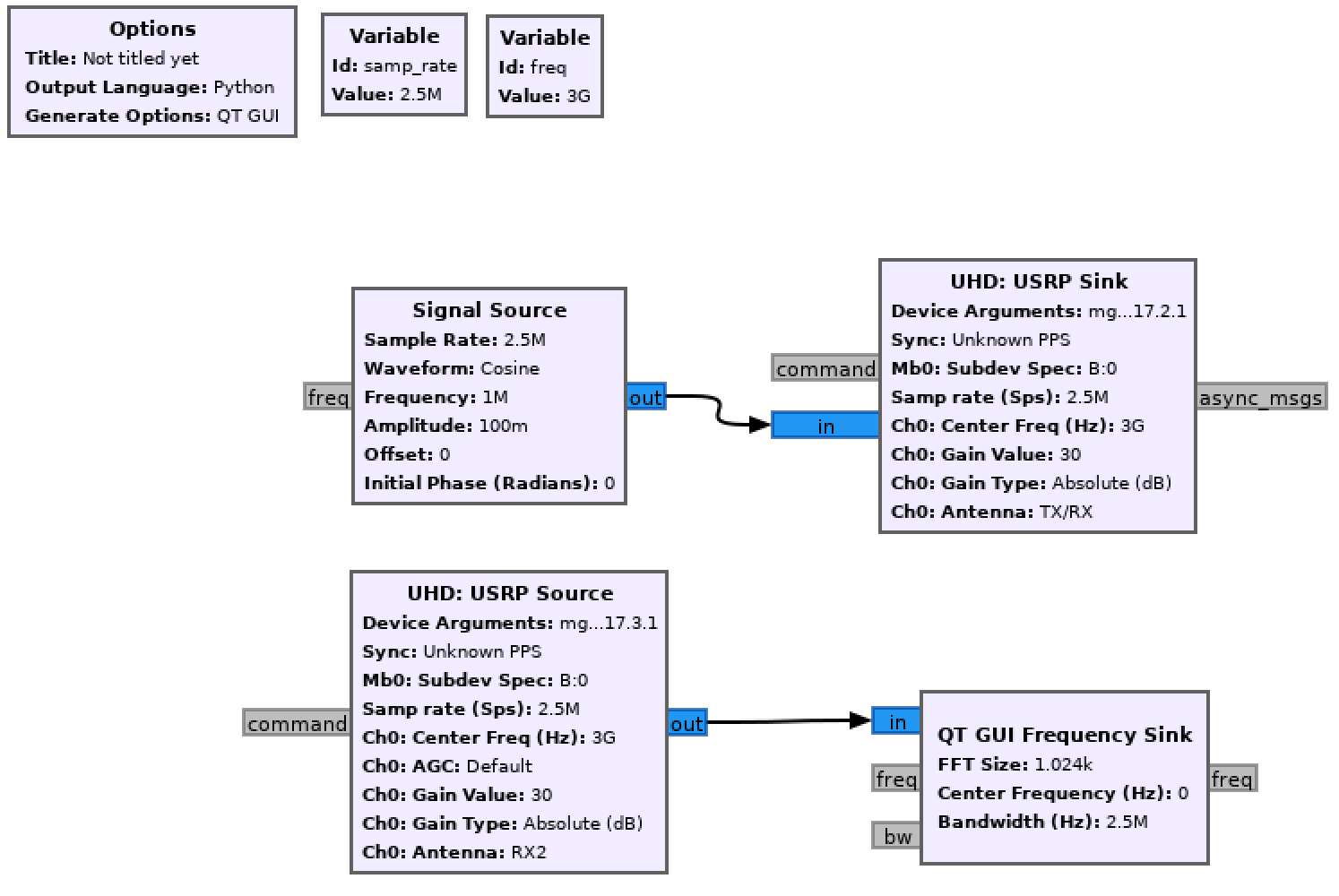
Run the flowgraph by clicking the play button in GNU Radio Companion.
¶ Verification
uhd_find_devices --args "product=n310"lists two N310 devices with the expected serial numbers and IP addresses for the sandbox.- The
configureAPI calls return<response status="OK">with non-zero2v7_*ADC readings, confirming all PAAM ICs are initialized. - The GNU Radio Companion frequency sink display shows a peak at 1 MHz offset from the carrier (28 GHz as up-converted from the 3 GHz IF).
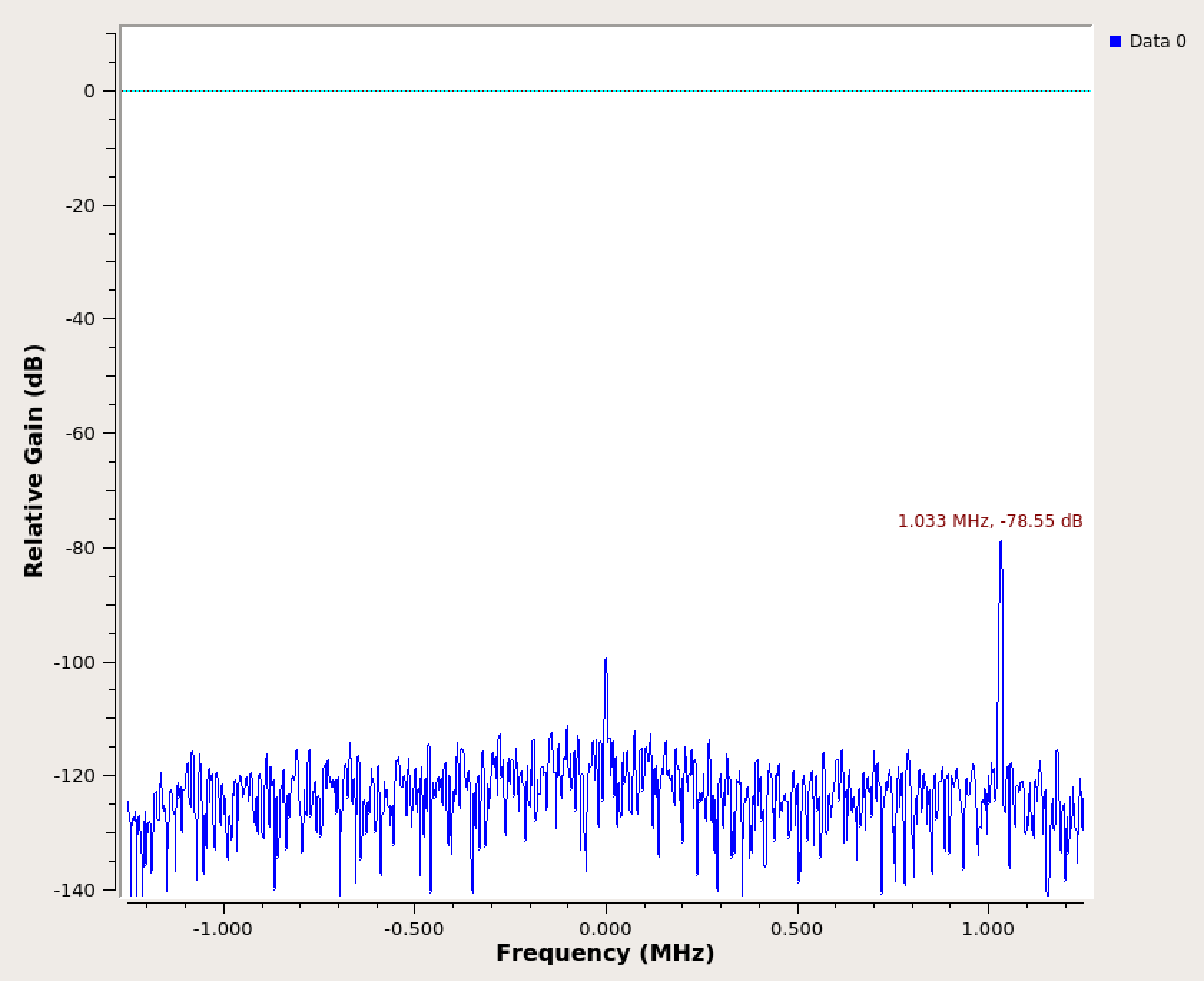
The figure above shows the expected frequency response of the received tone at 1 MHz offset.
¶ Cleanup
Stop the GNU Radio flowgraph, then from the console, clean up and turn off both PAAMs before powering down all nodes.
SB1:
root@console:~# curl "http://am1.orbit-lab.org:5054/array_mgmt/connect?dev_name=rfdev4-in1.sb1.cosmos-lab.org"
root@console:~# curl "http://am1.orbit-lab.org:5054/array_mgmt/cleanup?dev_name=rfdev4-in1.sb1.cosmos-lab.org"
root@console:~# curl "http://am1.orbit-lab.org:5054/array_mgmt/disconnect?dev_name=rfdev4-in1.sb1.cosmos-lab.org"
root@console:~# omf tell -a offh -t rfdev4-in1.sb1.cosmos-lab.org
root@console:~# curl "http://am1.orbit-lab.org:5054/array_mgmt/connect?dev_name=rfdev4-in2.sb1.cosmos-lab.org"
root@console:~# curl "http://am1.orbit-lab.org:5054/array_mgmt/cleanup?dev_name=rfdev4-in2.sb1.cosmos-lab.org"
root@console:~# curl "http://am1.orbit-lab.org:5054/array_mgmt/disconnect?dev_name=rfdev4-in2.sb1.cosmos-lab.org"
root@console:~# omf tell -a offh -t rfdev4-in2.sb1.cosmos-lab.org
SB2:
root@console:~# curl "http://am1.orbit-lab.org:5054/array_mgmt/connect?dev_name=rfdev2-1.sb2.cosmos-lab.org"
root@console:~# curl "http://am1.orbit-lab.org:5054/array_mgmt/cleanup?dev_name=rfdev2-1.sb2.cosmos-lab.org"
root@console:~# curl "http://am1.orbit-lab.org:5054/array_mgmt/disconnect?dev_name=rfdev2-1.sb2.cosmos-lab.org"
root@console:~# omf tell -a offh -t rfdev2-1.sb2.cosmos-lab.org
root@console:~# curl "http://am1.orbit-lab.org:5054/array_mgmt/connect?dev_name=rfdev2-1.sb2.cosmos-lab.org"
root@console:~# curl "http://am1.orbit-lab.org:5054/array_mgmt/cleanup?dev_name=rfdev2-2.sb2.cosmos-lab.org"
root@console:~# curl "http://am1.orbit-lab.org:5054/array_mgmt/disconnect?dev_name=rfdev2-1.sb2.cosmos-lab.org"
root@console:~# omf tell -a offh -t rfdev2-2.sb2.cosmos-lab.org
Then power off all remaining nodes:
omf tell -a offh -t system:topo:allres
(No omf save needed unless you customized the image on srv1-lg1.)
¶ Troubleshooting
| Symptom | Likely cause | Fix |
|---|---|---|
uhd_find_devices returns fewer than 2 devices |
eth_config.sh not run, or 10G interface down |
Re-run ./eth_config.sh; verify with ifconfig eno1 eno2 that IPs are assigned; ping the N310 mgmt address |
configure API returns non-OK status or zero 2v7_* ADC readings |
PAAM not powered on, or wrong dev_name |
Confirm rfdev4-in1/rfdev4-in2 (SB1) or rfdev2-1/rfdev2-2 (SB2) are powered (omf stat); check dev_name matches the sandbox |
| GNU Radio flowgraph throws UHD error | Wrong device address in USRP block | Double-check mgmt_addr and addr parameters match the sandbox IP table |
| No tone visible in frequency sink | Wrong subdev setting | SB1 needs B:1 (RF3); SB2 needs B:0 (RF2); confirm both TX and RX blocks have the same carrier frequency |
| X11 forwarding fails / GRC window does not appear | SSH not started with -Y |
Reconnect with ssh -Y root@srv1-lg1; alternatively use Chrome Remote Desktop |
¶ References
- IBM 28 GHz PAAM hardware page
- COSMOS Array Management Service
- SB1 domain architecture and IP assignments
- SB2 domain architecture and IP assignments
- COSMOS getting started guide
- SSH / console access
- Chrome Remote Desktop setup
- T. Chen et al., "Programmable and open-access millimeter-wave radios in the PAWR COSMOS testbed," WiNTECH'21.
- X. Gu et al., "Development of a compact 28-GHz software-defined phased array for a city-scale wireless research testbed," IMS'21.
- B. Sadhu et al., "A 28-GHz 32-element TRX phased-array IC with concurrent dual-polarized operation and orthogonal phase and gain control for 5G communications," IEEE JSSC, vol. 52, no. 12, pp. 3373–3391, 2017.
Author(s): COSMOS team (original: Tingjun Chen, Duke University) · Last verified: Not re-tested (migrated 2026-06-20) · Tested image/release: paam28GHz-tutorial-cosmos-tone-crd.ndz · Tags: mmwave, paam, ibm, usrp, n310, gnuradio, 28ghz, beamforming